

Pulsar Photonics breaks ground for new HQ
With a seven-figure investment, the laser technology company unites the different business areas at one new place.
The new location at the Aachen Verlautenheide highway exit not only offers the urgently needed reserves for future growth and allows the consolidation of the business divisions at a joint location, strengthening their interaction.


The focus on modern working methods and technologies increase flexibility and efficiency. This includes not only the design of the workspaces, but also the technological and digital infrastructure such as the expansion of fiber optic networks, the networking between the teams, or the implementation of modern in-house IT.
At the same time, measures are planned to pave the way for a sustainable and energy-efficient orientation of the company. This includes the availability of space for the use of renewable energy sources such as solar or the provision of larger parking spaces for bicycles and electric cars. The planned building is a so-called KfW building and therefore meets certain energy standards. These include the use of CO2-reduced building components, a green roof, heating by heat pump and photovoltaic systems to secure the power supply. Prospects that are due in particular to the infrastructure partner. However, the current operation is also ensured by the real availability of larger electrical connection cross-sections for machine operation.
A seven-figure investment is being made to construct the new building, which will later be used primarily for assembly and production. With a work and manufacturing area of around 1,600 square meters, the first construction phase of the new building should be completed and ready to move into by the end of 2024.
“Our aim is to become even more visible as a laser company in the region,” says Dr Joachim Ryll, one of the three managing directors. “To this end, the new headquarters will be designed to be representative.”
Pulsar Photonics has its current headquarters in Aachen-Herzogenrath and operates two further manufacturing halls in Aachen-Verlautenheide. The company was founded in 2013 as a spin-off of the Fraunhofer ILT in Aachen and was financed in its growth phase by the Hightech Gründerfonds HTGF, Bonn. With more than ninety employees today, it belongs to the Schunk group since 2021.
Further reading: Laserpore: a new machine technology for additive manufacturing of porous glass – An innovative solution developed by Ernst Abbe University, Leipzig University, ITG Wismar, and Pulsar Photonics, PhotonicsViews 19(4), August/September 2022, pp. 44-45 • J. Ryll, J. Holtkamp, S. Eifel: Accelerator for Ultrafast Laser Serial Production – Interaction of important components opens up new possibilities, PhotonicsViews 16(4), August/September 2019, pp. 65-69, DOI: 10.1002/phvs.201900036
Company
Pulsar Photonics GmbHKaiserstraße 100
52134 Herzogenrath
Germany



most read

IMTS 2026: America's Manufacturing Sector Focuses on Growth and Technology
The largest manufacturing trade show in the Western Hemisphere is bringing together 1,788 exhibitors this year, including about 400 companies participating for the first time.

Solid-State Transformers for AI Data Centers
As part of a strategic partnership, Siemens and Reinhausen are developing a solid-state transformer for AI data centers with an 800-volt DC system.

ZVEI Calls for Swift Protection of Critical Power Infrastructure
The association has issued a statement in response to the recent attempted attacks on substations in Brandenburg and North Rhine-Westphalia and warns of the consequences for Germany's energy security.
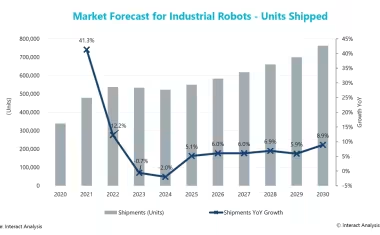
Forecast: Significant Growth in Industrial Robotics by 2030; Cobots Are Growing the Fastest
According to a recent analysis by Interact Analysis, global sales of industrial robots are expected to rise from about 550,000 units in 2025 to just over 760,000 units in 2030.

European machine vision expects slight recovery and growth in 2026
According to the VDMA Machine Vision department, sales are expected to increase by around 3%, following a decline of 2% in 2025.