Global robot density: Western Europe leads ahead of North America and Asia
In the EU-27, the robot density is 231, which is above the global average of 132
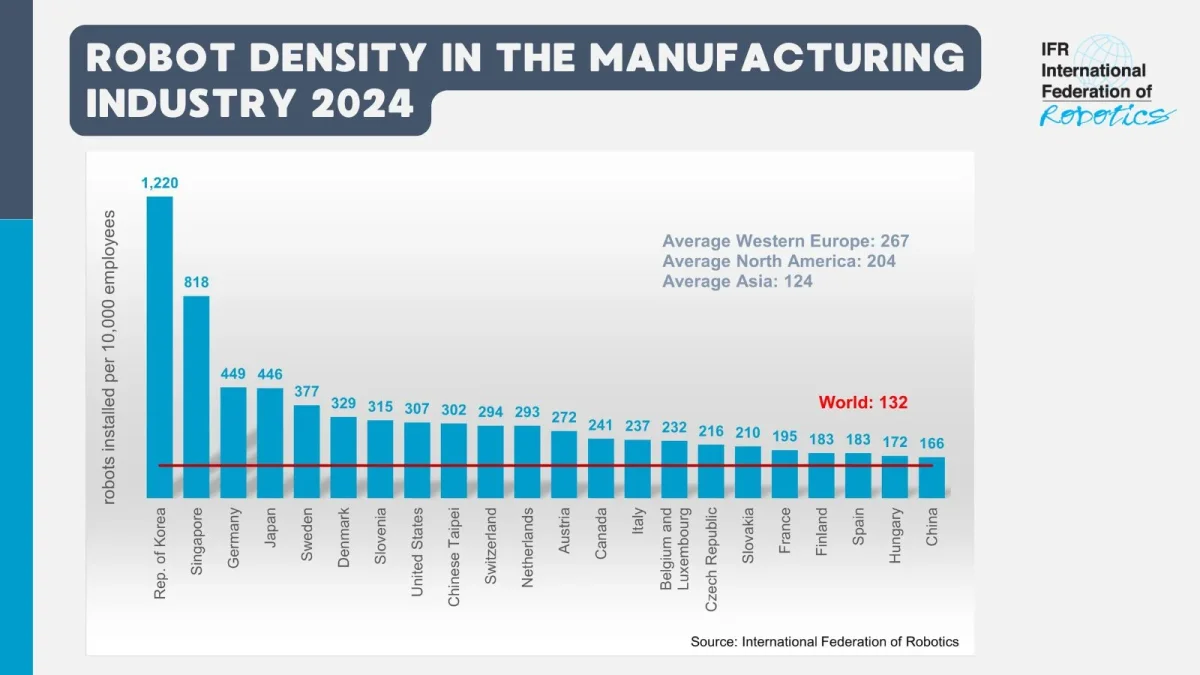
The International Federation of Robotics (IFR) reports a further increase in robot density in the manufacturing industry for 2024. With 267 industrial robots per 10,000 employees, Western Europe will reach an all-time high, ahead of North America (204) and Asia (131). The key figure puts the number of operating robots in relation to the number of employees and thus enables a comparison of economies of different sizes.
In the EU-27, the robot density is 231, which is above the global average of 132. Eight Western European countries are in the global top 20, including Germany, Switzerland and Italy. In North America, the USA leads with 307 robots per 10,000 employees, ahead of Canada (241) and Mexico (62). Asia recorded an increase of 11%, with South Korea (1,220), Singapore (818), Germany (449) and Japan (446) in the lead. China achieved 166 units and remains the largest single market worldwide with around 2 million installed robots.