

Detecting food fraud – thanks to light quanta
A new analysis method uses quantum mechanical effects to test food for ingredients and origin more cost-effectively.
Fraud in the labeling of food ingredients cannot only cause economic damage but can also lead to health risks. Laboratories therefore use authenticity tests to determine whether the declared geographical origin of foods is correct, whether certain ingredients such as palm oil have actually been omitted, or whether no others have been added. To date, nuclear magnetic resonance (NMR) spectroscopies are being used for these analyses. NMR spectroscopy makes it possible to clearly identify almost any organic substance in a given sample. However, the analyses are very expensive, as the systems are large, complex, and cost several million euros.
In the BMBF-funded project QSPEC, Amo, the Laser Zentrum Hannover (LZH), the LUH, Toptica Photonics, Amotronics, and the DIL now want to develop an alternative testing method: the quantum-based spectroscopy method.
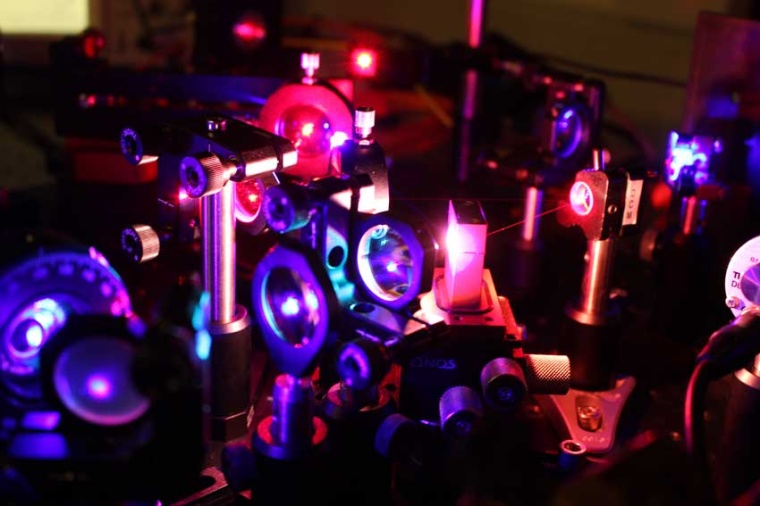
“We are researching a method that uses entangled photons to measure the substance to be analyzed at one wavelength and detect the information obtained from it at another wavelength,” explains Dr. Stephan Suckow, Head of the Nanophotonics Group at Amo and collaborative coordinator of the QSPEC project. “In the first step, an entangled photon pair consisting of a long-wavelength and a short-wavelength photon is generated,” Suckow further explains. The long-wavelength photon now interacts with the sample, changing its phase, for example. This manipulated photon pair is then fed into another process in which yet another photon pair is generated. The information contained in the pair is transformed by quantum interference, so it eventually becomes readable simply by the count rate of the short-wavelength photons. The short-wavelength photons act as carriers of information and can be measured particularly well with current technology. The bandwidth of the photon pairs makes it possible to resolve the sample spectrally.
“The resulting spectra of the individual food samples are like fingerprints in this regard,” explains Suckow “We can then compare these fingerprints with other reference samples and thus draw conclusions about ingredients and geographical characteristics.”
The goal: Tools for the quality assurance of food
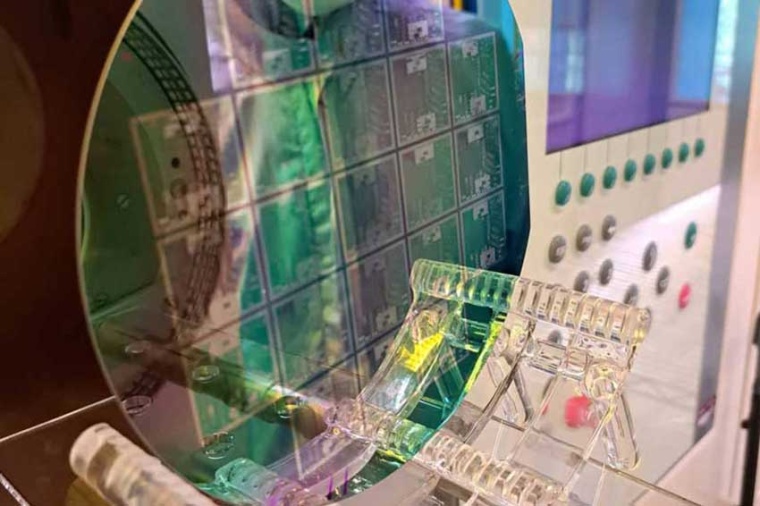
Necessary for the generation of the quantum frequency combs are novel laser beam sources, which LZH and Toptica are developing for the project. Amo will use nanolithographic methods to create chips that accommodate the necessary technology in the smallest possible space. Amotronics will contribute the ultrafast electronics required for detection. The Institute for Photonics at LUH will subsequently combine the individual components into a system so that the DIL can test the new method and build a reference library.
From the composition of the ingredients, the origin of foods such as olive oil, fruit juice, honey, and many others can be determined beyond doubt. Even the detection of contaminants in the lowest concentrations is possible. This would be the basis for a new generation of analytical tools that allow comprehensive quality assurance in food production.
About QSPEC
The project QSPEC aims to provide the basis for a new generation of analytical instruments with a sensitivity almost comparable to NMR, but at a much lower cost. QSPEC is funded by the German Federal Ministry of Education and Research (BMBF) as part of the funding measure “Lighthouse projects in quantum-based measurement technology to address societal challenges”. (Source: LZH)
Company
Laser Zentrum Hannover e.V.Hollerithallee 8
30419 Hannover
Germany



most read
Schaeffler bundles Defense and New Space activities under new CEO
Celia Pelaz takes over the position of CEO Defence & New Space at Schaeffler on October 1, 2026 and becomes Chairwoman of the Management Board of Stech Defence GmbH.

European machine vision expects slight recovery and growth in 2026
According to the VDMA Machine Vision department, sales are expected to increase by around 3%, following a decline of 2% in 2025.

Siemens Consolidates Its Automation Business into a New Unit Called Automation
Rainer Brehm, who previously served as COO of the automation business and CTO of Digital Industries, was appointed president of the new unit.

ZVEI Calls for Swift Protection of Critical Power Infrastructure
The association has issued a statement in response to the recent attempted attacks on substations in Brandenburg and North Rhine-Westphalia and warns of the consequences for Germany's energy security.

ABB Machine Automation (B&R) Appoints Christian Strahberger as New Division President
He succeeds Florian Schneeberger, who died in a tragic accident in April.