

Compact on-chip photon pair sources for quantum technologies
Fraunhofer IAF starts project QuoAlA on AlGaAs Bragg reflection waveguides
Fraunhofer IAF has started a project on compact on-chip sources for entangled photons, which are an important component for the realization of industrial quantum technology applications. In the project “QuoAlA”, scientists are researching waveguides based on aluminum gallium arsenide (AlGaAs) as sources for generating entangled photons. AlGaAs enables a particularly compact design and chip integration. The project started in February and is funded by the BMBF within the funding program “Quantum technologies – from basic research to market” as “WiVoPro” (Scientific Preliminary Project).
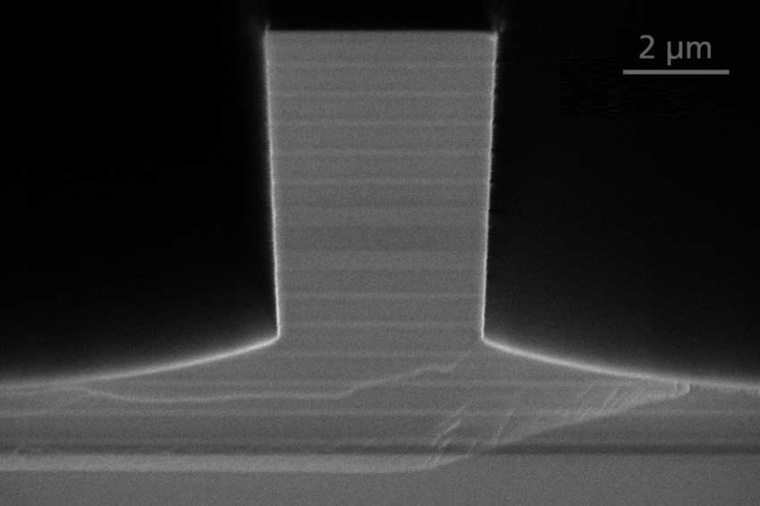
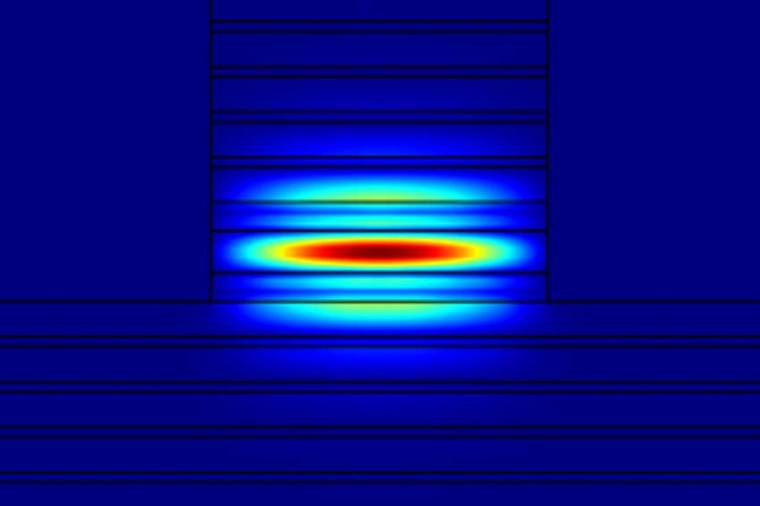
Quantum technological applications are based on various quantum phenomena and physical laws to which elementary particles are subjected. These include the effect of entangled photons, on which promising concepts for high-precision sensor technology and secure quantum communication are based. In order to bring these technologies into application, compact and efficient sources of entangled photon pairs are needed that can be integrated into photonic circuits.
The main components of quantum photonic systems, such as mirrors, beam splitter and phase shifters, can all be realized in integrated form by now. However, this does not yet apply to the light sources and detectors that are required as well. “Our goal is now to integrate all the functions needed for quantum communication, i.e. the generation, manipulation and detection of single and entangled photons, into just one chip,” explains Thorsten Passow, project manager at the Fraunhofer Institute for Applied Solid State Physics IAF. The researchers are taking a first step with regard to light sources with the project “Quantum entangled photon pair source at telecom wavelength based on AlGaAs Bragg reflection waveguides (QuoAlA)”.
AlGaAs Bragg reflection waveguides as photon pair sources
The focus of “QuoAlA” is on fundamental research of AlGaAs-based photon sources and their epitaxial fabrication. The aim is to generate photon pairs with a high quality of entanglement at an exactly defined wavelength. The target wavelength is 1,550 nm, which is within the telecom range (1,500 – 1,600 nm).
The semiconductor material AlGaAs is a promising material for photon pair sources for several reasons. For example, it has nonlinear properties. In a material with nonlinear properties, a photon can spontaneously split into two photons at high light intensity due to an optical effect. Such light particle pairs can be quantum mechanically entangled.
Potential for particularly compact design
Furthermore, AlGaAs Bragg reflection waveguides allow the integration of other optical and electronic components on chip level. “A unique feature of the technology used in the project “QuoAlA” is the potential to integrate a pump laser diode. This makes a particularly compact design possible,” emphasizes Dr Passow. By reducing the size, weight and power of the components, an essential requirement for the realization of practical applications would be met.
For use as a source in telecommunications, it must be possible to adjust the wavelength of the photons very precisely because the wavelength spacing of the channels is less than a nanometer. The wavelength of the generated photons depends very sensitively on the epitaxial produced layer structure of the waveguides. Therefore, the project focuses on the accuracy of the epitaxy of AlGaAs-based Bragg reflection waveguides with regard to the wavelength of the generated entangled photons. (Source: Fh. IAF)


most read

Solid-State Transformers for AI Data Centers
As part of a strategic partnership, Siemens and Reinhausen are developing a solid-state transformer for AI data centers with an 800-volt DC system.

Siemens Consolidates Its Automation Business into a New Unit Called Automation
Rainer Brehm, who previously served as COO of the automation business and CTO of Digital Industries, was appointed president of the new unit.

ZVEI Calls for Swift Protection of Critical Power Infrastructure
The association has issued a statement in response to the recent attempted attacks on substations in Brandenburg and North Rhine-Westphalia and warns of the consequences for Germany's energy security.
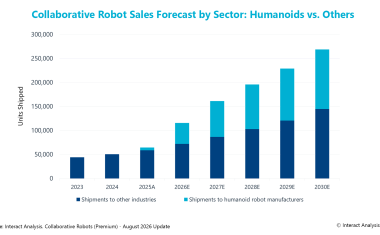
Humanoid robotics is driving demand for cobot arms and actuators
According to recent analyses, global production of humanoid robots exceeded the 20,000-unit mark in 2025 and is expected to more than triple in 2026.

Schaeffler bundles Defense and New Space activities under new CEO
Celia Pelaz takes over the position of CEO Defence & New Space at Schaeffler on October 1, 2026 and becomes Chairwoman of the Management Board of Stech Defence GmbH.