

Bosch Rexroth and MantiSpectra win Hermes Awards
Companies from Germany and The Netherlands were presented with the prestigious industrial prizes at the opening ceremony of Hannover Messe.
This year the jury, chaired by Prof Reimund Neugebauer, president of the Fraunhofer Society, awarded the prize for a product geared to the dynamic robotics market. As one of the three nominees, the Smart Flex Effector project consists of a sensor-based compensation module (end effector) for robots, featuring independent, precise kinematics in six degrees of freedom. It can be used in handling or joining processes with tight tolerances in automation technology or robotics, with loads of up to 6 kg. The position of workpieces or handling objects can be sensed by robots which are outfitted with the Smart Flex Effector. The range of applications is diverse, since it is also suitable for human-robot collaboration as an add-on device for a variety of robots.
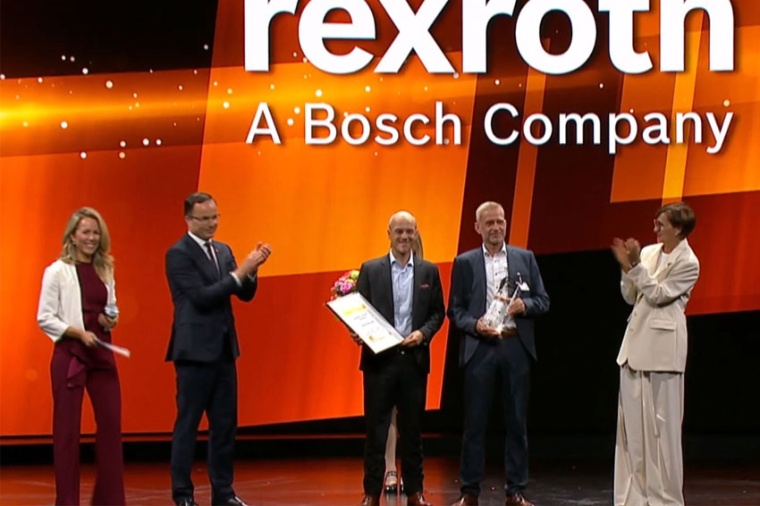
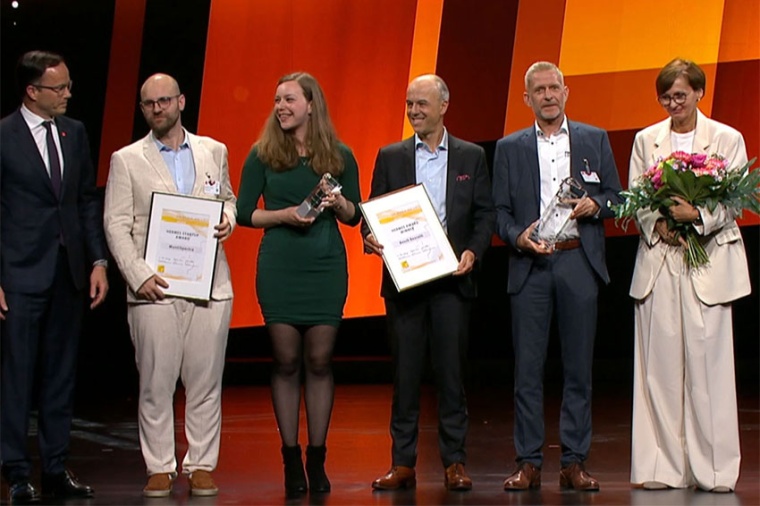
“Close human-robot interaction occupies a central position in solving pressing economic, societal and demographic challenges: from optimizing industrial assembly to increasing productivity in agriculture to supporting medical and nursing staff in the form of assistance robots,” declared Prof Neugebauer, chairperson of the Hermes Award jury, adding: “The Smart Flex Effector is driving efficiency and diversity in the uses of robots, creating quantifiable value for industry, the environment and society. With the award for this project, the Hermes Award goes to Bosch Rexroth for the third time. Congratulations on this excellent achievement.”
The young company MantiSpectra from Eindhoven was awarded the coveted Hermes Startup Award for its ChipSense product, a fully integrated near-infrared sensor – the smallest of its kind on the market, with a footprint of 1 mm2. The sensor enables rapid, highly accurate analysis and is used directly on the production line, from where it delivers real-time data. This makes it possible for defects to be detected as soon as they occur and for savings to be made through immediate quality control on the spot, on the production line. The product is already in use in industry, agriculture and food processing.
“The small and cost-effective sensor in the near-infrared spectrum is easy to integrate and opens up a whole range of new application perspectives. For example, in agriculture or food processing,” Prof Neugebauer said.
More than three hundred startups are showcasing their innovations at Hannover Messe this year. This represents a significant increase over 2022. With the annual Hermes Startup Award, Deutsche Messe recognizes a company that is younger than five years old and whose product or solution exhibits a particularly high level of technological innovation.
Further reading: A new tiny near-infrared sensor, wileyindustrynews.com, 9 February 2022
Company
Deutsche Messe AGMessegelände
30521 Hannover
Germany
most read

IMTS 2026: America's Manufacturing Sector Focuses on Growth and Technology
The largest manufacturing trade show in the Western Hemisphere is bringing together 1,788 exhibitors this year, including about 400 companies participating for the first time.
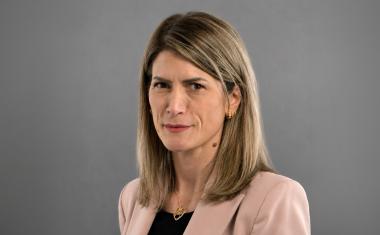
Schaeffler bundles Defense and New Space activities under new CEO
Celia Pelaz takes over the position of CEO Defence & New Space at Schaeffler on October 1, 2026 and becomes Chairwoman of the Management Board of Stech Defence GmbH.
Vision 2026 Breaks Exhibitor Record
About 500 exhibiting companies—about two-thirds of which are from abroad and about 30 percent of which are first-time exhibitors—are showcasing their products at the trade show.

ZVEI Calls for Swift Protection of Critical Power Infrastructure
The association has issued a statement in response to the recent attempted attacks on substations in Brandenburg and North Rhine-Westphalia and warns of the consequences for Germany's energy security.

Siemens Consolidates Its Automation Business into a New Unit Called Automation
Rainer Brehm, who previously served as COO of the automation business and CTO of Digital Industries, was appointed president of the new unit.