

Best business prospects for additive technologies
Investment plans in AM remain high – technology development of greatest importance in the industry.
“The additive manufacturing industry is looking ahead with a good dose of optimism. This is evidenced by our current economic survey.” This is how Dr Markus Heering, managing director of the additive manufacturing working group (AG AM) in the VDMA, summarizes the results of the current survey. Companies covering the entire process chain took part in the survey in March. Service providers and users of additive manufacturing were particularly well represented.
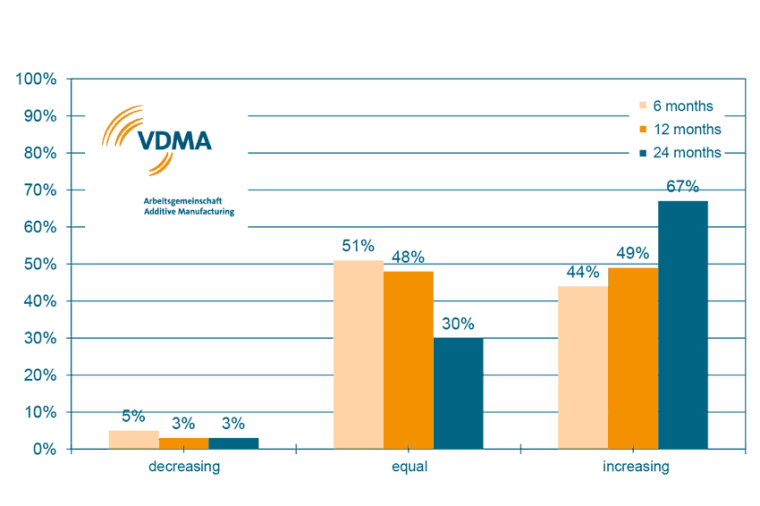
Heering is extremely pleased that more than eighty percent of the respondents assess their business prospects for the next 24 months positively and that none of the participants expects the business situation to deteriorate. “The participants have never indicated such a high level of expectation. We can be more than satisfied with such a result,” says Heering. Even the short-term forecast for the next twelve months is positive for 65 percent of the companies. None of the participants expects a deterioration in business expectations for the current year either. It has a positive effect on the industry, only eight percent of the participants are strongly affected by the Ukraine conflict.
The respondents underline their optimism through entrepreneurial action. “Every fourth company says it will increase its investments and another 54 percent plan to invest at the same level,” explains Heering. Only five percent of firms plan to invest less in technology over the course of the year. Proof that companies are behind the young industry.
During the crisis, additive manufacturing (AM) was perceived as a flexible and quickly adaptable technology. Supply bottlenecks could be circumvented with the help of additively manufactured components. “Many companies realized that AM was made for emergency situations and extraordinary requirements. This should also contribute to the positive mood in the industry,” he sums up.
Almost seventy percent of the participants expect exports to increase in the next 24 months. Another thirty percent expect at least the same level of business abroad. Conversely, this means that only three percent of the companies expect a decline in exports. Heering sees this export orientation as evidence of the demand for additive manufacturing and the increased maturity of the industry. Europe and the USA continue to be named as the most important export markets. However, the expectations that exports to the US will increase have fallen from 57 to 38 percent.
Heering sees one reason for the member companies’ confidence in the growing technological maturity. The application of prototypes, tools and spare parts are slightly declining. Accordingly, 25 percent of the respondents say they already want to use additive processes in series production in the next 12 months. “As series use increases, the requirements are shifting,” he reports. The focus of the members is no longer only on costs and reproducibility as in the previous survey. The companies seem to have found solutions for this. For seventy percent of the respondents, the focus is on further technology development. Heering interprets this as a clear indication of the importance of this forward-looking industry.
Company
VDMA Verband Deutscher Maschinen- und Anlagenbauer e.V.Lyoner Str. 18
60528 Frankfurt
Germany

most read
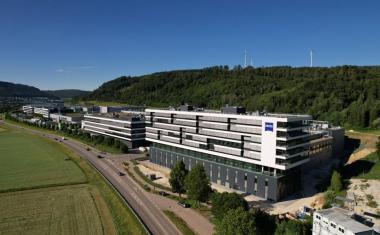
Zeiss SMT Expands Capacity
At the Oberkochen site, approximately 25,000 square meters of additional space is being built for production and production-related areas.
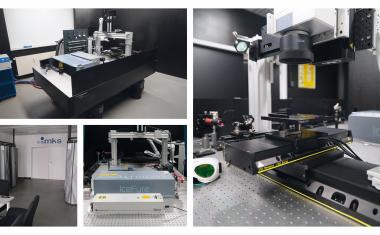
Mks Opens European Laser Applications Lab for Pulsed Lasers
Lasers of various power classes are available in separate laboratory rooms, supplemented by Ophir measurement equipment as well as optical benches, optomechanical components, and motion systems from Newport.
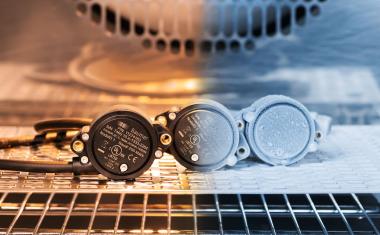
Baumer Opens New Innovation Lab for Sensor Testing
Baumer, a sensor specialist, has opened a new innovation lab in Frauenfeld. Across 1,300 square meters, new products undergo leak, shock, vibration, and temperature tests before going into mass production.
Siemens Consolidates Its Automation Business into a New Unit Called Automation
Rainer Brehm, who previously served as COO of the automation business and CTO of Digital Industries, was appointed president of the new unit.
AMS Osram Strengthens Its Core Semiconductor Business and Develops microLED Arrays for AR Glasses
The company reported revenue of 805 million euros and an adjusted EBITDA margin of 16.9% for the second quarter of 2026, reaching the upper end of its forecast range.