

Symmetric graphene quantum dots for future qubits
Double quantum dots with a nearly perfect electron-hole-symmetry for a robust read-out mechanism.
Quantum dots in semiconductors such as silicon or gallium arsenide have long been considered hot candidates for hosting quantum bits in future quantum processors. Scientists at Forschungszentrum Jülich and RWTH Aachen University have now shown that bilayer graphene has even more to offer here than other materials. The double quantum dots they have created are characterized by a nearly perfect electron-hole-symmetry that allows a robust read-out mechanism – one of the necessary criteria for quantum computing.

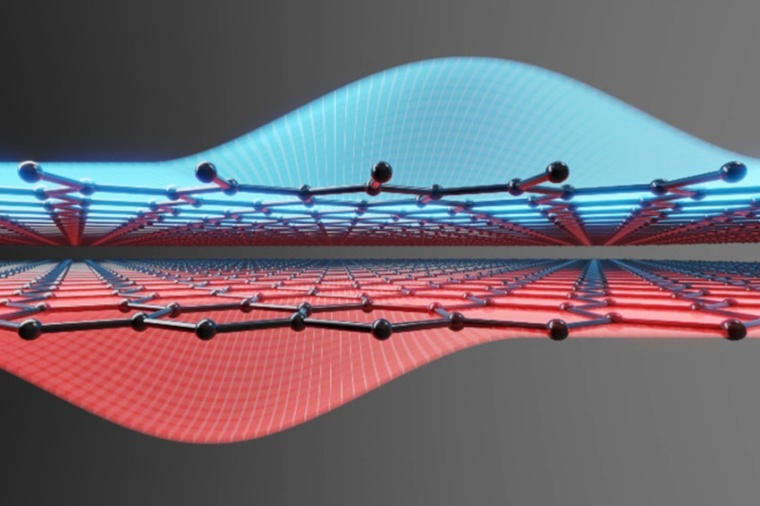
The development of robust semiconductor spin qubits could help the realization of large-scale quantum computers in the future. However, current quantum dot based qubit systems are still in their infancy. In 2022, researchers at QuTech in the Netherlands were able to create 6 silicon-based spin qubits for the first time. With graphene, there is still a long way to go. The material, which was first isolated in 2004, is highly attractive to many scientists. But the realization of the first quantum bit has yet to come. “Bilayer graphene is a unique semiconductor,” explains Christoph Stampfer of Forschungszentrum Jülich and RWTH Aachen University. “It shares several properties with single-layer graphene and also has some other special features. This makes it very interesting for quantum technologies.”
One of these features is that it has a bandgap that can be tuned by an external electric field from zero to about 120 millielectronvolt. The band gap can be used to confine charge carriers in individual areas, the quantum dots. Depending on the applied voltage, these can trap a single electron or its counterpart, a hole – basically a missing electron in the solid-state structure. The possibility of using the same gate structure to trap both electrons and holes is a feature that has no counter part in conventional semiconductors. “Bilayer graphene is still a fairly new material. So far, mainly experiments that have already been realized with other semiconductors have been carried out with it. Our current experiment now goes really beyond this for the first time,” Christoph Stampfer says. He and his colleagues have created a double quantum dot: two opposing quantum dots, each housing an electron and a hole whose spin properties mirror each other almost perfectly.
“This symmetry has two remarkable consequences: it is almost perfectly preserved even when electrons and holes are spatially separated in different quantum dots,” Stampfer said. This mechanism can be used to couple qubits to other qubits over a longer distance. And what’s more, “the symmetry results in a very robust blockade mechanism which could be used to read out the spin state of the dot with high fidelity.”
“This goes beyond what can be done in conventional semiconductors or any other two-dimensional electron systems,” says Fabian Hassler of the JARA Institute for Quantum Information at Forschungszentrum Jülich and RWTH Aachen University. “The near-perfect symmetry and strong selection rules are very attractive not only for operating qubits, but also for realizing single-particle terahertz detectors. In addition, it lends itself to coupling quantum dots of bilayer graphene with superconductors, two systems in which electron-hole symmetry plays an important role. These hybrid systems could be used to create efficient sources of entangled particle pairs or artificial topological systems, bringing us one step closer to realizing topological quantum computers.” (Source: FZJ / RWTH)
Link: 2D Materials and Quantum Devices, RWTH Aachen, Aachen, Germany




most read
Humanoid robotics is driving demand for cobot arms and actuators
According to recent analyses, global production of humanoid robots exceeded the 20,000-unit mark in 2025 and is expected to more than triple in 2026.

Schaeffler bundles Defense and New Space activities under new CEO
Celia Pelaz takes over the position of CEO Defence & New Space at Schaeffler on October 1, 2026 and becomes Chairwoman of the Management Board of Stech Defence GmbH.
Vision 2026 Breaks Exhibitor Record
About 500 exhibiting companies—about two-thirds of which are from abroad and about 30 percent of which are first-time exhibitors—are showcasing their products at the trade show.

IMTS 2026: America's Manufacturing Sector Focuses on Growth and Technology
The largest manufacturing trade show in the Western Hemisphere is bringing together 1,788 exhibitors this year, including about 400 companies participating for the first time.

Solid-State Transformers for AI Data Centers
As part of a strategic partnership, Siemens and Reinhausen are developing a solid-state transformer for AI data centers with an 800-volt DC system.