

Renewed: Collaborative Research Center of Paderborn University and TU Dortmund
The German Research Foundation (Deutsche Forschungsgemeinschaft, DFG) announced a further renewal of the Collaborative Research Center (CRC) / Transregio 142, “Tailor-made nonlinear photonics: From fundamental concepts to functional structures” at Paderborn University.
This collaborative project with TU Dortmund focuses on the basic principles of photonics and quantum optics in order to make advances in the field of nonlinear photonic systems, e.g. in information and communication technology, through the targeted manipulation of light. The CRC was initially approved by the DFG in 2013 for a period of four years, and was provided with around ten million euros in funding. The second renewal, for an additional four years, was announced in 2018. Now the Transregio project is moving into its third phase. The project combines Paderborn University’s expertise in the areas of photonic materials and quantum optics with TU Dortmund’s expertise in nonlinear spectroscopy.

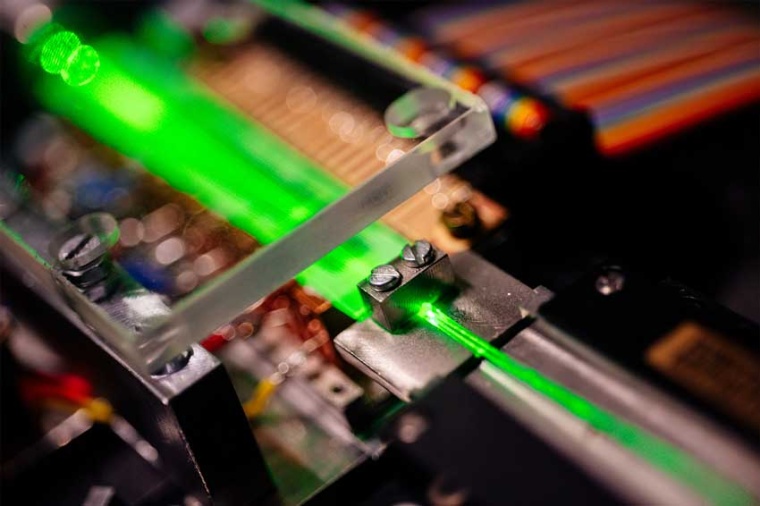
“This latest renewal will allow us to continue driving fundamental research forward in the areas of optoelectronics and photonics, thereby developing concepts and applications that can promote faster, more efficient and above all secure communication,” says Prof Christine Silberhorn from the Paderborn department of physics, who is the spokesperson for the CRC. Prof Manfred Bayer, the local spokesperson for the CRC and the Rector of TU Dortmund, adds, “For eight years now, we have been steadily expanding the partnership between Paderborn and Dortmund on the basis of our complementary expertise. We are very pleased that the reviewers have once again recognized this, along with our plans for the next four years.”
Thanks to their special properties, photons – small light particles that make up electromagnetic rays – are considered very promising for a revolution in data transmission. For instance, special methods for creating and shaping photons can potentially deliver new concepts for coding information.
The researchers are developing tailor-made photonic systems with innovative functionalities. The goal is to support their research activities – from fundamental light and material physics research up through the application stage. They pursue an interdisciplinary approach in order to realize innovative photonic systems. Critical technologies that form the basis for the development are established one step at a time as they move from fundamental research to application. Along with the founding of the Institute for Photonic Quantum Systems PhoQS in Paderborn, this will allow them to continue building a unique interdisciplinary center for nonlinear photonics and quantum technologies.
University president Prof Birgitt Riegraf also offers her congratulations to all of the participating researchers: “The fact that the DFG approved the third phase of the Collaborative Research Center confirms the enormous achievements of the researchers involved, who show great dedication and outstanding expertise in creating future-proof and ground-breaking key technologies.”
Company
Technische Universität DorrtmundBaroper Str. 285
44227 Dortmund
Germany

most read

Conrad B2B Catalog Reissued
Conrad Electronic is expanding its B2B operations with a new, 960-page catalog that serves as a print introduction to the Conrad Sourcing Platform.

Solid-State Transformers for AI Data Centers
As part of a strategic partnership, Siemens and Reinhausen are developing a solid-state transformer for AI data centers with an 800-volt DC system.
Mitutoyo Open House Day 2026: Focus on Precision Measurement Technology
This free event is aimed at professionals in manufacturing and quality assurance who would like to learn about the latest developments in precision measurement technology.

Siemens Consolidates Its Automation Business into a New Unit Called Automation
Rainer Brehm, who previously served as COO of the automation business and CTO of Digital Industries, was appointed president of the new unit.

Discontinuation and End of Support
Neurocheck will end the product life cycle of its Neurocheck 6.1 image processing software on December 31, 2026.