

Perovskite-on-silicon-tandem solar cells pass 30 % mark
For the first time, this efficiency for perovskite-on-silicon-tandem solar cells has been exceeded thanks to a joint effort led by scientists at EPFL’s Photovoltaics and Thin Film Electronics Laboratory in partnership with the innovation center CSEM.
Increasing the power conversion efficiency of solar cells is important for two reasons. In the long run, it is the most effective way to reduce the levelized cost of electricity. In the short term, it is the best way to promote photovoltaics for applications where space is limited e.g., roofs, facades, vehicles, or even drones. However, all solar cells are fundamentally limited by the materials they are made from, which in turn affects the efficiencies they can achieve. The most adopted solar cell technologies to date are made with silicon. But despite silicon’s success, it has a theoretical efficiency limit of around 29 %. Current efficiencies for this technology stand slightly below 27 %, leaving a very small margin for future efficiency gains.
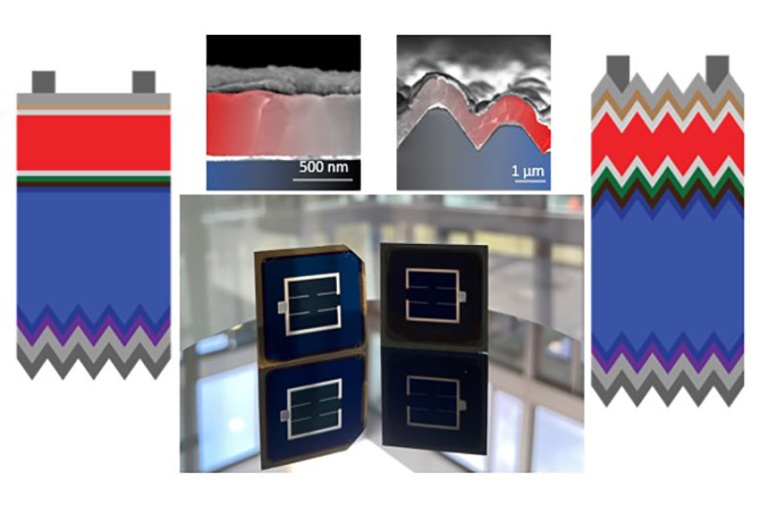
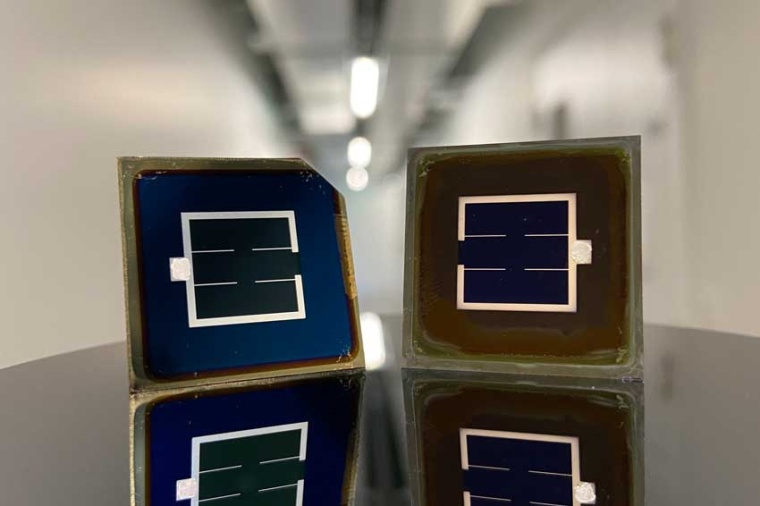
In the innovative race to exceed this limitation, scientists have added one (or more) complementary solar cell(s) to silicon to form “tandem” solar cells. The higher-energy visible light of the sun is absorbed in the top cell, while the lower-energy infrared light is absorbed in the silicon cell placed at the rear of the tandem. Halide perovskites have been identified as an ideal partner for silicon, as they can convert visible light more efficiently to electrical power in comparison to silicon alone, without overly increasing fabrication costs.
“We have passed a psychological barrier,” says Christophe Ballif, head of the EPFL Photovoltaics Laboratory and CSEM’s Sustainable Energy Center. “We have validated experimentally the high-efficiency potential of perovskite-on-silicon tandems. The 30 % efficiency mark had already been achieved with other types of materials, namely III-V semiconductors. However, these materials and the processes used to make them are too expensive to sustain the energy transition – these devices are a thousand times more expensive than silicon solar cells. Our results are the first to show that the 30 % barrier can be overcome using low-cost materials and processes, which should open new perspectives for the future of PV,” Ballif enthuses.
The researchers from Neuchâtel have succeeded in improving the efficiency of two kinds of perovskiteon-silicon tandems. Firstly, they adapted materials and fabrication techniques to deposit high-quality perovskite layers from solution on a planarized silicon surface, reaching a power conversion efficiency of 30.93 % for a 1 cm2 solar cell. Secondly, by working on a new version of a hybrid vapor/solution processing technique compatible with textured silicon surfaces, they have produced a solar cell with a power conversion efficiency of 31.25 % (again on 1 cm2). These results constitute two new world records: one for the planar and one for the textured device architecture. The latter approach provides a higher current and is compatible with the structure of current industrial silicon solar cells. The previous efficiency conversion record for perovskite-on-silicon tandem solar cells was set in 2021 by a team at the Helmholtz Zentrum Berlin, who achieved 29.8 %. EPFL’s and CSEM’s new records were independently certified by the National Renewable Energy Laboratory (NREL) in the United States.
“These high-efficiency results will now require further R&D to allow their scaling up onto larger surface areas and to ensure that these new cells can maintain a stable power output on our rooftops and elsewhere over a standard lifetime,” notes Quentin Jeangros of CSEM. “Tandem perovskite-on-silicon technologies have been said to have the potential to exceed the 30 % efficiency benchmark, but this is the first time this long-predicted potential has been demonstrated, which should hopefully pave the way for even cheaper sustainable electricity in the future,” concludes Christian Wolff of EPFL.


most read
Humanoid robotics is driving demand for cobot arms and actuators
According to recent analyses, global production of humanoid robots exceeded the 20,000-unit mark in 2025 and is expected to more than triple in 2026.

Solid-State Transformers for AI Data Centers
As part of a strategic partnership, Siemens and Reinhausen are developing a solid-state transformer for AI data centers with an 800-volt DC system.
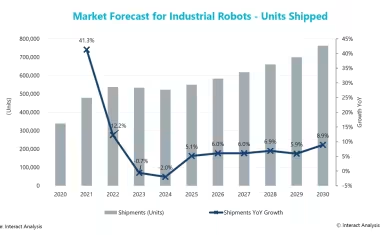
Forecast: Significant Growth in Industrial Robotics by 2030; Cobots Are Growing the Fastest
According to a recent analysis by Interact Analysis, global sales of industrial robots are expected to rise from about 550,000 units in 2025 to just over 760,000 units in 2030.

IMTS 2026: America's Manufacturing Sector Focuses on Growth and Technology
The largest manufacturing trade show in the Western Hemisphere is bringing together 1,788 exhibitors this year, including about 400 companies participating for the first time.

ZVEI Calls for Swift Protection of Critical Power Infrastructure
The association has issued a statement in response to the recent attempted attacks on substations in Brandenburg and North Rhine-Westphalia and warns of the consequences for Germany's energy security.