Microscope developers win the Deutscher Zukunftspreis 2022
The development of a microscope for the gentle 3D imaging of living cells was honored with the Federal President's Award for Technology and Innovation
The President of Germany, Frank-Walter Steinmeier, awarded the Deutscher Zukunftspreis 2022, the Federal President's Award for Technology and Innovation, to the team from Zeiss during a festive ceremony. The jury recognized the experts Dr Thomas Kalkbrenner, Dr Jörg Siebenmorgen, and Ralf Wolleschensky for their significant contribution in the development of the microscope system Lattice Lightsheet 7.
With this award, the German President honors scientists for exceptional achievements in technology, engineering and the life sciences as well as software and algorithm-based achievements that have resulted in viable products. It has a cash value of 250,000 euros. In addition to scientific excellence, the winning projects present a clear and recognizable benefit for society, the environment, and the economy.
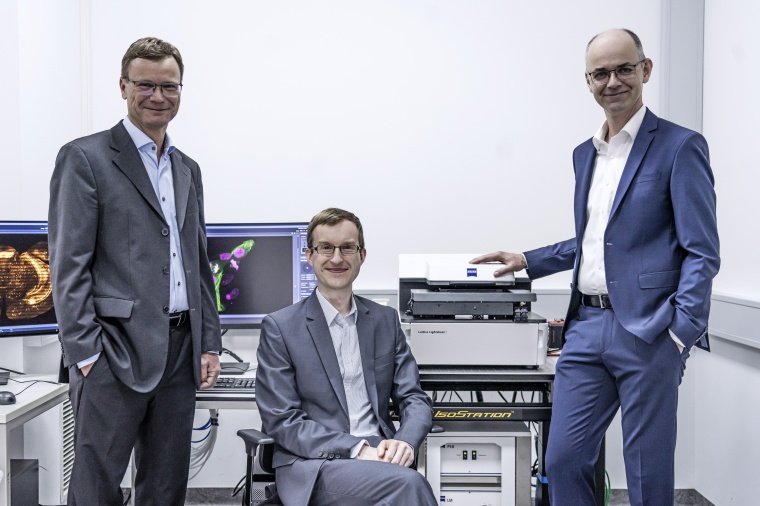
Lattice Lightsheet 7 enables, for the first time, biomedical researchers to observe living cells live and in 3D for hours or even days. They study how, for example, the cells react to certain active agents, or what happens when viruses or bacteria enter cells. The problem for researchers studying living cells with fluorescence microscopes used to be the illumination: the intensities of the laser radiation used are higher than those of the sun by a factor of 1,000 or more. This intense illumination can permanently damage living cells. A significant reduction in this photo damage is achieved with light sheet microscopy: unlike all other microscopes, the laser beam – in the form of a light sheet – is applied only in the area of the sample that is in the focus of the objective lens.
To do this, the team had to tame the laser in a special way and completely rearrange the objective lenses because the cells grow on the cover slips in culture vessels like Petri dishes or multiwell plates. They developed a completely new type of microscope optic that enables a person to look through the sample vessels ‒ at an angle and from below ‒ at the cells inside without artifacts. All this has been developed into an easy-to-use, compact system with high potential for automation.