Ubiquitous Lasers: 30 Years of Progress—and the Next Era of Photonics
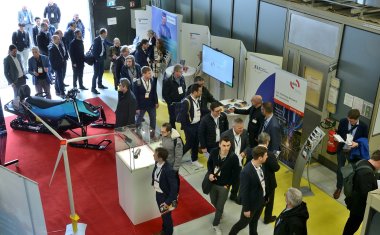
For three decades, the AKL – International Laser Technology Congress has been one of the leading international meeting points for the laser community. From April 22–24, 2026 over 500 experts, 57 exhibiting companies and research institutions gathered in Aachen, Germany, to discuss the latest developments in laser technology and photonics.
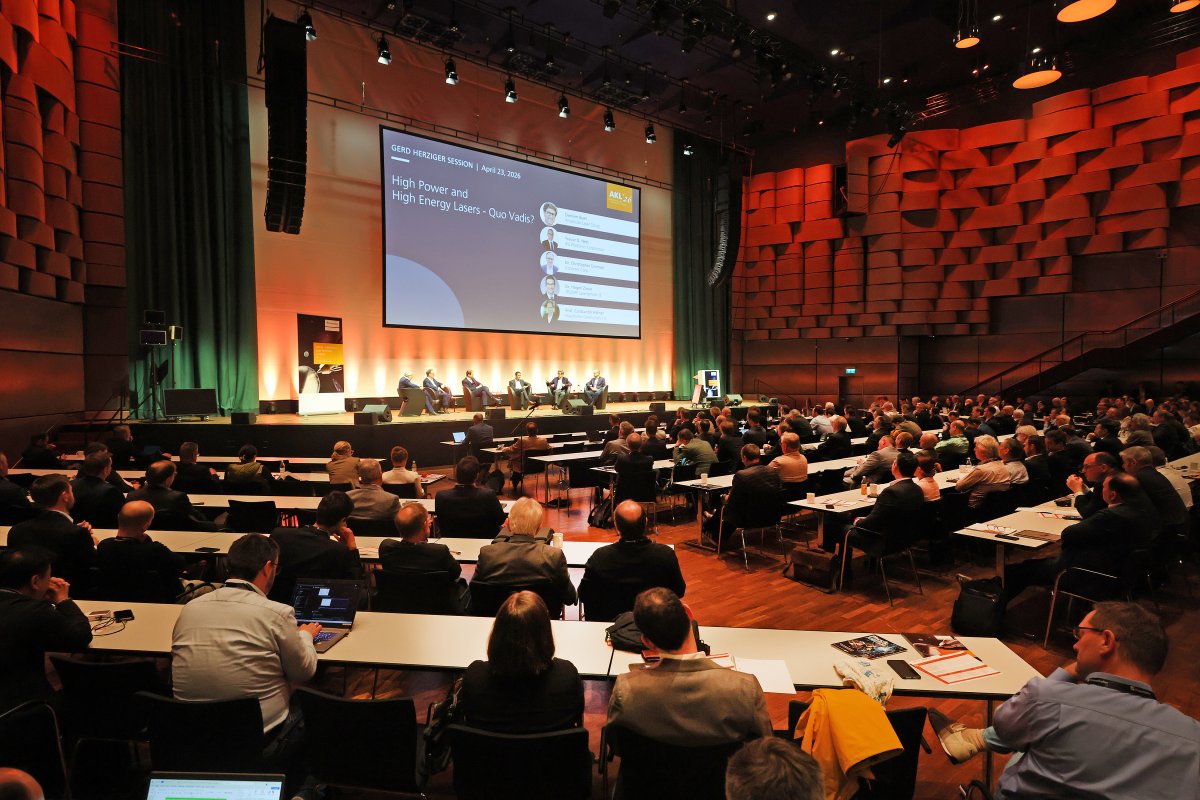
Marking the congress' 30th anniversary, this year's Gerd Herziger Session – the heart of the AKL – brought together 544 representatives from industry and research to reflect on the evolution of laser technology over the past three decades while exploring the opportunities and challenges that lie ahead. The panel discussion "High Power and High Energy Lasers – Quo Vadis?" featured Dr. Hagen Zimer (Trumpf), Dr. Christopher Dorman OBE (Coherent Group), Prof. Constantin Haefner (Fraunhofer-Gesellschaft), Trevor D. Ness (IPG Photonics), and Damien Buet (Amplitude Laser Group), with Dr. Jochen Stollenwerk (Fraunhofer ILT) as moderator. Their common conclusion was clear: lasers are becoming increasingly ubiquitous—not because they attract attention, but because they are quietly becoming indispensable across industry and society.
Today, laser technology underpins countless industrial processes, from semiconductor manufacturing, electronics production and automotive engineering to medical diagnostics, telecommunications and advanced materials processing. At the same time, entirely new application fields are emerging, driven by artificial intelligence, quantum technologies, fusion energy, robotics and defense.
Photonics Remains an Industry with Momentum
Artificial intelligence was repeatedly highlighted as a major growth driver. Dr. Hagen Zimer explained how the rapid expansion of AI infrastructure and data centers is creating strong demand for advanced manufacturing technologies, with laser-based processes playing an essential role throughout semiconductor production as well as in the construction of the infrastructure itself. At the same time, AI is increasingly becoming part of laser systems, enabling more intelligent process control, higher productivity and faster development of new applications.
Despite current economic uncertainties, the speakers expressed confidence in the long-term outlook for photonics. Over the past decades, continuous advances in laser power, reliability, flexibility and cost efficiency have steadily expanded the range of industrial applications. As these technologies mature further, laser systems are becoming easier to integrate into production environments while delivering increasing value for users.
Think in Terms of Applications Rather than Technologies
Trevor D. Ness emphasized that future success will no longer depend primarily on the laser source itself, but on complete application-oriented solutions. Customers increasingly expect integrated systems combining laser technology with sensors, digitalization, automation and AI. In this environment, competitive advantage lies less in individual components than in delivering reliable, efficient and easy-to-use manufacturing solutions.
The discussion also highlighted profound structural changes within the global photonics market. Growing international competition requires faster innovation cycles, closer collaboration between industry and research, and a stronger focus on customer value. At the same time, participants agreed that Europe continues to possess outstanding strengths in photonics, optics and laser engineering, providing an excellent foundation for future growth.
Growth Areas: AI, Fusion, Robotics and Defense
One topic that attracted particular attention throughout the congress was fusion energy. Prof. Constantin Haefner and Damien Buet agreed that fusion has the potential to become a major future market for photonics. Developing commercially viable fusion power plants will require entirely new generations of high-performance laser systems as well as scalable optics, advanced materials and highly integrated engineering solutions.
Beyond fusion, experts identified additional growth opportunities in areas including humanoid robotics, advanced manufacturing, quantum technologies and defense applications. Many of these emerging markets share a common requirement: highly reliable laser systems that can be integrated seamlessly into increasingly automated and intelligent environments.
Supply Chains and Innovation Ecosystems for Fusion
Realizing the potential of fusion demands more than technological excellence. Constantin Haefner stressed the importance of coordinated innovation ecosystems, reliable supply chains and close cooperation between research institutions, industrial partners, policymakers and investors. Germany's recent decision to significantly increase funding for fusion research was widely welcomed as an important step toward accelerating industrial development in this field.
Participants also emphasized that future competitiveness will depend on scaling technologies into industrial production. Building resilient supply chains and creating demand for key photonic components will be essential to reducing costs, accelerating innovation and opening entirely new markets.
The Key to New Markets for Photonics
A recurring theme throughout the discussions was that laser technology itself is gradually moving into the background. As lasers become more robust, affordable and easier to integrate, users will focus less on the technology and more on the value it creates. Trevor D. Ness suggested that the most successful laser applications of the future may well be those that users hardly notice because they have become a natural part of everyday industrial processes.
The congress concluded with a clear message: photonics remains a dynamic innovation driver with considerable long-term growth potential. Whether supporting AI, enabling fusion energy, advancing robotics or creating entirely new industrial applications, laser technology is entering a new phase in which collaboration, intelligent integration and rapid innovation will be as important as technological breakthroughs themselves.
Thirty years after its first edition, AKL once again demonstrated its role as a platform where industry, research and policymakers come together to discuss the future of laser technology. Judging by this year's discussions, that future will be shaped not by a single breakthrough, but by the steadily growing presence of lasers in almost every area of modern technology—making them truly ubiquitous.
The next AKL – International Laser Technology Congress will take place in Aachen from May 3 to 5, 2028.