Precise Movement as the Key to Laser Micro-machining
In medical technology, microelectronics and the precision machining of complex geometries, accuracies in the micrometer range are required – while throughput is also rising. In addition to the laser source, the motion and control technology are becoming increasingly important. Manufacturers such as Aerotech therefore view laser micro-machining not in isolation, but as a complete system consisting of a laser, motion technology and control software.
Ralf Haaßengier, Managing Director, PRX Agentur für Kommunikation, Stuttgart
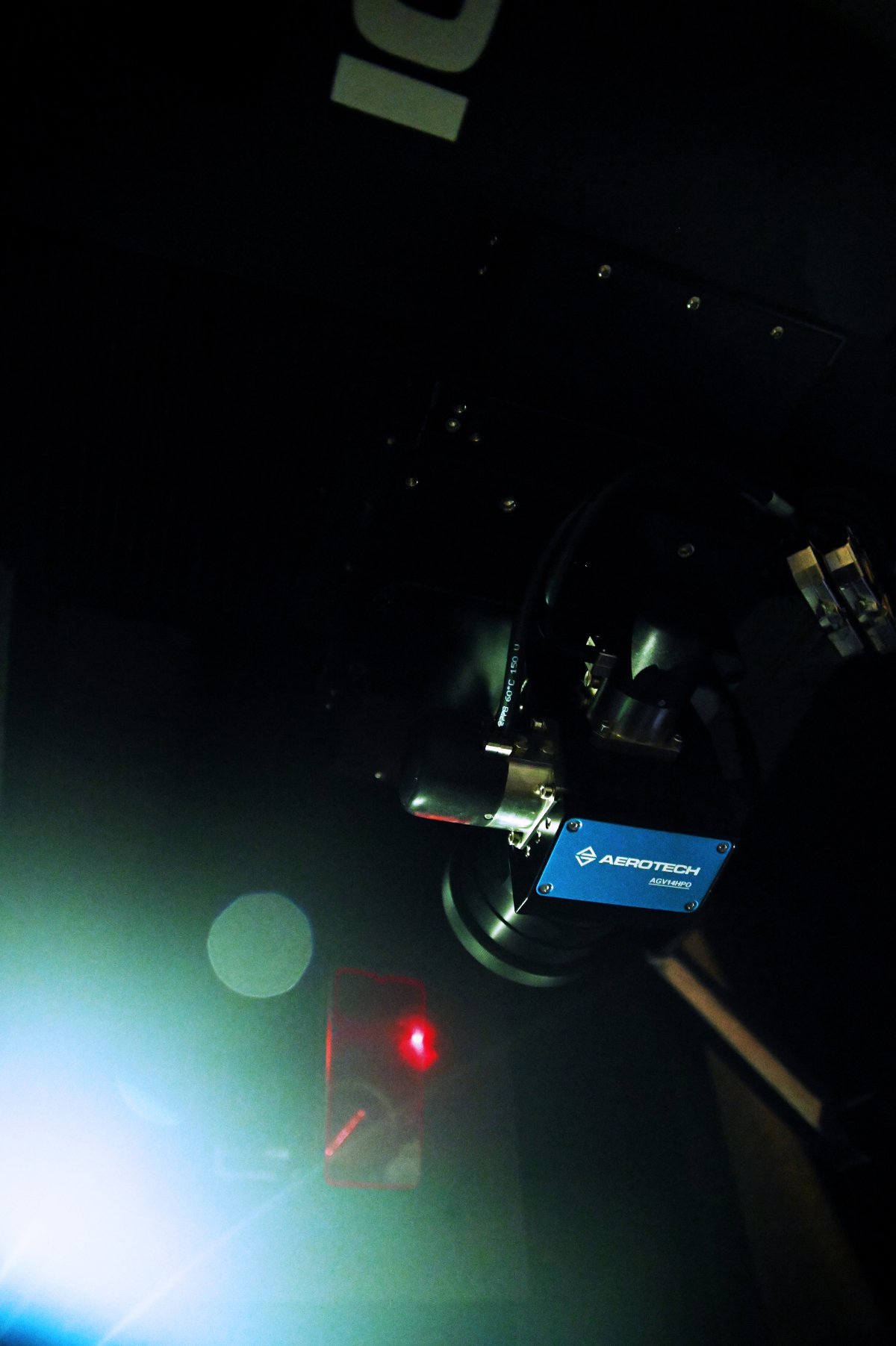
Scanner technology is an essential part of this system approach. Aerotech experts integrate galvanometer scanners not as separate optical components, but as axes that are fully integrated into the motion control architecture. The AGV scanner family is controlled like a classic servo axis and features high-resolution encoders that enable highly accurate feedback. This enables scanner movements to be recorded accurately and synchronized precisely with linear and rotary axes.
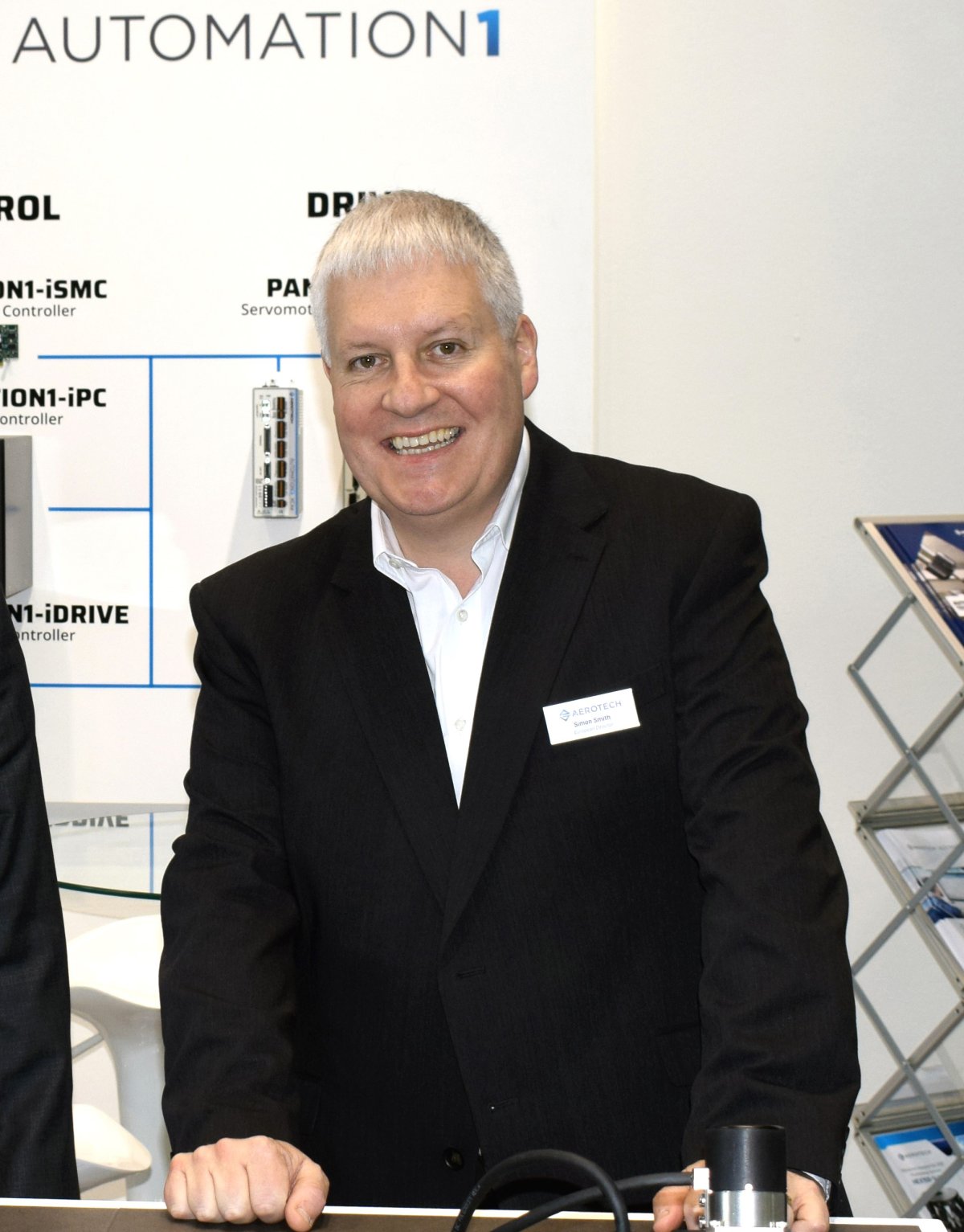
"It is crucial that scanner movements are not only fast, but also precisely measurable and controllable," emphasizes Simon Smith, European Director at Aerotech, "complex laser processes can only be reliably reproduced if galvo scanners are fully integrated into the motion control system."
This systemic approach forms the basis for process reliability in industrial practice. Modern manufacturing tasks also require the seamless integration of other technologies – from measurement sensors and handling systems to cooling – which must also be integrated into the higher-level control system. The challenge lies in connecting these heterogeneous components in such a way that they work in coordination in real time. "Only the precise synchronization of axes, scanners and lasers enables reproducible microstructures," continues Smith, "Deviations in positioning or timing can thus be systematically minimized."
While classic laser processing systems are often designed for two-dimensional or limited three-dimensional kinematics, they reach their physical and process-related limits when it comes to rotationally symmetrical or spatially complex components. In such cases, integrated motion control solutions combine linear and rotary axes, galvo scanners and laser control in a single system. Movements are controlled simultaneously rather than sequentially. This allows the laser beam to be guided continuously and precisely onto the workpiece surface, even when machining complex geometries and fine details at the same time.
Motion and Laser from a Single System
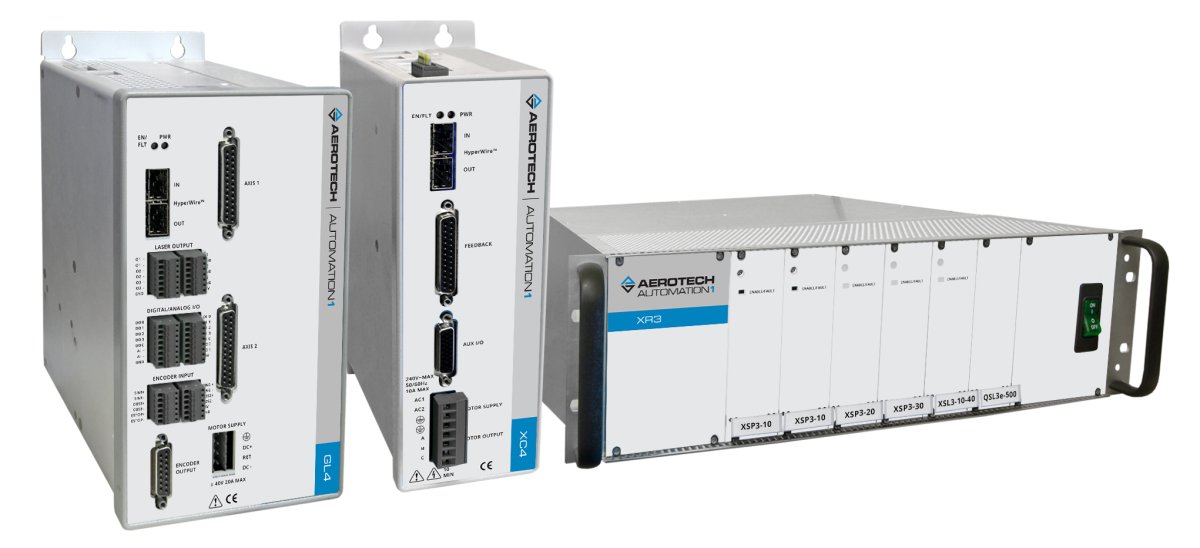
A central approach to modern laser processing is to consider motion axes and laser functionality not separately, but as a functional unit. At Aerotech, this close integration forms the basis for the implementation of demanding laser applications. Linear motors, highly dynamic rotary axes and galvo scanners must not only be mechanically precise, but also capable of being synchronized exactly on the software side.
Aerotech has been pursuing this approach for years: the combination of positioning systems, integrated scanner technology and a uniform control platform allows complex motion profiles and laser processes to be implemented precisely. Functions such as Position Synchronized Output (PSO) or continuous focus tracking help to keep the energy input constant regardless of the direction and speed of movement.
At Aerotech, these functions are available for linear and rotary axes, and also for AGV scanner axes. Laser pulses are triggered depending on position feedback – regardless of whether the movement is performed by a mechanical axis, a galvo scanner, or a combination of both. This means that scanner and axis movements are treated as a continuous, simultaneously controlled unit.
In addition, the control software enables dynamic adjustment of the laser parameters to different material characteristics. For example, pulses per second, power or spot size can be automatically adjusted to prevent material overheating and optimize surface quality. This significantly reduces scrap and increases process stability.
Five-axis Kinematics for Complex Geometries
A significant development in laser micro-machining is the use of five-axis systems that combine both linear and rotary movements. The simultaneous control of three linear and two rotary axes enables components to be machined from almost any angle without the need for re-clamping. The laser beam remains aligned with the workpiece surface, which is particularly relevant for rotationally symmetrical or spatially complex components.
Such kinematics open up new possibilities for machining complex contours, such as undercuts or filigree structures. The challenge here lies less in the mechanical design than in the precise synchronization of all axes with the scanner and laser. A motion control architecture forms the basis for reproducible results and enables the energy input of the laser to be kept constant, even with dynamic movements or changing machining speeds.
For applications with variable beam inclination or demanding drilling geometries, Aerotech supplements these kinematics with the AGV5D laser scanner. It extends the classic XY scanner movement with a focus axis and two degrees of freedom for beam tilt. This allows, among other things, conical, inclined or multidimensional micro-drilling with defined geometry.
"Especially in precision drilling, control of the angle of incidence determines dimensional accuracy and surface quality," says Simon Smith, "The combination of axis movement and AGV5D scanner creates additional degrees of freedom here."
Platform concepts for medical technology
With platforms such as the Laserturn 160 Gen 2 and, more recently, the Laserturn 280, Aerotech offers modular solutions for machining cylindrical workpieces in medical technology. The second generation of this platform combines linear and rotary axes and is designed for the machining of small diameters. Optional enhancements, such as more powerful rotary axes or simplified cable management systems, allow adaptation to specific manufacturing requirements. At the same time, the shared use of components with other platforms enables economical scaling and facilitates maintenance and integration.
The close integration of mechanics and control also allows multiple axes to be moved simultaneously, enabling even particularly complex or small components to be machined efficiently. In micro-machining, this simultaneous control has a direct impact on repeatability and surface quality. Errors due to mechanical tolerances or time delays between movement and laser pulses can thus be significantly reduced.
Software as a productivity factor
In addition to the mechanics, the control software plays a central role in the performance of modern laser systems. With its uniform motion control platform Automation1, Aerotech not only controls galvo scanners, axes and laser sources, but also integrates peripheral components such as gripping systems, measuring sensors and cooling units into a complete system. This close integration enables precise synchronisation of all movements and ensures that complex machining tasks can be reliably reproduced.
Application Example from Medical Technology
An example from medical technology shows how integrated motion control and laser systems work in practice. A manufacturer of ceramic implants uses a laser-based manufacturing system with integrated AGV scanners and several simultaneously controlled axes to produce precision tools and microstructures.
Aerotech was the supplier of the motion control and scanner technology, and was also involved in the design and validation of the process. The combination of a fixed beam path, highly rigid mechanics, synchronized axis control and application-specific expertise enables complex geometries to be machined with high repeatability.
The flexibility is also evident in the machining of different workpiece sizes: blanks with diameters from 0.5 mm to 13 mm and machining lengths up to 10 mm can be machined precisely and without tension. Handling robots and optical axes ensure fast positioning and adjustment, enabling the system to achieve high throughput rates even for complex tasks.