

Manufacturing Data Platform Showcases Smart Factory Automation
Increasing Efficiency in Production
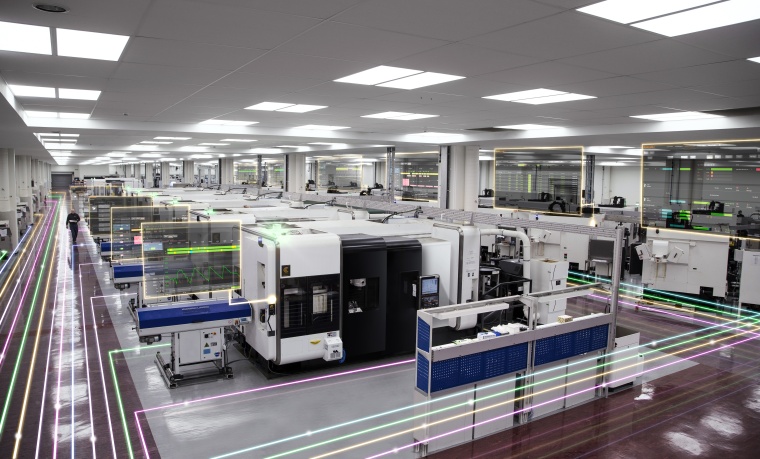
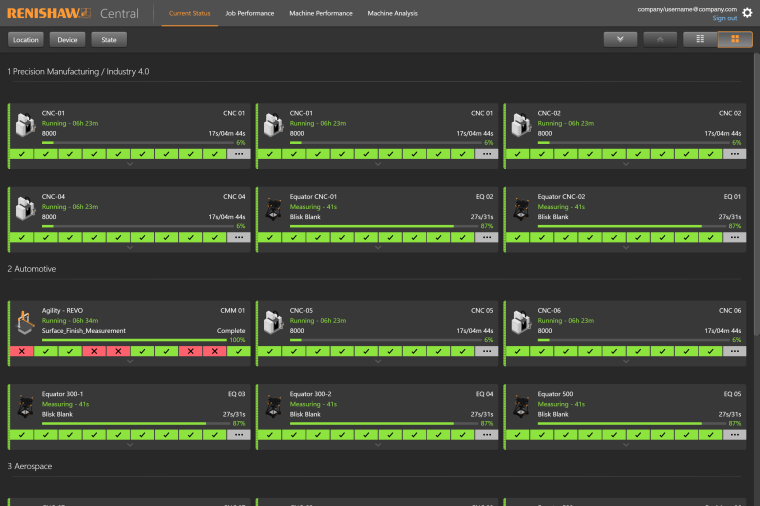
The Renishaw Central platform provides machine shop connectivity, consistency, control, and confidence. It allows manufacturers to harness end-to-end process data and use it to develop a robust factory-wide system architecture.
Global engineering technologies company, Renishaw, demonstrated its new manufacturing connectivity and data platform at IMTS 2024: Renishaw Central. It’s a data-driven solution designed to transform the productivity, capability, and efficiency of manufacturing operations. Bringing the power of connectivity to the machine shop floor, the system collects accurate, actionable data on machines, parts, and processes from across the factory, and presents it centrally for insight and interrogation at the point of manufacture.
The platform enables the user to monitor and update machining and quality control systems. Manufacturing process parameters can also be updated using its unique and patented Intelligent Process Control (IPC) software functionality. The ability to predict, identify and correct process errors before they happen supports increasingly automated solutions and processes for long-term productivity, capability, and efficiency gains.
“The Renishaw Central concept was born out of our own need to digitalize, visualize and control the manufacturing and measurement processes within our own production facilities. We wanted to reduce assumptions when problem solving, and facilitate the adoption of automated process control,” said Guy Brown, Renishaw Central Development Manager. “Because we live and breathe many of the same challenges faced by our customers, we’re confident that we’ve created a digital solution capable of driving actionable data across machining shop floors everywhere.”
Renishaw Uses Process Automation Technologies in its Own Production
Renishaw has used process automation technologies in the manufacture of its own products for over 30 years. During its in-house design and development, the Renishaw Central platform was deployed in the UK at Renishaw’s own low-volume high-variety manufacturing facilities at Miskin and Stonehouse. 69 machines were connected to Renishaw Central, and both sites subsequently reported a reduction in unplanned machine downtime caused by automation system stoppages.
Collaboration with those working directly with Renishaw Central in the machine shop, including production engineers, and maintenance and operations staff, allowed Renishaw to engineer a product that solves real-world problems. “Our original aim for Renishaw Central was to introduce further automation for lathes using our IPC technology, and this is progressing well. But an unexpected and positive outcome has been Renishaw Central's ability to highlight and rank unplanned stoppages of our automation systems,” said Guy. “Analysis of this information has guided remedial actions, leading to a 69 percent reduction in automation stoppages and significant improvements in utilization.”
A global selection of pilot customers who trialled Renishaw Central also confirmed that access to standardized end-to-end data provided an insight into their processes that has allowed them to improve manufacturing performance.
Renishaw Central collects and provides visibility of machining process data across the factory for insights at the point of manufacture. With Renishaw Central, manufacturers can check the performance of devices on the shop floor, understand device utilization, and examine and validate part quality. User-friendly dashboards show live device data. Data can be passed into industry-leading tools such as Microsoft Power BI via APIs. Data analytics can then be used for in-process control applications and continuous improvement.
Company
Renishaw, Inc.1001 Wesemann Drive
60118 West Dundee
US


most read
3D laser scanning for 100 percent inspection
Modern production requires precise, fast, and fully automated inspection processes. The robot-assisted inline measurement system Flexscan meets this requirement with two 3D compact sensors
Powerful in operation, intelligent in collaboration
How Faulhaber Drive Systems Are Bringing Humanoid Robotics Closer to Everyday Use

It Does Not Always Have to Be a Humanoid Robot
Mythomorphic design adds a distinct perspective to social robotics. Inspired by myths and fantasy rather than humans or animals, the article classifies examples and examines related opportunities and risks.
Microspectrophotometer in Practice
During a three-day Open House in Unterschleißheim near Munich, Optoprim Germany and Craic Technologies demonstrated integrated UV–visible–NIR and Raman microspectroscopy under real research conditions.

From Gamescom to the Factory
How the Gaming Industry Is Driving Automation