

Laser cleaning of insect residue without surface alteration
Insect residues disturb and interrupt the laminar air flow on airplane wings after a while. These residues therefore need to be repeatedly removed. Shockwave-based laser cleaning of insect residue on stainless steel (1.4544.9) is presented in an early view article in PhotonicsViews.
Researchers at BIAS performed shockwave-based laser cleaning of insect residue using an ML105E pulsed nanosecond TEA CO2 laser from SCLR Lasertechnik. The beam was emitted with a wavelength of 10.6 µm over a pulse duration of 100 ns and at a frequency of 10 Hz. The beam had a rectangular shape and was guided by a concave focusing mirror onto the target’s surface, which was made of stainless steel 1.4544.9.
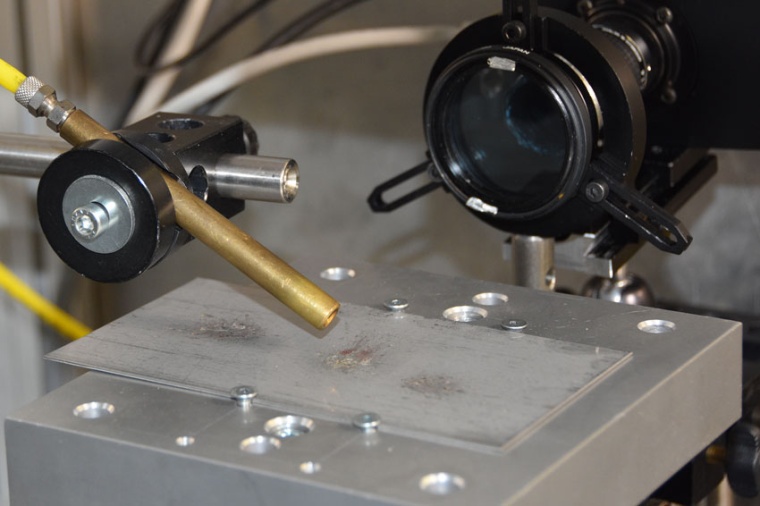
The target was placed on an x-y table of type KT310-200 produced by Steinmeyer Mechatronik that performed the movement of the target to enable the areal cleaning process using a meander path, a pulse overlap of 33 % and a path overlap of 30 %.
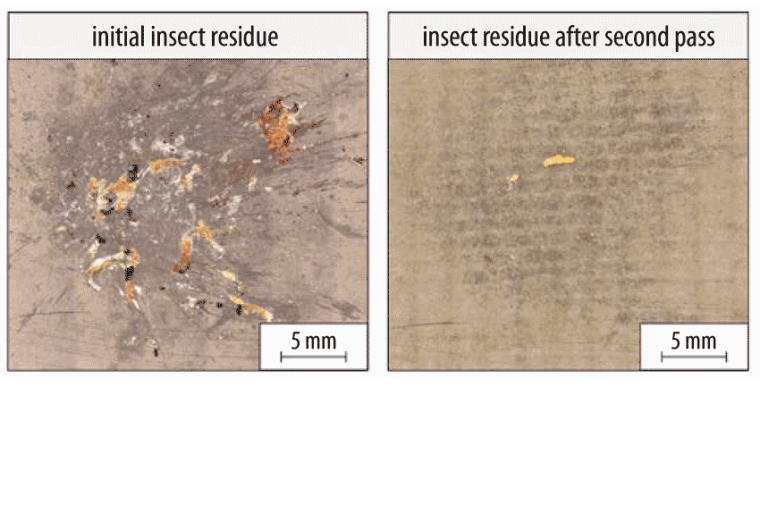
Prior to the first cleaning pass, the residue was imaged with an Olympus BX53M with a 2.5-fold lens by single images stitched together to provide an overview. Images were taken at 10-fold magnification for a more precise depiction of characteristic locations within the residue using a confocal laser-scanning microscope of type VK-X 3000 produced by Keyence. After the first and second pass, the imaging was repeated to visualize the cleaning progress. The images were analyzed using the MultiFileAnalyzer software, also provided by Keyence.
According to microscope images, the cleaning process shows a great cleaning effect after a first cleaning pass due to a significant reduction of the insect residue in volume and height, and with the potential to remove all of it after multiple passes.
Read the full article now online and in the upcoming PhotonicsViews issue 5/2024, out November 4, 2024:
Reference: Tim Radel & Lewin Rathmann (both: BIAS): Laser cleaning of insect residue without surface alteration – A pulsed CO2 laser provides an effective shockwave-based cleaning process, PhotonicsViews 21(5), in print, first published online: 1 September 2024; DOI: 10.1002/phvs.202400025
Company
BIAS – Bremer Institut für angewandte Strahltechnik GmbHKlagenfurter Str. 5
28359 Bremen
Germany


most read

Packaging Is Becoming a Strategic Task in Production
The new EU Packaging Regulation affects more than just packaging manufacturers. Production, logistics, and automation experts must also reassess their processes, materials, and equipment.

From Gamescom to the Factory
How the Gaming Industry Is Driving Automation

It Does Not Always Have to Be a Humanoid Robot
Mythomorphic design adds a distinct perspective to social robotics. Inspired by myths and fantasy rather than humans or animals, the article classifies examples and examines related opportunities and risks.
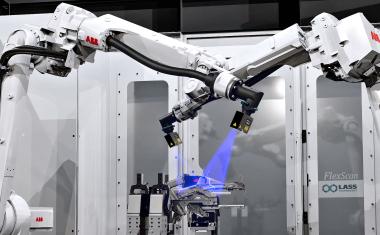
3D laser scanning for 100 percent inspection
Modern production requires precise, fast, and fully automated inspection processes. The robot-assisted inline measurement system Flexscan meets this requirement with two 3D compact sensors
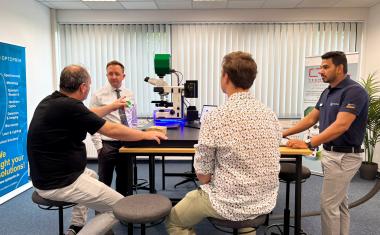
Microspectrophotometer in Practice
During a three-day Open House in Unterschleißheim near Munich, Optoprim Germany and Craic Technologies demonstrated integrated UV–visible–NIR and Raman microspectroscopy under real research conditions.