Chatbots for Dead, Endangered, and Extinct Languages
Possibilities and Limitations of Generative AI for Continuing Education
Oliver Bendel
1. Introduction
Language serves living beings as a means of communication. For humans, it is both a cultural tool and a cultural asset, a gateway to the world and a filter of the world, and, in the best sense, a home – a place of comfort and retreat. It is inherent in the individual, like morality, and requires the group or community in order to develop and reach its full potential (Bendel 2023b). The diversity of human languages is a phenomenon that both unites and divides: people either understand one another or they do not. If one does not understand the other but continues to learn, understanding may eventually emerge, and one begins to express oneself – perhaps with limitations, but sufficiently to become part of the speech community and to influence language use. The loss of a language is therefore not merely a linguistic event, but also an individual, cultural, and anthropological one.
According to UNESCO, more than 40 percent of the world’s languages are endangered, many of them critically so (UNESCO 2010). What is still familiar to parents and grandparents becomes unknown to children and grandchildren. In some cases – such as Latin – the language is “dead”, meaning it no longer has native speakers, yet it remains for centuries a carrier of intellectual tradition and scholarly study. Other languages, such as Egyptian or Akkadian, are extinct and can only be reconstructed fragmentarily. These developments pose challenges for entire cultures as well as for individual educational institutions – and, in the case of endangered languages, for each individual.
At the same time, new technologies are emerging in the field of artificial intelligence (AI) that can help document, reflect on, and possibly counteract language loss. Particularly noteworthy are chatbots, which, due to advances in generative AI, have become semantically and syntactically powerful and flexible systems (Bendel 2017a, b, 2019a, 2024a). Today, these are typically based on large language models (LLMs), as well as multimodal variants (MLLMs) that process not only text but also images, audio, and other media formats. All of these systems possess a broad “understanding of language” and are capable of reproducing linguistic structures, representing grammar and semantics, and serving users as artificial conversational partners, in written or spoken language (Shi et al. 2020).
Chatbots based on generative AI could therefore prove to be suitable tools for integrating dead, endangered, and extinct languages into education and continuing education. This applies both to formal learning (for example, in traditional educational institutions) and informal learning (such as self-study), and to children and adolescents as well as adults. Access via the natural language capabilities of dialog systems, supplemented by didactic and technical means, can facilitate – or even make possible – the acquisition or practice of such languages, including dialects and idioms. Chatbots are easy to use, available around the clock, and can be employed in dialogical, playful, and exploratory ways.
The author of this paper conducted several projects in this context at the FHNW School of Business between September 2022 and January 2025 (Bendel and N’diaye 2023; Bendel and Jabou 2024; Lluis Araya 2024). These resulted in chatbots such as @ve (for Latin), @llegra (for the Romansh idiom Vallader), kAIxo (for Basque), as well as experimental applications such as Cleop@tr@ (for Egyptian) and H@mmur@pi (for Akkadian). In addition, GPTs were created for Māori (Maori Girl) and Irish (Irish Girl). These prototypes illustrate how generative AI can model even displaced and neglected languages, act as a conversational partner, and support learning – with all the associated opportunities and risks. As early as 2012, the author also developed chatbots as moral machines together with his students, within the field of machine ethics (Bendel 2019a, b). These, as well as the systems for endangered languages, can be associated with concepts such as “AI for Good” or “AI for Well-being” (Rellstab and Bendel 2025).
At the core of this paper lies the question of how chatbots based on generative AI can contribute to the preservation and promotion of dead, endangered, and extinct languages in continuing education (as well as in formal education). Following an introduction to the technical and conceptual foundations (Section 2), several projects are presented and discussed from technical, ethical, and didactic perspectives (Section 3). These dimensions are revisited and generalized in Section 4. Finally (Section 5), possible and necessary steps are outlined that go beyond purely technological discourse. An outlook on future possibilities is also provided, particularly in relation to new versions of large language models.
2. Foundation
2.1 Dead, Endangered, and Extinct Languages
Natural languages are forms of communication used by living beings. In a metaphorical sense, they are themselves living systems: they emerge, develop, change, and eventually disappear. In linguistic classification, which focuses on human language, a distinction is made between living, endangered, dead, and extinct languages (UNESCO 2010; Eberhard et al. 2023). A living language such as English, French, or German is actively spoken and typically used in everyday life, education, culture, and administration, both in spoken and written form.
Endangered languages, by contrast, are at risk of disappearing, whether due to a small or declining number of speakers, a lack of transmission to subsequent generations, or the dominance of more widely used languages in social and media contexts. UNESCO differentiates within endangered and extinct languages into five levels: “vulnerable”, “definitely endangered”, “severely endangered”, “critically endangered”, and “extinct” (UNESCO 2010; Bendel and Jabou 2024). A related term is that of a threatened language.
A dead language such as Latin is no longer spoken as a native language but remains present in education, scholarship, or religion (Bendel and N’diaye 2023). Comparable examples include Sanskrit and Ancient Greek. Sanskrit, however, is a special case, as several thousand people in India actively use it in everyday life or at least strive to do so. An extinct language such as Egyptian (with hieroglyphs) or Akkadian (with cuneiform), on the other hand, is no longer part of active language use, often preserved only in written records, and dependent on extensive reconstruction and interpretation.
The reasons for the transformations and upheavals in contemporary communication are manifold. Globalization, depopulation, migration, technological standardization, and media monopolization or omnipresence contribute to a decline in linguistic diversity. Well-known examples include Māori, Irish, Basque, and Sardinian. Both languages in the strict sense and dialects and idioms are affected. The loss of a language results in the loss of cultural knowledge, social narratives, and forms of personal expression – and thus a loss of part of human diversity.
2.2 Chatbots and Voice Assistants and Their Variants
A chatbot – derived from “chat” and “bot” (short for “robot”) – is a dialog-oriented computer system that responds to text input and generates linguistically coherent answers. It belongs to the category of conversational agents, as do voice assistants (Bendel 2023a). These – such as Siri, Alexa, or Google Assistant – process spoken input and produce spoken output, and are therefore designed for spoken language. Traditional chatbots, by contrast, often operate purely on a text basis but can also be extended with speech capabilities, for example through speech output.
A distinction is made between rule-based systems, in which predefined inputs lead to predefined outputs, and systems that are created or improved through machine learning. Generative chatbots based on LLMs – representatives of the second category – are capable of responding to arbitrary inputs, establishing contextual relationships, and conducting complex dialogues (sometimes drawing on previous exchanges). Both categories can be assigned to artificial intelligence: in each case, the aim is to replicate the results of human intelligence through a computer system, here specifically elements of dialogue (Bendel 2017b).
In educational contexts, chatbots can be usefully applied wherever they serve as conversational partners for practicing or training language comprehension, grammar, vocabulary, or idiomatic expressions. They can create easily accessible practice environments, for example for learners without access to native speakers, for self-directed learning, or for playful reinforcement. In some contexts, text input and output are sufficient; in others, speech output is essential in order to become familiar with a language (including its pronunciation) and to learn it effectively – and then to use it successfully within a speech community.
Overall, chatbots and voice assistants have a long tradition in education. Around the turn of the millennium, the author of this paper wrote his doctoral thesis on this topic. It dealt with so-called pedagogical agents, which were typically rule-based dialog systems with static or dynamic avatars (Bendel 2003). In some cases, hardware components were involved, such as facial recognition systems or tools for object manipulation. A few systems were genuine agents (also called AI agents) with goal orientation and autonomy. The predecessors of pedagogical agents were intelligent tutoring systems and first-generation virtual learning companions (Hauske and Bendel 2024).
2.3 Potential for Language Preservation and Continuing Education
The use of generative chatbots for dead, endangered, or extinct languages is an obvious application. They can function as artificial conversational partners when natural ones are difficult or impossible to find; they can convey grammatical and lexical knowledge, including knowledge that may no longer be widely known within the language community; and they can provide content related to history and culture (Bendel 2017a). This is particularly relevant for continuing education, where structured language instruction is often lacking or where specific learning goals are pursued, for example by teachers and cultural mediators.
Due to their easy accessibility, intuitive usability, high interactivity, and individual scalability, chatbots based on generative AI are available to a broad range of users and can adapt to different needs (Bendel 2024a). This is especially important in the case of endangered languages, where objectives and use cases can vary widely. They can be used both for introductory learning phases and for more advanced practice (Hauske and Bendel 2024). They are not bound to a specific place or time and enable dialogical, playful, and exploratory learning – an aspect that is particularly important in the context of endangered languages.
Certainly, these systems are not a substitute for human language teachers (who are increasingly difficult to find in the case of endangered languages), for native speakers (who are becoming fewer and fewer), or for philological precision. Their role lies in offering support, in complementing existing learning processes, and in simulation. They open up new pathways for learning but must be used critically and reflectively, particularly from ethical and didactic perspectives. It also remains an open question whether they can actually halt the decline of endangered languages – or whether they are merely temporary companions that will eventually disappear along with them.
3. Projects on Chatbots at the FHNW School of Business
This section presents projects on chatbots for dead, endangered, and extinct languages that the author of this paper initiated, commissioned, or carried out between September 2022 and January 2025. Most of them were based on bachelor’s theses in business information systems. Accordingly, they were low-budget projects, financed by the author himself. The aim is not to list and evaluate all projects in this field, though it can be noted that around 2022 there were hardly any efforts to use LLMs in this way.
3.1 @ve: A Chatbot for Latin
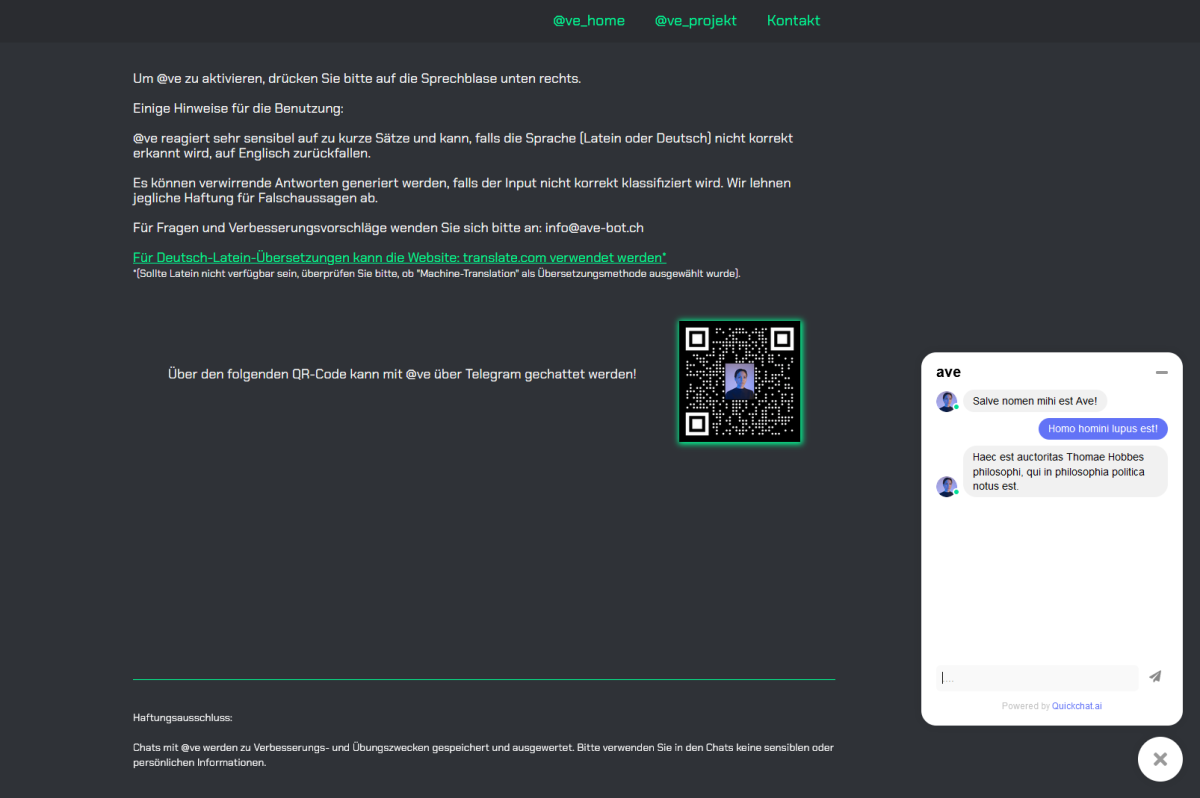
The first project in the context of dead and endangered languages at the FHNW School of Business was initiated and commissioned (i.e., proposed and funded) by the author of this paper in September 2022. His student Karim N’diaye developed @ve, a chatbot for Latin – a dead language (Bendel and N’diaye 2023). The system was based on GPT-3, supplemented by a manually curated knowledge base. The goal was to create a text-based system that enables simple dialogues in Latin, correctly applies and explains vocabulary and grammar, and is able to navigate historical and cultural contexts.
The chatbot is not merely a technical artifact but also a didactic tool. It is aimed at pupils, students, participants in continuing education, and anyone who wishes to practice or deepen their Latin skills outside formal educational settings. The popular greeting “ave” (“hail” or “greetings”) served as the entry point for dialogue and also gave the chatbot its name. The project contributor collected and structured Latin texts, translated content, and developed a prompt-based dialogue model. @ve was integrated into a website and an instant messaging platform (Telegram) (Bendel and N’diaye 2023). A video about the project is available here.
In a test run with a Latin expert, both strengths and weaknesses became apparent (Bendel and N’diaye 2023). The chatbot was able to generate grammatically correct sentences, conduct simple conversations, and answer vocabulary-related questions. At the same time, it exhibited typical weaknesses of generative systems at the time (and in part still today), namely semantic imprecision, occasional errors in case usage or conjugation, and inconsistent responses. At that stage, @ve was hardly suitable as a standalone tool in or alongside school education, but it did show promise as a supplementary learning medium.
From an ethical perspective, questions arise regarding cultural authenticity: can a large language model represent a dead language in its historical and cultural depth? The answer is: only to a certain extent. Chatbots like @ve are not digital reincarnations of classical Latin but simulation-based tools whose strengths lie in motivation and repetition rather than in philological precision. As such, they may convey a somewhat misleading impression of the language.
From a didactic perspective, however, @ve can still be a valuable instrument – particularly in classroom settings with teacher guidance, for self-directed learning among advanced learners, and for playful introduction. Outside formal education, for example in continuing education for theologians, philosophers, or medical professionals who require knowledge of Latin, @ve offers low-threshold access and an engaging mode of learning. It is important, however, that corrective mechanisms are in place when errors occur, and that such errors are not inadvertently reinforced by the system.
It should be added that the project was originally conceived differently. The intention had been to develop a chatbot for Romansh (Rhaeto-Romanic) – the first of its kind – but the project team failed to achieve this using GPT-3. After several discussions, the initiator redirected the project. It was likely the first chatbot based on generative AI that specialized in Latin. Nevertheless, interest in it remained limited. Scholars of Latin found the technical aspect questionable, while technologists regarded the Latin focus with skepticism – at least this is how the author interprets the reactions.
3.2 @llegra: A Chatbot for Vallader
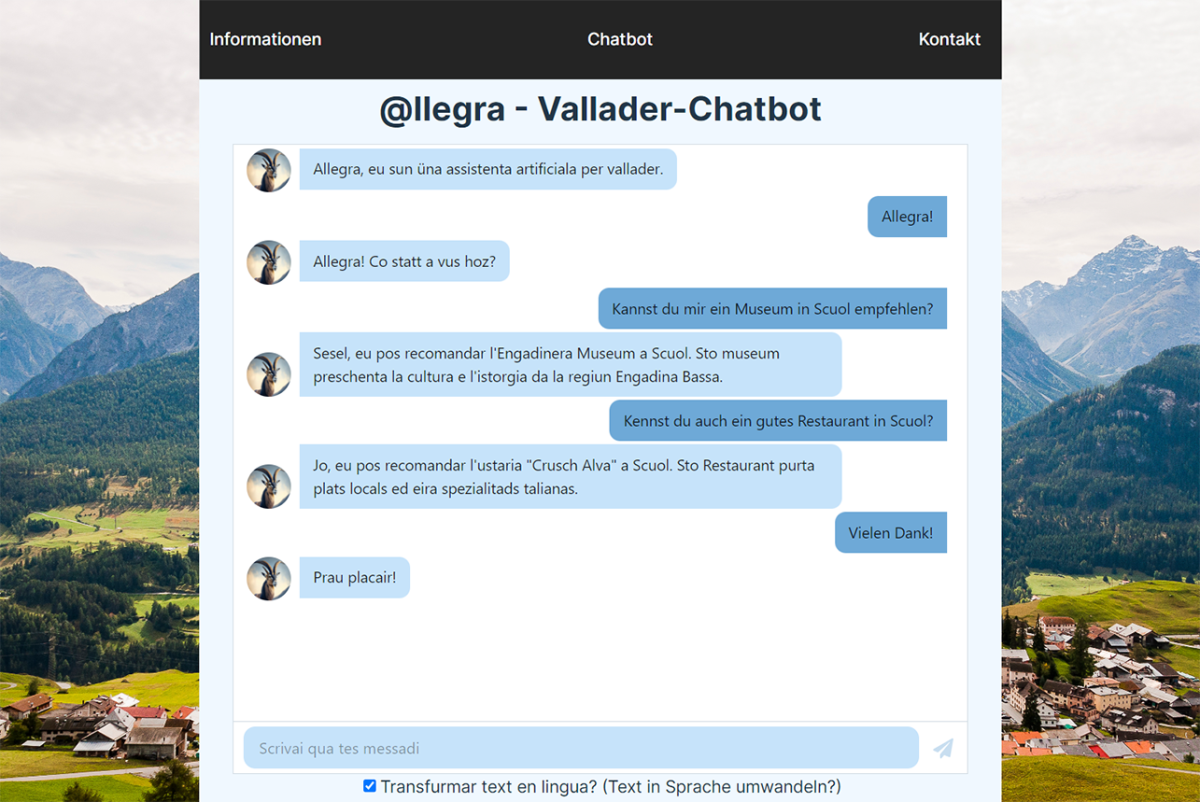
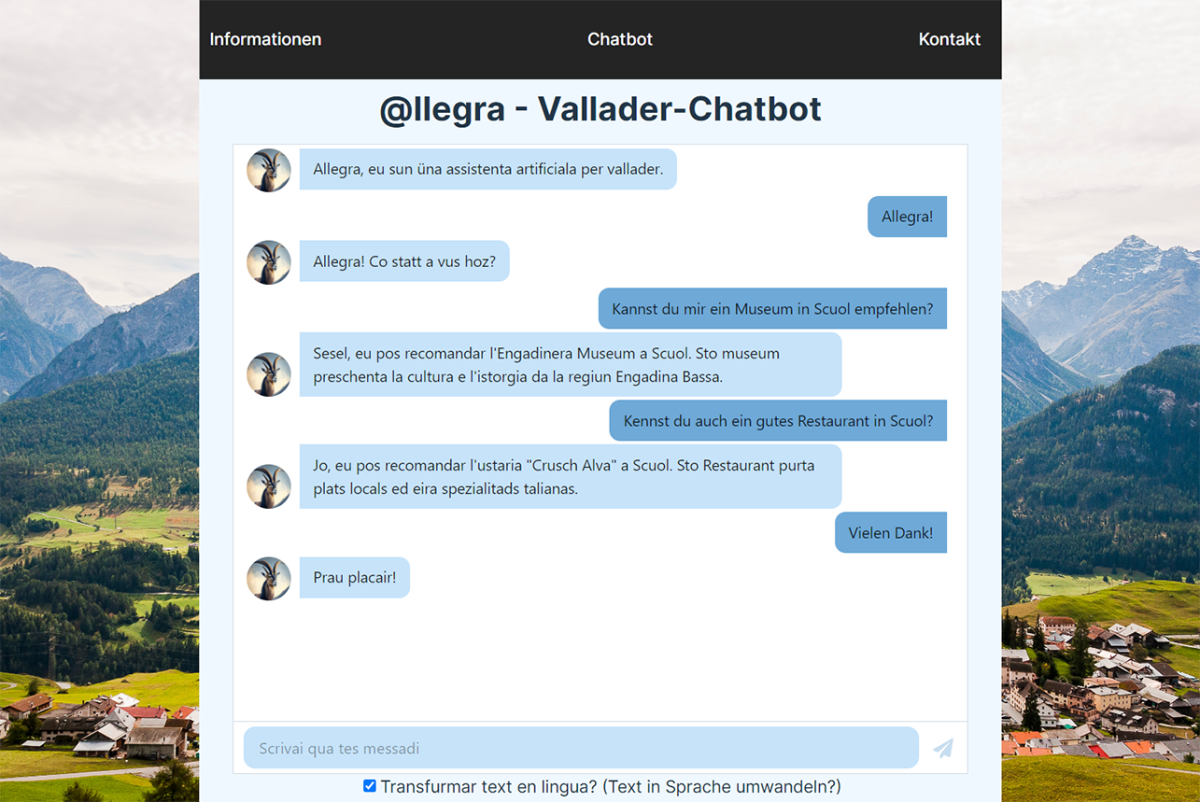
In 2023, the chatbot @llegra was developed at the FHNW School of Business for the Romansh idiom Vallader (Bendel and Jabou 2024). The expression “allegra” literally means “be cheerful” or “rejoice” in German and is used as a greeting, similar to “hello”. Romansh is an official national language of Switzerland but is spoken by only a few tens of thousands of people (with the Vallader idiom primarily used in the Lower Engadine). The project was once again initiated and commissioned by the author of this paper. His student Dalil Jabou developed @llegra based on GPT-4 – the LLM that finally enabled a breakthrough in this context.
The chatbot supports text processing as well as speech output and is enriched with a manually curated knowledge base on language and culture (Bendel and Jabou 2024). Its avatar is an ibex, the symbol of Graubünden and part of its coat of arms. The initiator referred to it as a female ibex to match the feminine-sounding name. @llegra was integrated into a website, which has since been taken offline. For documentation purposes, a video was produced.
The aim of the project was to provide a tool that could appeal to local residents and native speakers, as well as learners outside the language area – possibly also tourists visiting the Lower Engadine. In addition to linguistic competence, @llegra demonstrated extensive knowledge of the region’s geography, history, and particularities, including information about local museums. This made the ibex not only a learning assistant but also a “cultural agent”. For example, it was well acquainted with facilities in Scuol, to name just one case.
The technical implementation benefited from existing developments in text-to-speech. A Vallader-specific engine from a Zurich-based company was integrated (Bendel and Jabou 2024). Tests with native speakers yielded positive reactions, although minor grammatical inaccuracies were identified. More notably, however, @llegra repeatedly switched into another idiom, such as Sursilvan, or into Rumantsch Grischun, the artificial standard language used in media and administration. Overall, the chatbot proved suitable for practicing spoken language and improving listening comprehension, but less so for correcting complex sentence structures.
From an ethical perspective, the question arises of how to preserve the cultural sovereignty of small language communities when their language is placed in the hands of generative AI. The developers sought – where possible – dialogue with the community and emphasized transparency and discretion. @llegra was not designed as an authoritative voice of Vallader but as a learning support system with an explicitly defined beta status. Nevertheless, it ultimately imposes the implicit or explicit assumptions of a corporation onto a fragile and endangered idiom.
From a didactic point of view, @llegra is particularly convincing in the context of adult education. Those who wish to learn Romansh without attending a formal course find in the chatbot a conversational partner that does not evaluate but instructs and motivates. It can also contribute to language maintenance among native speakers, especially in an environment where the media sphere is dominated by German and public life by Swiss German – not to mention Rumantsch Grischun. This is particularly relevant for children, who may find the chatbot appealing and prefer to learn with it.
It should be added that, in discussions with institutions, media representatives, and native speakers, it repeatedly became apparent that some perceived the project’s engagement with Romansh as interference or imposition. The initiator is from Germany, and the student has an Arabic name and background – factors that led some to question their legitimacy and suitability. This concern is not entirely unfounded, as despite their commitment, they were not truly proficient in the idiom and relied on translation tools such as Textshuttle (later Supertext). On the other hand, someone had to take the first step, especially since among language advocates there were not many who were also interested in technology.
3.3 kAIxo: A Chatbot for Basque
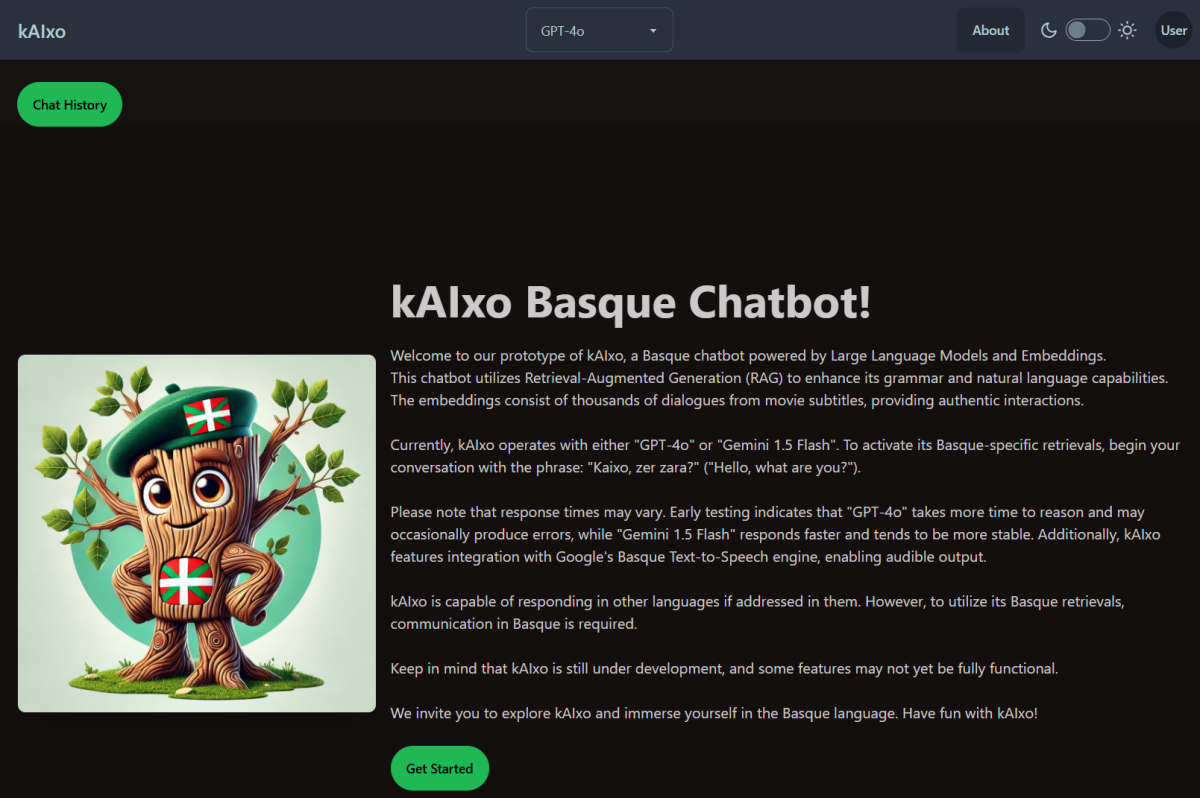
kAIxo is a chatbot for the Basque language, developed by Nicolas Lluis Araya in 2024 at the FHNW School of Business (Lluis Araya 2025), with the project completed in January 2025. The author of this paper once again initiated and commissioned the project. It proved technically and conceptually demanding, as Basque is one of the oldest languages in Europe, is linguistically isolated, and – despite official recognition – is no longer widely spoken in large parts of France and Spain. The Basque word “kaixo” means “hello”. The chosen avatar was a tree representing the Oak of Gernika, a symbol of resistance and survival in the Basque Country.
Technically, the chatbot was implemented by the student using the LangChain framework, combined with a RAG (retrieval-augmented generation) architecture (Lluis Araya 2025). Basque film subtitles and dialogues served as the data source and were stored in a vector database. On the website, users could choose between GPT-4o and Gemini 1.5 Flash. The text-to-speech function additionally enabled targeted listening comprehension training. The Google-based engine was usable but less convincing than the one developed for Romansh in the @llegra project. Two testing phases with volunteers showed high learning motivation and good comprehensibility (Lluis Araya 2025). A video about the project is available at https://youtu.be/lrCjypaQrnM.
It is also worth noting that, with the use of the LangChain framework, kAIxo can be considered an AI agent. It has a certain degree of autonomy and can independently access different tools and resources depending on the use case – for example, adapting to different proficiency levels (beginner, intermediate, advanced) or selecting appropriate material based on specific needs and contexts. This setup can be extended into a multi-agent system, creating links to earlier agent-based projects from the 1990s and 2000s.
From an ethical perspective, the project was deliberately designed to be sensitive and inclusive: development took place in close interaction with the online community, particularly via Reddit (Lluis Araya 2025). Feedback on pronunciation, grammar, and cultural context was incorporated iteratively. Nevertheless, the question of cultural responsibility remains: can an AI system represent the diversity of a living language without simplifying it? And does the power of a corporation in this context also imply power over the language of a minority?
From a didactic perspective, kAIxo proved to be a flexible tool for self-directed learning processes and thus also for certain forms of continuing education. It was particularly valuable for learners outside the Basque Country, as it required minimal technical and linguistic prerequisites and was available around the clock. The integration of audio output was especially appreciated by test participants. Excluding automated traffic, the website was visited by perhaps around one thousand unknown users between August 2024 and August 2025. No analysis of chat logs was conducted.
It should also be noted that, despite existing contacts with the University of the Basque Country (Basque: “Euskal Herriko Unibertsitatea”, Spanish: “Universidad del País Vasco”), no collaboration with researchers or experts could be established. Authors of Basque textbooks and grammar books also declined to participate in the RAG-based approach. The project team had the impression that the research was perceived as interference in the affairs of the language community. However, it is equally possible that concerns about artificial intelligence played a role – as well as skepticism about the use of proprietary large language models to process their own texts.
3.4 Chatbots for Extinct Languages: Cleop@tr@ and H@mmur@pi
An experimental chapter is represented by chatbots for extinct languages. Cleop@tr@ for Egyptian and H@mmur@pi for Akkadian were developed in 2024 by the author of this paper as GPTs (“custom versions of ChatGPT”, as OpenAI calls them). Although there are no longer any native speakers or active users, generative AI can be used to simulate reconstructed language structures, analyze and interpret writing systems, and initiate dialog-based learning processes. A prerequisite is always the availability of training material, which is indeed the case for Egyptian hieroglyphs and Babylonian cuneiform.
With Cleop@tr@ – Cleopatra VII Thea Philopator was the last pharaoh of the Macedonian-Greek Ptolemaic dynasty and is known, among other things, for her relationship with Julius Caesar, whom she first met in 48 BCE – initial dialogues were conducted starting in May 2024. The aim was to allow users to form simple sentences using hieroglyphs. Similar experiments were carried out with H@mmur@pi. Hammurabi I was the sixth king of the First Dynasty of Babylon (reigned 1792–1750 BCE) and is famous for the Code of Hammurabi, the oldest fully preserved legal code. In Egypt, Cleop@tr@ was tested by the author in late 2024, first at the Karnak Temple and then in the Valley of the Kings. When interpreting inscriptions on columns and walls, the chatbot provided plausible explanations but also produced significant errors.
Overall, these chatbots are valuable not as experts or authorities but as low-threshold entry points, for playful interactions, and as tools that stimulate historical and linguistic curiosity. They are suitable for museums, exhibitions, or educational institutions seeking to convey culture in digital form. They offer excitement and entertainment for tourists engaged in educational travel – ideally equipped with reliable books to verify or correct the chatbot when necessary. Their experimental character is intentional and invites supplementation and contradiction.
The technical implementation of these GPTs was straightforward and rapid (Hauske and Bendel 2024). Prompt engineering and RAG were used. The developer conducted tests with various documents without aiming for extensive scope or depth. The focus was rather on demonstrating the principle and basic feasibility – despite all limitations and errors. A technical issue in early 2024, which affected many GPTs – where uploaded documents were removed without direct communication from OpenAI – led to temporary restrictions. This once again highlights the problem of dependency on providers.
From an ethical perspective, the issue of linguistic authenticity and cultural appropriation arises once more. Does the use of generative AI lead to simplifications and distortions? This can indeed be the case if expert oversight is lacking or if the available data is insufficient. Such systems are therefore not substitutes for archaeologists or philologists but rather exploratory tools that spark curiosity and make knowledge more accessible.
From a didactic perspective, an interesting effect emerges: interaction with a chatbot such as Cleop@tr@ or H@mmur@pi can serve as an initial impulse to engage more deeply with history, language, and culture – beyond digital media and artificial interlocutors. Both formal education and continuing education provide suitable contexts for this, ideally guided by subject-matter experts.
4 Technical, Ethical, and Didactic Discussion of the Use of Chatbots for Specific Languages
This section provides a technical, ethical, and didactic discussion of the use of chatbots for dead, endangered, and extinct languages. Specific considerations have already been addressed in the previous section – here, the focus shifts to a more general perspective.
4.1 Technical Aspects
Generative chatbots, based on LLM architectures, combine accessibility with expressive power. They are easy to use – via graphical user interfaces, websites, or instant messengers – while offering strong capabilities in interaction and communication. Text processing takes place in natural language; the systems respond dialogically, can generate new content, and – among other things through RAG – can incorporate both structured and unstructured data. In some cases, speech output is also available.
Their accessibility is also reflected in how easily they can be created: many of these systems, such as GPTs, can be built or adapted without programming knowledge (Hauske and Bendel 2024). Platforms like OpenAI’s GPT Builder make it possible to create functional chatbots within minutes or hours, supported by retrieval-augmented generation and text-to-speech. However, this also creates dependency on providers, and in the past there have already been issues – such as data loss – that users had to handle themselves. Version changes can also lead to problems.
The power of generative chatbots is evident in their ability to process context, generalize semantically, and simulate complex speech acts (Bendel 2024a), which is essential in conversation. Learners can interact with them, make mistakes, receive corrections, and explore cultural contexts – all within a dialog that approximates human conversation in structure. Increasingly, these systems have been trained not only to react but also to act proactively, for example by asking follow-up questions or prompting users.
Nevertheless, technical limitations are evident. The models operate statistically and generate language without truly understanding it. Incorrect or misleading statements due to manipulation are possible, as are hallucinations (Bendel 2024a). This is particularly critical in the case of extinct or only fragmentarily documented languages, where there is often no reliable control mechanism. RAG can help mitigate this issue – the world of learning is combined with that of knowledge.
Most LLMs have been primarily trained on major languages. GPT-4o and GPT-5.2, for example, are particularly strong in English. In contemporary usage, even relatively rare terms have become more prominent (Yakura et al. 2025). In German, noticeable errors and deviations have also been observed, as confirmed by various tests. For instance, LLMs sometimes use punctuation and formatting in unconventional ways. Moreover, they tend to favor gender-inclusive language, diverging from standard language conventions – an effect linked to the principles of their developers. For languages such as Romansh and Basque, at least written forms exist that can be utilized, including by open-source models that can be fine-tuned accordingly.
4.2 Ethical Perspectives
From an ethical standpoint, both opportunities and risks can be identified. Chatbots for endangered languages can contribute to the democratization of education, increase the visibility of marginalized cultures, and support individual language acquisition. They enable playful access, create new spaces for language maintenance, foster historical and cultural awareness, and strengthen the principle of self-efficacy. They can support self-directed learning and complement institutionalized education.
At the same time, challenges arise in the field of information and media ethics. These systems are typically based on proprietary models developed by large corporations such as OpenAI, Google, Meta, or xAI. This results in structural dependency: data processing, hosting, and model adaptation are controlled by private entities rather than public institutions. This raises questions of sovereignty and transparency, especially in the context of small language communities that have limited technological resources.
Another ethical tension concerns manipulation. Generative systems shape content, filter, paraphrase, and reframe information. They may emphasize certain perspectives while omitting others, historicize or decontextualize content. In the worst case, meanings may be trivialized or cultural elements misrepresented, for example through stereotypes or superficial exoticization. Many LLMs and MLLMs also tend to avoid topics such as sexuality, often due to cultural norms or legal concerns (Bendel 2024b).
A related issue, already mentioned in the technical discussion, concerns language norms. Some models promote specific linguistic conventions – such as gender-inclusive language – and present them as broadly accepted or more equitable, although this is debated in linguistic research (Meineke 2023). Above all, it is dangerous when corporations set their own standards for moral or other reasons and thereby influence language use, especially when it comes to American corporations and non-English-speaking communities. Much like in the GDR, this constitutes an attempt to impose language change from above.
If such influence occurs in widely spoken languages, it may also affect smaller or endangered languages. In these cases, it can be even more difficult to detect and counteract deviations. Furthermore, user preferences may not always be respected, even when explicitly stated. This raises broader questions about user autonomy and the balance of power between providers and users.
Data protection is another critical issue. Dialog systems collect and store user inputs, retain contextual information, and analyze patterns. While companies increasingly offer privacy options – including locally running systems – the protection of personal data remains fragile, especially when such systems are used by children, adolescents, or culturally sensitive groups. Responsibility also lies with developers who build applications on top of LLMs.
One possible solution lies in developing open, non-commercial alternatives – for example, publicly funded language models with transparent training data, or the fine-tuning of open-source models. In Switzerland, for instance, the LLM “Apertus” was introduced in 2025 as an open system. Chatbots based on such foundations could help educational institutions become more independent, regain cultural control, and enforce ethical standards. A similar approach is being pursued in a “follow-up project” to @llegra called IdiomVoice, focusing on the Sursilvan idiom and supported by several Swiss universities.
Finally, from the perspective of machine ethics, the question arises of how such systems should be designed to act in morally acceptable ways (Bendel 2019b, c). Approaches such as moral prompt engineering and corresponding RAG implementations – incorporating guidelines and codes of conduct (Rellstab and Bendel 2025) – offer practical pathways. This allows chatbots to be aligned not only functionally but also ethically, which is particularly important in educational contexts.
4.3 Didactic Potentials
Continuing education – understood as both formal and informal learning beyond initial education (Bendel and Hauske 2004) – is an ideal context for the use of generative chatbots in language learning. It brings together curiosity, practical experience, and lifelong learning – an environment that dialog systems can serve particularly well. At the same time, especially in informal learning contexts, learners may be left on their own.
Chatbots can be used in many ways in continuing education: as individual language trainers, as mediators of cultural knowledge, or as interactive tutors, mentors, and coaches (Hauske and Bendel 2024). They are well suited for repetition, consolidation, and application, particularly for learning goals related to verbal expression, idiomatic competence, or cultural knowledge.
Their integration can take place within institutional settings – such as adult education centers, universities, or cultural institutions – or in self-organized learning. Hybrid formats are also conceivable, in which humans and chatbots collaborate: the chatbot supports practice, while the teacher provides reflection and correction. Alternatively, the chatbot provides input, and the group discusses its substance. This creates added didactic value beyond traditional learning scenarios.
Their use is particularly promising in the context of endangered languages, which are often preserved only in fragments or spoken within diasporic communities. Here, chatbots can act as a bridge between generations, between language communities and digital learning environments. Even extinct languages represent a meaningful application area, for example in cultural and historical education.
At the same time, caution is required. Systems such as GPT-5.2, Claude, Gemini, or Grok are neither neutral nor infallible. Their use requires media literacy, critical thinking, and an understanding of algorithmic processes – skills that should themselves be part of continuing education. Whether in formal instruction or self-study, it is important to understand and critically assess the influence of large technology providers.
The educational space is thus expanded in two ways: through new content and through new forms of learning. Chatbots are not substitutes for teachers or native speakers but complementary tools – with significant didactic potential, yet also a strong need for pedagogical integration, ethical reflection, and institutional responsibility.
5 Summary and Outlook
Dead, endangered, and extinct languages exemplify the fragility of forms of communication, cultural tools, and cultural assets. With the disappearance of a language, not only words and structures are lost, but also worldviews, narrative traditions, social practices, and individual preferences – and with them, a sense of home. The preservation of endangered languages is therefore more than an academic or linguistic project; it is an ethical and cultural concern.
This paper has shown how chatbots based on generative AI can be used to support such languages in both formal education and continuing education. The projects presented – from @ve for Latin to @llegra for Vallader, kAIxo for Basque, and Cleop@tr@ for Egyptian and H@mmur@pi for Akkadian – demonstrate that technological solutions can create access, raise awareness, and support learning processes. They contribute to cultural resilience and enable new forms of engagement with language, independent of location, time, and institutional context.
Technically, these systems are characterized by their dialog capability, contextual sensitivity, and broad knowledge (despite inherent limitations). Didactically, they provide learning environments that are scalable, playful, exploratory, and motivating. Ethically, they offer opportunities to make marginalized linguistic spaces more visible – while also requiring critical reflection on issues such as copyright, data sovereignty, cultural appropriation, algorithmic bias, and manipulation.
The paper also makes clear that chatbots are not substitutes. They are tools – not teachers, not scholars, not linguistic authorities. Their strength lies in offering possibilities, not in delivering final judgments. They excel in dialogue, not in definitiveness. In continuing education, they are best understood as complementary elements: a “second voice”, a stimulus for conversation, and a trigger for reflection.
Looking ahead, several key directions emerge from the practical examples and the broader technical, social, and didactic discussion:
- First, there is a need to promote open, transparent, and public-interest-oriented large language models, for example through publicly funded AI infrastructures or collaborations with cultural institutions. This can reduce dependency on international corporations and commercial platforms.
- Second, ethical guidelines – well-founded and practical frameworks – should be developed for culturally sensitive applications of generative AI and integrated into both organizational and educational practice, with particular attention to copyright, data protection, participation, and representation.
- Third, media, IT, and AI literacy should be systematically integrated into education and continuing education, enabling learners not only to use chatbots and voice assistants but also to understand how they function, what their limitations are, and what individual and societal effects they may have.
- Fourth, closer collaboration with language communities, linguists, educators, and cultural stakeholders is essential. Chatbots should be conceived as cooperative projects – not as mere technical reproductions, but as forms of shared cultural development. This also requires identifying and overcoming both unfounded and justified reservations. In the case of extinct languages, experts in ancient studies – from classicists to Egyptologists – are particularly important.
In an era in which education, language, and technology increasingly overlap, new learning environments are emerging, both in formal education and, especially, in continuing education. Chatbots can play a meaningful role in these environments if they are developed thoughtfully, critically accompanied, and used reflectively. They are not a cure-all for language loss, but they represent one possible way to bring forgotten sentences back to life and to make silenced voices audible again – even if only for a few years or decades.
With the further development of large language models – toward systems such as GPT-5.x – additional possibilities arise for endangered languages that go beyond the approaches described in this paper. Advances in multimodality, contextualization, and adaptability make it possible to use small language corpora more effectively, model dialects more precisely, and personalize dialog-based learning environments to a greater extent. Modern LLMs and MLLMs can not only generate text but also recognize and synthesize spoken language, analyze historical sources, compare linguistic variants, and create collaborative learning spaces for dispersed language communities.
As a result, chatbots (and voice assistants) could become long-term infrastructural components: tools for documentation, for the creation of learning materials, for the revitalization of language use in everyday life, or for building online language communities. At the same time, this increases the need to develop such systems in collaboration with linguists, philosophers, cultural stakeholders, and the affected communities in order to align technological possibilities with cultural authenticity and linguistic sovereignty.
References
Bendel, Oliver. Pädagogische Agenten im Corporate E-Learning. Dissertation, Difo, St. Gallen, 2003.
Bendel, Oliver. „Chatbot.“ In Gabler Wirtschaftslexikon. Springer Gabler, 2017a. https://wirtschaftslexikon.gabler.de/definition/chatbot-54248.
Bendel, Oliver. „Künstliche Intelligenz.“ In Gabler Wirtschaftslexikon. Springer Gabler, 2017b. https://wirtschaftslexikon.gabler.de/definition/kuenstliche-intelligenz-54119.
Bendel, Oliver. „Von Cor@ bis Mitsuku: Chatbots in der Kundenkommunikation und im Unterhaltungsbereich.“ In Handbuch Digitale Wirtschaft, herausgegeben von Tobias Kollmann, 1–17. Springer Gabler, 2019a. https://doi.org/10.1007/978-3-658-17345-6_86-1.
Bendel, Oliver. „Chatbots as Moral and Immoral Machines: Implementing Artefacts in Machine Ethics.“ In Proceedings of the Workshop ‘Conversational Agents: Constructing Action Plans from a Wave of Research and Development’, Glasgow, UK, Mai 2019b.
Bendel, Oliver. 400 Keywords Informationsethik. Grundwissen aus Computer-, Netz- und Neue-Medien-Ethik sowie Maschinenethik. 2. Aufl. Springer Gabler, 2019c. https://doi.org/10.1007/978-3-658-26664-6.
Bendel, Oliver. „Conversational Agent.“ In Gabler Wirtschaftslexikon. Springer Gabler, 2023a. https://wirtschaftslexikon.gabler.de/definition/conversational-agent-125248.
Bendel, Oliver. „Sprache.“ In Gabler Wirtschaftslexikon. Springer Gabler, 2023b. https://wirtschaftslexikon.gabler.de/definition/sprache-124739.
Bendel, Oliver. 300 Keywords Generative KI: Ökonomische, technische und ethische Grundlagen. Springer Gabler, 2024a.
Bendel, Oliver. „How Can Generative AI Enhance the Well-Being of Blind?“ In Proceedings of the AAAI 2024 Spring Symposium Series, Symposium ‘Impact of GenAI on Social and Individual Well-being’, 340–47. Burlingame, CA: The AAAI Press, 2024b. https://ojs.aaai.org/index.php/AAAI-SS/article/view/31232/33392.
Bendel, Oliver, and Stefanie Hauske. E-Learning: Das Wörterbuch. Sauerländer Verlage, 2004.
Bendel, Oliver, and Dalil Jabou. „@llegra: A Chatbot for Vallader.“ International Journal of Information Technology, 2024. https://doi.org/10.1007/s41870-024-01779-0.
Bendel, Oliver, and Karim N’diaye. „@ve: A Chatbot for Latin.“ ArXiv, 2023. https://arxiv.org/abs/2311.14741.
Eberhard, David M., Gary F. Simons and Charles D. Fennig, eds. Ethnologue: Languages of the World. 26th ed. SIL International, 2023. https://www.ethnologue.com.
Hauske, Stefanie, and Oliver Bendel. „How Can GenAI Foster Well-Being in Self-Regulated Learning?“ In Proceedings of the AAAI 2024 Spring Symposium Series, Symposium ‘Impact of GenAI on Social and Individual Well-being’, 354–61. Burlingame, CA: The AAAI Press, 2024. https://ojs.aaai.org/index.php/AAAI-SS/article/view/31234/33394.
Lluis Araya, Nicolas. kAIxo: Ein Chatbot für Baskisch. Erhaltung einer gefährdeten Sprache. Bachelorarbeit, Hochschule für Wirtschaft FHNW, Olten, 2025.
Meineke, Eckhard. Studien zum genderneutralen Maskulinum. Universitätsverlag Winter, Heidelberg 2023.
Rellstab, Myriam, and Oliver Bendel. „Miss Tammy as a Use Case for Moral Prompt Engineering.“ In Proceedings of the AAAI 2025 Spring Symposium ‘Human-Compatible AI for Well-Being: Harnessing Potential of GenAI for AI-Powered Science’, März–April 2025. Burlingame, CA: The AAAI Press. https://ojs.aaai.org/index.php/AAAI-SS/issue/view/654.
Shi, Nuobei, Qin Zeng, and Raymond Lee. „The design and implementation of Language Learning Chatbot with XAI using Ontology and Transfer Learning.“ ArXiv, 2020. https://arxiv.org/abs/2009.13984.
UNESCO. Atlas of the World’s Languages in Danger. Edited by Christopher Moseley and Nicolas, Alexandre. Paris: UNESCO, 2010. http://www.unesco.org/culture/languages-atlas/.
Yakura, Hiromu, Ezequiel Lopez-Lopez, Levin Brinkmann, Ignacio Serna, Prateek Gupta, Ivan Soraperra, and Iyad Rahwan. „Empirical evidence of Large Language Model’s influence on human spoken Communication.“ V3. ArXiv, 2025. https://arxiv.org/abs/2409.01754.