

Could the global industrial automation market face another supply chain crunch?
In 2025, industrial automation OEMs faced uncertainty due to a US-China trade policy shift, delaying orders. While a rebound is possible in 2026 with potential interest rate cuts, supply chain concerns persist due to unresolved rare earth material export agreements
Blake Griffin, Interact Analysis Research Manager

Industrial automation OEMs and their customers have been faced with a year of uncertainty in 2025. A dramatic shift in US trade policy has seen the market adopt a stance of ‘wait and ‘see’. Even now [end of 2025], the US and China remain locked in talks over the details of sales of rare earth material, weeks after US President Donald Trump and his Chinese counterpart, Xi Jinping, reached an agreement that was expected to increase exports. While the US has rolled back tariffs since those initial talks, China has yet to confirm full details of the truce. Reports suggest both sides have until the end of November to agree to ‘general licenses’ for exports of rare earth materials from China to the United States.
For automation OEMs, uncertainty has led to delayed orders from customers rather than outright cancellations. However, these delays could lead to a ‘pop’ in orders during 2026, particularly if a predicted reduction in interest rates creates the right conditions for a strong rebound in the first half of 2026. While this is good news for the industrial automation industry, questions over the supply of industry-critical raw materials are a cause for concern, as it could place significant strain on supply chains at a crucial time.
Continue with login
No account yet?
Register now for free and get full access to all exclusive articles from wileyindustrynews.com.
With our newsletter we regularly send you top news from Automation, image processing and light and laser technology in industrial environments, as well as the latest e-issue.
Company
Interact Analysis Group Holdings Ltd.Riverside House
NN9 5QF Irthlingborough
UK



most read

It Does Not Always Have to Be a Humanoid Robot
Mythomorphic design adds a distinct perspective to social robotics. Inspired by myths and fantasy rather than humans or animals, the article classifies examples and examines related opportunities and risks.
Powerful in operation, intelligent in collaboration
How Faulhaber Drive Systems Are Bringing Humanoid Robotics Closer to Everyday Use
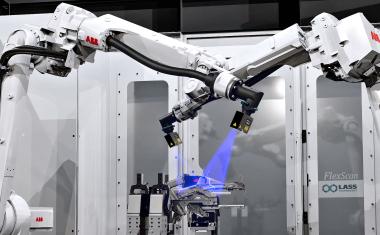
3D laser scanning for 100 percent inspection
Modern production requires precise, fast, and fully automated inspection processes. The robot-assisted inline measurement system Flexscan meets this requirement with two 3D compact sensors
Packaging Is Becoming a Strategic Task in Production
The new EU Packaging Regulation affects more than just packaging manufacturers. Production, logistics, and automation experts must also reassess their processes, materials, and equipment.

From Gamescom to the Factory
How the Gaming Industry Is Driving Automation