

Fresnel Lenses as an Economic Alternative to Aspheric Lenses
Fresnel lenses can be used for a variety of tasks in industrial applications. New design algorithms enable the creation of unusual shapes. Due to advances in engineering and manufacturing, these optical components are now manufactured in large-scale production. Thus, Fresnel lenses represent an economic alternative to aspheric lenses.

Fresnel lenses can be used for a variety of tasks in industrial applications. New design algorithms enable the creation of unusual shapes. Due to advances in engineering and manufacturing, these optical components are now manufactured in large-scale production. Thus, Fresnel lenses represent an economic alternative to aspheric lenses.
In machine vision systems, optimal illumination is essential. Illumination modules based on Fresnel lenses feature optical components that are tailored for industrial use. Advantages of these lenses are their low weight and their small dimensions. The low mass results in low costs.
The surface of Fresnel lenses might be considered as an alternating sequence of facets that direct the light into the desired direction and those that do not contribute. This implies that the efficiency is somewhat lower than the efficiency of a comparable aspheric lens. In many applications in inspection systems, the multiple advantages outweigh this disadvantage.
Possibility of Different Refractive Structures
In industrial applications as inspection, an illumination with high homogeneity is important. It is the prerequisite that deviations or defective parts can be detected reliably. Using Fresnel lenses, a high homogeneity can be obtained. They are well suited to be employed in collimation optics, and allow to obtain a high degree of collimation.
Some tasks require structured illumination. It might be that the intensity should vary according to a prescribed function. Or a region of interest has to be emphasized against a peripheral background. To realize a scenario with structured illumination, Fresnel technology offers the advantage that a divided aperture is feasible. Partial areas can be provided with different refractive structures that feature different functionalities.
Continue with login
No account yet?
Register now for free and get full access to all exclusive articles from wileyindustrynews.com.
With our newsletter we regularly send you top news from Automation, image processing and light and laser technology in industrial environments, as well as the latest e-issue.
Company
Forvia HellaRixbecker Straße 75
59552 Lippstadt
Germany


most read

From Gamescom to the Factory
How the Gaming Industry Is Driving Automation
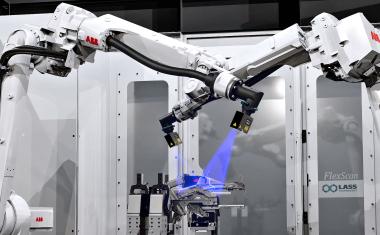
3D laser scanning for 100 percent inspection
Modern production requires precise, fast, and fully automated inspection processes. The robot-assisted inline measurement system Flexscan meets this requirement with two 3D compact sensors
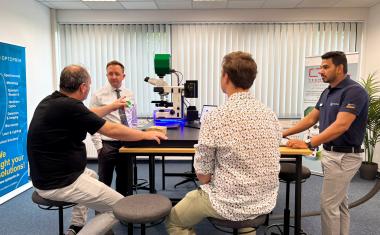
Microspectrophotometer in Practice
During a three-day Open House in Unterschleißheim near Munich, Optoprim Germany and Craic Technologies demonstrated integrated UV–visible–NIR and Raman microspectroscopy under real research conditions.

Packaging Is Becoming a Strategic Task in Production
The new EU Packaging Regulation affects more than just packaging manufacturers. Production, logistics, and automation experts must also reassess their processes, materials, and equipment.

It Does Not Always Have to Be a Humanoid Robot
Mythomorphic design adds a distinct perspective to social robotics. Inspired by myths and fantasy rather than humans or animals, the article classifies examples and examines related opportunities and risks.