

Trumpf presents new VCSEL laser platform
Trumpf Photonic Components, a provider of VCSEL (vertical cavity surface emitting lasers) and photodiode solutions for the consumer electronics, data communications, industrial sensing and heating markets, has revealed the new product platform ViBO (VCSEL with integrated backside optics).
This VCSEL array technology supports a new generation of illumination devices that are inherently eye-safe over the whole product lifetime as the diffusor optics are monolithically incorporated into the laser array. This allows easy interfacing with the new platform and enhances reliability. Also, the form factor is significantly reduced compared to present hybrid VCSEL package solutions. ViBO can be directly SMD mounted onto a board or driver IC without additional wire bonding. This supports for instance easier integration under smartphone displays.


“ViBO has superior properties as well as cost advantages compared to standard top-emitting devices that are combined with external optics. Using ViBO as light source for 3D sensing applications offers more flexibility and freedom in design for its integration, as the footprint and the height are significantly smaller than hybrid solutions. This is especially interesting for consumer electronics such as smartphones or AR glasses”, says Ralph Gudde, VP of marketing and sales. “The smart combination of our high-performance VCSELs with unique, patented lens forms directly etched into the GaAs substrate, gives our customers unprecedented benefits in creating tailored illumination profiles needed in advanced 3D sensing applications,” adds Gudde. Addressable zones allow to create not only flood or spot illumination, but also linear or induvial illumination profiles as the emitting zones can be flexibly turned on and off.
In the first generation products, Trumpf focuses on the realization of illumination devices incorporating various diffusor designs for a wide range of emission angles to support various flood illumination applications for consumer and automotive. Ralph Gudde motivates that approach, “after having shipped millions of hybrid packaged products containing separate VCSEL arrays and diffusors, these widely used flood illuminators are the logical candidates for our ViBO technology.” With coplanar contact designs, the devices can be flip-chip mounted yielding the most compact integration with the shortest electrical path and thus minimum electrical inductance. This design setup allows short pulses, high modulation speed and the flexibility of addressing multiple channels or even selected segments on the chip.
ViBO lays the foundation of a new platform which can be tailored to various customer requirements and optical system designs. Conceivable fields of application could be all areas of proximity sensing – from smart glasses over face recognition towards lidar applications.
Company
TRUMPF Photonic Components GmbHLise-Meitner-Straße 13
89081 Ulm
Germany


most read
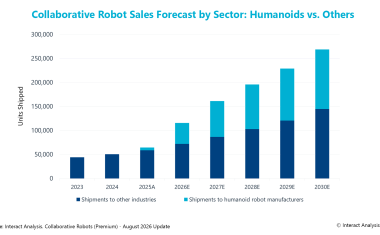
Humanoid robotics is driving demand for cobot arms and actuators
According to recent analyses, global production of humanoid robots exceeded the 20,000-unit mark in 2025 and is expected to more than triple in 2026.

Schaeffler bundles Defense and New Space activities under new CEO
Celia Pelaz takes over the position of CEO Defence & New Space at Schaeffler on October 1, 2026 and becomes Chairwoman of the Management Board of Stech Defence GmbH.

Siemens Consolidates Its Automation Business into a New Unit Called Automation
Rainer Brehm, who previously served as COO of the automation business and CTO of Digital Industries, was appointed president of the new unit.

IMTS 2026: America's Manufacturing Sector Focuses on Growth and Technology
The largest manufacturing trade show in the Western Hemisphere is bringing together 1,788 exhibitors this year, including about 400 companies participating for the first time.

European machine vision expects slight recovery and growth in 2026
According to the VDMA Machine Vision department, sales are expected to increase by around 3%, following a decline of 2% in 2025.