

Laser technology for the New Space economy
German government space coordinator pleads for Europe’s independence and know-how in orbit and beyond during Trumpf visit.
In November, the ESA council meeting at ministerial level in Paris approved a budget increase for the European Space Agency of 17 percent, an increase higher than ever before. The council is chaired by Germany for the next three years in the person of economics minister Robert Habeck. Two weeks later, Dr Anna Christmann, the German government’s coordinator for aerospace and commissioner for digital economy and start-ups, visited the high-tech company Trumpf in Ditzingen.
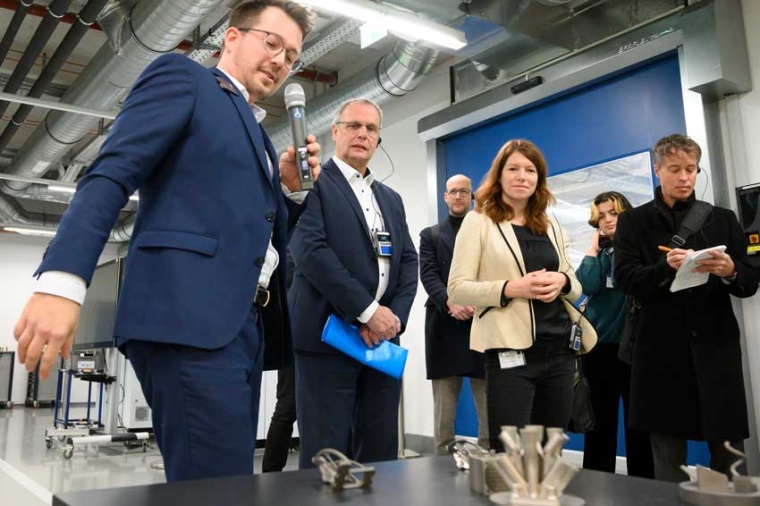

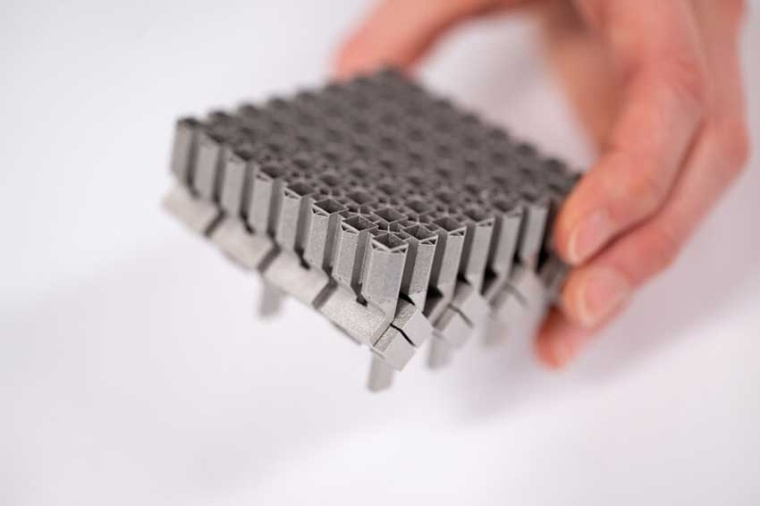
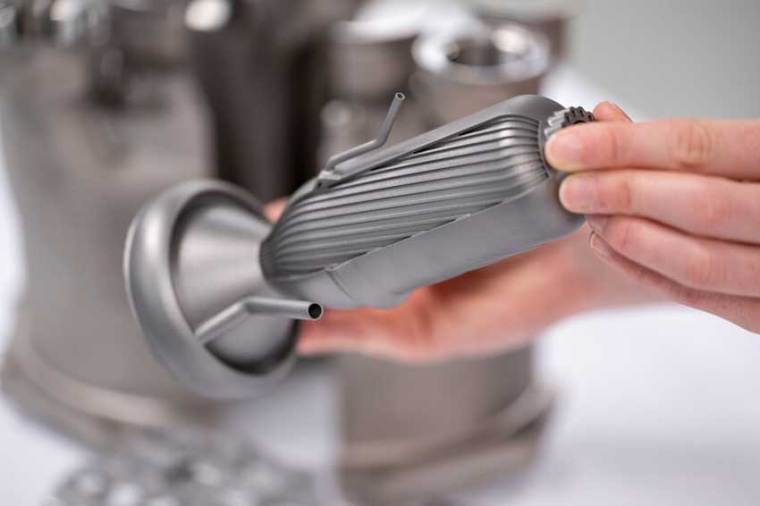
The Stuttgart member of the Bundestag explained focal points of European and German projects in the coming years and, for her part, learned about the contributions that laser technology is making. During a tour, Trumpf employees showed ongoing projects in the field of metallic 3D printing, such as a position control nozzle for a future lunar lander and a high-performance antenna in lightweight construction.
Dr Christian Schmitz, CEO of laser technology at Trumpf, explained other contributions of laser technology in aerospace. For example, aerospace companies use lasers to weld together propellant tank components made of special metal alloys so precisely that the rocket does what it is supposed to do, even under the extreme conditions of launch or flight through the atmosphere. The welding work on the rocket engine itself must also be precise and flawless. In future satellite constellations, VCSEL-based gyroscopes will ensure highly accurate pointing of each of the satellites in low Earth orbit to ensure fail-safe optical communications.
However, special attention is also being paid to ‘new space’ as an economic factor. For some years now, space travel has been commercialized, combined with an increasing interlocking with traditional industry. This development, known as new space, is the key to future technologies such as autonomous driving, digitally networked industry or a fast, global Internet. The increase in rocket launches and commercial satellites makes this possible. The interplay between new space and classic industry holds great potential and will continue to gain importance in view of the future challenges of our global economy, was also the assessment of Ilan Rozenkopf, expert for aerospace in Europe, McKinsey, Paris, to the participants.
For example, the private sector is providing the momentum for aerospace, albeit to the greatest extent so far in the United States. In 2021, private investors invested more than 10 billion dollars in space worldwide. That's a new record and a tenfold increase from ten years ago.
Already, around three-quarters of the 125 new space companies based in Germany have national and international customers from traditional industry, i.e. the non-space sector. So far, these include agriculture, logistics and transport, the insurance industry, the energy sector and the pharmaceutical industry with business models for forest and vegetation management, infrastructure monitoring and smart farming.
Company
TRUMPF SE + Co. KGJohann-Maus-Straße 2
71254 Ditzingen
Germany

most read

IMTS 2026: America's Manufacturing Sector Focuses on Growth and Technology
The largest manufacturing trade show in the Western Hemisphere is bringing together 1,788 exhibitors this year, including about 400 companies participating for the first time.

ZVEI Calls for Swift Protection of Critical Power Infrastructure
The association has issued a statement in response to the recent attempted attacks on substations in Brandenburg and North Rhine-Westphalia and warns of the consequences for Germany's energy security.
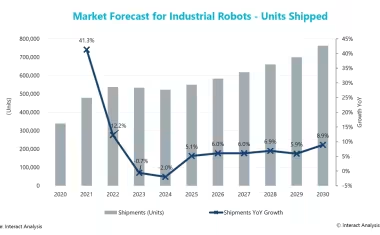
Forecast: Significant Growth in Industrial Robotics by 2030; Cobots Are Growing the Fastest
According to a recent analysis by Interact Analysis, global sales of industrial robots are expected to rise from about 550,000 units in 2025 to just over 760,000 units in 2030.

Solid-State Transformers for AI Data Centers
As part of a strategic partnership, Siemens and Reinhausen are developing a solid-state transformer for AI data centers with an 800-volt DC system.

European machine vision expects slight recovery and growth in 2026
According to the VDMA Machine Vision department, sales are expected to increase by around 3%, following a decline of 2% in 2025.