

Laser communication system achieves 1.2 Gb/s to and from ISS
Nasa’s first two-way, end-to-end laser relay system links at a rate of more than a gigabit per second – faster than most home internet speeds.
Recent transmissions from astronauts on the ground and aboard the International Space Station allowed Nasa’s Space Communications and Navigation SCaN program to showcase the power of laser communications while simultaneously testing out a new networking technique. This demonstration was inspired by “Taters the Cat” – an orange cat whose video was transmitted 19 million miles over laser links to the DSOC (Deep Space Optical Communications) payload on the Psyche asteroid mission. LCRD, DSOC, and Illuma-T are three of Nasa’s ongoing laser communications demonstrations to prove out the technology’s viability.
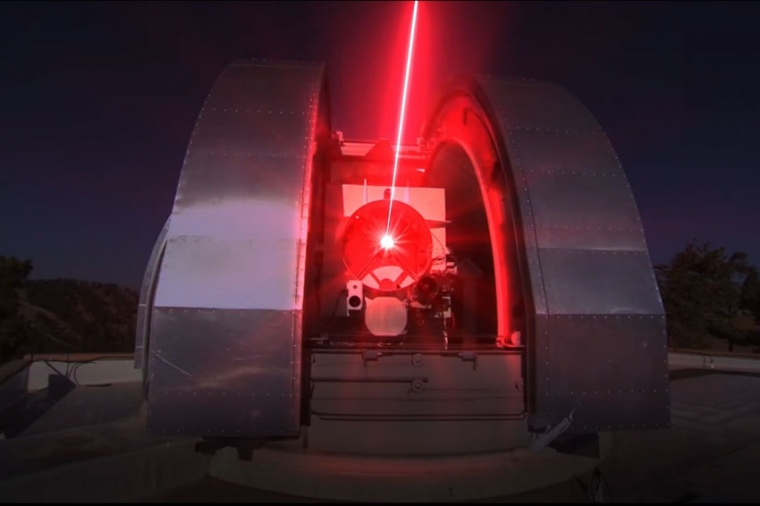
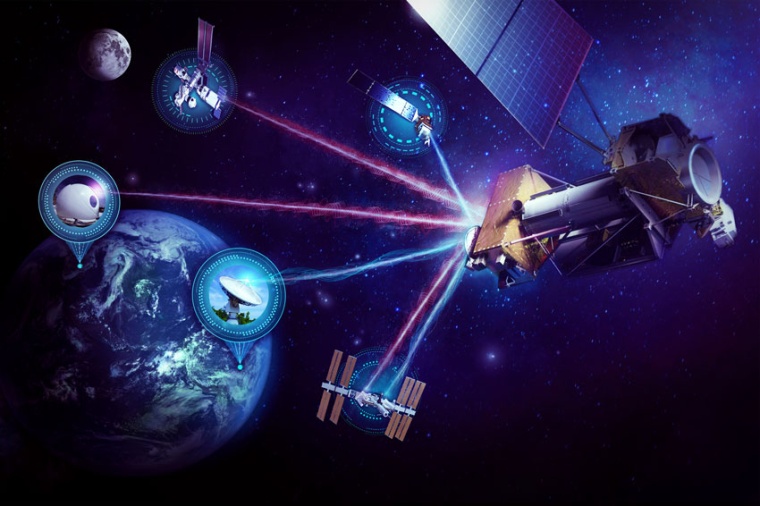
The images and videos started on a computer at a mission operations center in Las Cruces, New Mexico. From there, Nasa routed the data to optical ground stations in California and Hawaii. Teams modulated the data onto infrared lasers and sent the signals to Nasa’s LCRD (Laser Communications Relay Demonstration) satellite, located 22,000 miles above earth in geosynchronous orbit. LCRD then relayed the data to Illuma-T (Integrated LCRD Low Earth Orbit User Modem and Amplifier Terminal), a payload currently mounted on the outside of the space station.
This demonstration also allowed Nasa to test out another networking technique. When data is transmitted across thousands and even millions of miles in space, the delay and potential for disruption or data loss is significant. To overcome this, Nasa developed a suite of communications networking protocols called delay/disruption tolerant networking, or DTN. The “store-and-forward” process used by DTN allows data to be forwarded as it is received or stored for future transmission if signals become disrupted in space.
To enable DTN at higher data rates, a team at Nasa’s Glenn Research Center in Cleveland developed an advanced implementation, HDTN (high-rate delay tolerant networking). This networking technology acts as a high-speed path for moving data between spacecraft and across communication systems, enabling data transfer at a speed of up to four times faster than current DTN technology – allowing high-speed laser communication systems to utilize the “store-and-forward” capability of DTN.
The optimized implementation of DTN technology aims to enable a variety of communications services, from improving security through encryption and authentication to providing network routing of 4K high-definition multimedia and more. All of these capabilities are being tested on the space station with Illuma-T and LCRD in the wake of the Artemis campaign which prepares to establish a sustainable presence on and around the moon.



most read

Siemens Consolidates Its Automation Business into a New Unit Called Automation
Rainer Brehm, who previously served as COO of the automation business and CTO of Digital Industries, was appointed president of the new unit.

European machine vision expects slight recovery and growth in 2026
According to the VDMA Machine Vision department, sales are expected to increase by around 3%, following a decline of 2% in 2025.

Schaeffler bundles Defense and New Space activities under new CEO
Celia Pelaz takes over the position of CEO Defence & New Space at Schaeffler on October 1, 2026 and becomes Chairwoman of the Management Board of Stech Defence GmbH.

Forecast: Significant Growth in Industrial Robotics by 2030; Cobots Are Growing the Fastest
According to a recent analysis by Interact Analysis, global sales of industrial robots are expected to rise from about 550,000 units in 2025 to just over 760,000 units in 2030.

Humanoid robotics is driving demand for cobot arms and actuators
According to recent analyses, global production of humanoid robots exceeded the 20,000-unit mark in 2025 and is expected to more than triple in 2026.