Imaging at the tip of a needle
A new technique could revolutionize medical imaging procedures.
A team of physicists, led by David Phillips from the University of Exeter, have pioneered a new way in which to control light that has been scrambled by passage through a single hair-thin strand of optical fiber. These ultrathin fibers hold much promise for the next generation of medical endoscopes enabling high-resolution imaging deep inside the body at the tip of a needle.
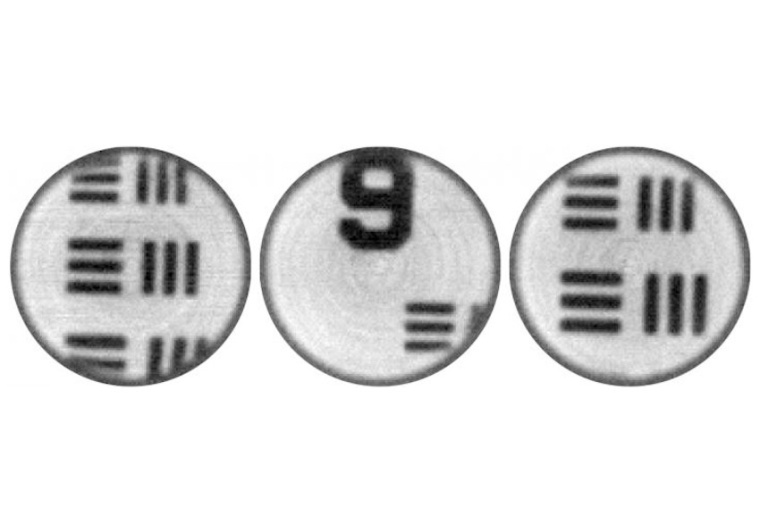
Conventional endoscopes are millimeters wide and have limited resolution – so cannot be used to inspect individual cells. Single optical fibers are approximately ten times narrower and can enable much higher-resolution imaging – enough to examine the features of individual cells directly inside living tissue. It is normally only possible to view cells once they have been taken outside the body and placed in a microscope. The catch is that we can't directly look through optical fibers, as they scramble the light sent through them. This problem can be solved by first calibrating an optical fiber to understand how it blurs images, and then using this calibration information as a key to decipher images from the scrambled light.
However, the measured key is very fragile, and easily changes if the fiber bends or twists, rendering deployment of this technology in real clinical settings currently very challenging. To overcome this problem, the Exeter based team have now developed a new way to keep track of how the image unscrambling key changes while the fiber is in use. This provides a way to maintain high resolution imaging even as a single fiber based micro-endoscope flexes. The researchers achieved this by borrowing a concept used in astronomy to see through atmospheric turbulence and applying it to look through optical fibers. The method relies on a guide-star which in their case is a small brightly fluorescing particle on the end of the fiber. Light from the guide-star encodes how the key changes when the fiber bends, thus ensuring imaging is not disrupted.
This is a key advance for the development of flexible ultra-thin endoscopes. Such imaging devices could be used to guide biopsy needles to the right place, and help identify diseased cells within the body. Phillips said: “We hope that our work brings the visualization of sub-cellular processes deep inside the body a step closer to reality and helps to translate this technology from the lab to the clinic.” The latest work is in collaboration with researchers at the Leibniz Institute of Photonic Technologies in Germany, and the Brno Insititute of Scientific Instruments in the Czech Republic. (Source: U. Exeter)
Link: Structured Light Group (D. Phillips), Physics and Astronomy, University of Exeter, Exeter, UK