

Canon and Stemmer Imaging partner to directly serve the machine vision industry
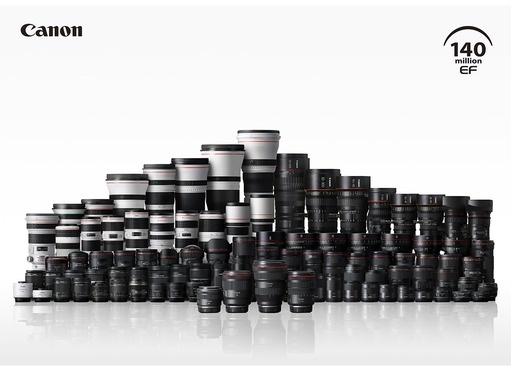

Stemmer Imaging has signed an agreement with Canon Europe for the distribution of the renowned Canon professional camera and large format lenses portfolio into the industrial imaging marketplace across Europe. This new partnership is focussed primarily at making it easier for the industrial market to take advantage of Canon’s high-performance EF format lenses. To achieve this Canon will share detailed technical lens data to Stemmer Imaging making it possible to apply its extensive technical expertise to provide fully engineered machine vision solutions containing Canon lenses.
For many years Canon has established a reputation for manufacturing high-quality lenses for both consumer and professional photographic use. These include an extensive range of large format long focal length telephoto lenses with direct motorised iris and focus where the focusing motor is mounted in the lens assembly itself. They require the use of Canon cameras with the specialised EF lens mount developed by Canon.
Traditionally, the majority of machine vision cameras feature comparatively small image sensors and utilise fittings for the smaller C-mount and CS-mount lenses, however at the high end, large format lenses have been used although limited to non-motorised applications with fixed focal lengths up to 100mm.
Mark Williamson, Marketing Director at Stemmer Imaging AG, explains: “More and more machine vision cameras are making use of large format, high-resolution CMOS sensors with larger pixels for high sensitivities, which need larger format lenses. In addition, many applications require lenses with very long focal lengths such as surveillance, sports, aerial photography, photography on theme park rides etc however need machine vision camera functionality.
For these, the cameras are not easily accessible, meaning that motorised focus and iris are essential requirements. Canon EF telephoto lenses with focal lengths from 135 mm to 300 mm fit perfectly into this gap in the market. Previously these lenses were only available via photography dealers without the optical design and lens interfacing knowledge. This agreement will allow customers needing this capability to be directly supported.”
Frank Winklmeier, Segment Business Development Manager for Industry at Canon Deutschland GmbH, said: “The opportunities for our lenses in a variety of machine vision markets has become increasingly apparent. However, it was very important that we partnered with a company that had a thorough understanding of and experience in a wide range of machine vision markets. We also needed to work with someone who could demonstrate technical excellence in all aspects of machine vision, including optics, and who operated throughout Europe. We are therefore delighted to enter into this agreement with Stemmer Imaging.”
Canon EF lenses are characterised by the highest standards of precision engineering and optical performance. Ring-type motor drives provide rapid autofocus adjustment and variable aperture versions give fine control over depth of field. Image stabilisation compensates for the vibrations often found in machine vision environments. Lens elements are designed to minimise aberrations, while specialised coatings ensure accurate colour balance and enhance contrast.
Stemmer Imaging can already offer a number of machine vision cameras equipped with the EF mount and the use of 3rd party EF mounts and adapters can allow EF lenses to be fitted to cameras that have other standard mounting configurations.

most read

ZVEI Calls for Swift Protection of Critical Power Infrastructure
The association has issued a statement in response to the recent attempted attacks on substations in Brandenburg and North Rhine-Westphalia and warns of the consequences for Germany's energy security.

IMTS 2026: America's Manufacturing Sector Focuses on Growth and Technology
The largest manufacturing trade show in the Western Hemisphere is bringing together 1,788 exhibitors this year, including about 400 companies participating for the first time.

Solid-State Transformers for AI Data Centers
As part of a strategic partnership, Siemens and Reinhausen are developing a solid-state transformer for AI data centers with an 800-volt DC system.

European machine vision expects slight recovery and growth in 2026
According to the VDMA Machine Vision department, sales are expected to increase by around 3%, following a decline of 2% in 2025.
Forecast: Significant Growth in Industrial Robotics by 2030; Cobots Are Growing the Fastest
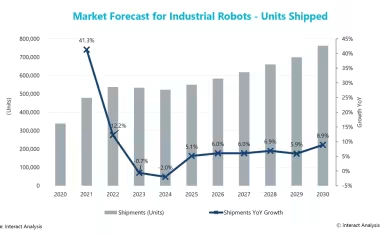
According to a recent analysis by Interact Analysis, global sales of industrial robots are expected to rise from about 550,000 units in 2025 to just over 760,000 units in 2030.