

Austria’s cluster of excellence for quantum sciences launched
Quantum Science Austria quantA brings together more than sixty research groups in Innsbruck, Vienna, Linz, and Klosterneuburg.
Building on the achievements of the past decades, scientists at the Universities of Innsbruck and Vienna, Vienna University of Technology, JKU Linz, the Institute of Quantum Optics and Quantum Information of the Austrian Academy of Sciences and the Institute of Science and Technology Austria (ISTA) are researching the quantum foundations of space, time and gravity, new paradigms of quantum information and the physics of engineered quantum many-body systems. “Together, we want to push the boundaries of knowledge and thus be a driving force for future innovations,” says director of research, Gregor Weihs. “The cluster of excellence offers us the opportunity to explore major questions in quantum research together and to exploit synergies between the working groups. Another important task will be training the future quantum generation. Austria is the best place for studies and research on the fundamentals of quantum physics.”
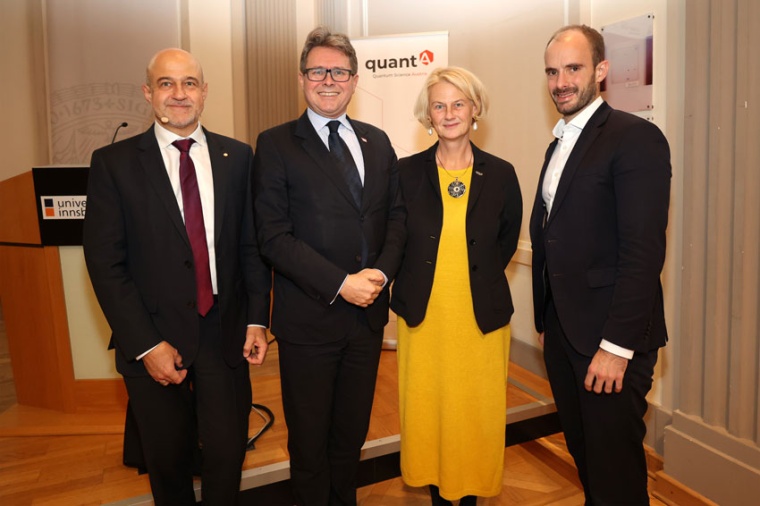
“The FWF Cluster of Excellence Quantum Science Austria underlines our commitment to excellence in research funding. Not least due to the cooperation of over sixty research groups, this research cluster will also become an international flagship for excellent Austrian research work in one of the key technologies of the future. However, knowledge must also be applied, which is why I welcome the anchoring of knowledge transfer as an important pillar of the clusters of excellence,” emphasizes Martin Polaschek, federal minister of education, science and research.
The project tracks funded as part of the cluster include collaborative and inter-institutional research projects in which the core questions of quantum science are researched through targeted collaboration and the joint use of equipment. This strengthens cooperation between the individual research groups throughout Austria in the long term. Twelve of these research projects were already launched in October. In total, around 35 quantum researchers, 12 postdocs and 25 PhD students are working on these first projects at all participating institutions. A second round is about to be announced.
In addition, a separate Austria-wide PhD program is planned with the aim of attracting the best minds and international talents to Austria and promoting them in a targeted manner. “The aim of this program is to be open to new things and to promote innovative research approaches by young scientists who have not yet been able to use any other funding scheme,” says Gregor Weihs. “Central aspects of quantA are also gender balance, the promotion of women and diversity as well as the involvement of the general public.”
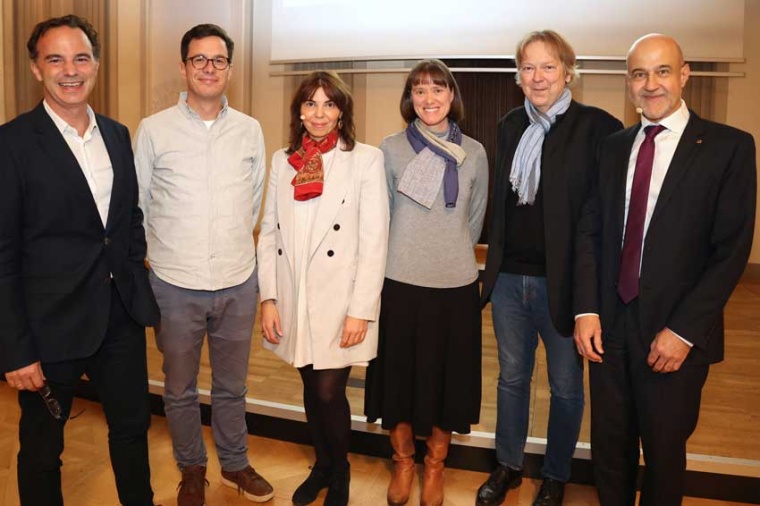
Together with research director Gregor Weihs from the University of Innsbruck, Markus Aspelmeyer (University of Vienna), Francesca Ferlaino (University of Innsbruck / ÖAW), Johannes Fink (ISTA), Tracy Northup (University of Innsbruck), Armando Rastelli (JKU Linz), Oriol Romero-Isart (University of Innsbruck / ÖAW) and Jörg Schmiedmayer (TU Vienna) form the board of the Quantum Science Austria Cluster of Excellence. A total of up to 70 million euros will be available to around 500 participating scientists over the next ten years.

most read

Solid-State Transformers for AI Data Centers
As part of a strategic partnership, Siemens and Reinhausen are developing a solid-state transformer for AI data centers with an 800-volt DC system.

European machine vision expects slight recovery and growth in 2026
According to the VDMA Machine Vision department, sales are expected to increase by around 3%, following a decline of 2% in 2025.
Siemens Consolidates Its Automation Business into a New Unit Called Automation
Rainer Brehm, who previously served as COO of the automation business and CTO of Digital Industries, was appointed president of the new unit.

IMTS 2026: America's Manufacturing Sector Focuses on Growth and Technology
The largest manufacturing trade show in the Western Hemisphere is bringing together 1,788 exhibitors this year, including about 400 companies participating for the first time.
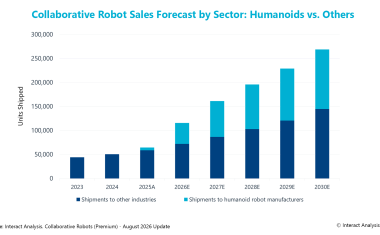
Humanoid robotics is driving demand for cobot arms and actuators
According to recent analyses, global production of humanoid robots exceeded the 20,000-unit mark in 2025 and is expected to more than triple in 2026.