

A keener eye for the invisible
A new type of detector for infrared radiation made from quantum dots.
Motion detectors, self-driving cars, chemical analyzers and satellites contain detectors for infrared (IR) light. At their core and besides readout electronics, such detectors usually consist of a crystalline semiconductor material. Such materials are challenging to manufacture: They often require extreme conditions, such as a very high temperature, and a lot of energy. Empa researchers in Switzerland are convinced that there is an easier way. A team led by Ivan Shorubalko from the Transport at the Nanoscale Interfaces laboratory is working on miniaturized IR detectors made of colloidal quantum dots.
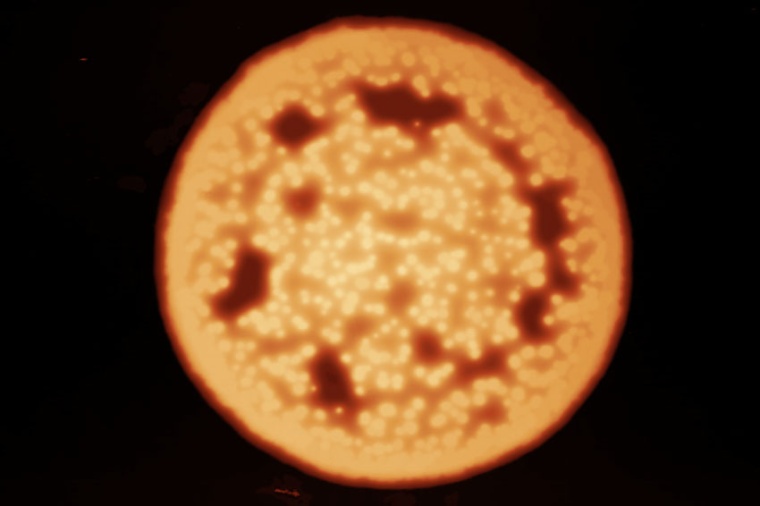
“The properties of a material depend not only on its chemical composition, but also on its dimensions,” Shorubalko says. If you produce tiny particles of a certain material, they may have different properties than larger pieces of the very same material. For the discovery and synthesis of these fascinating tiny particles, Moungi Bawendi, Louis E. Brus and Alexey Ekimov were awarded the Nobel Prize in Chemistry in 2023. But while the science behind quantum dots is complex, the simplicity instead lies in their processing. Colloidal quantum dots come in a solution and can be applied to different materials by means of spin coating or printing – cheaper, more energy-efficient and more flexible than conventional semiconductors.
Quantum dots already have a history at Empa. Maksym Kovalenko's research group in the Thin Films and Photovoltaics laboratory has been working on the synthesis of quantum dots from various materials for over ten years. Shorubalko and his team then integrate the quantum dots to produce functioning electronic components – for instance IR detectors. Together with other experts, they are also researching processing methods and further applications for the quantum dots and the devices made from them.
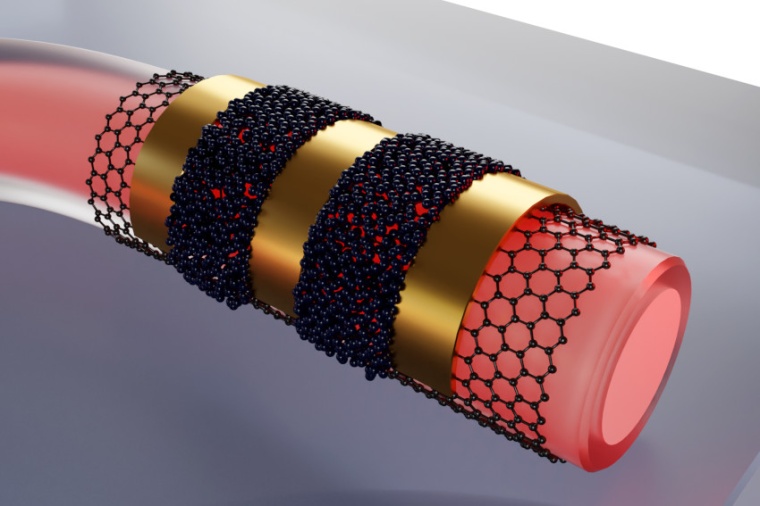
One example: In 2023, the researchers succeeded in printing an IR detector made of quantum dots onto an optical polymer fiber – something that is not possible with conventional IR detectors. To achieve this, device specialist Shorubalko and his doctoral student Gökhan Kara worked not only with materials expert Kovalenko, but also with Yaroslav Romanyuk, an expert in printing from Empa's Thin Films and Photovoltaics laboratory, and with fiber specialist René Rossi from the Biomimetic Membranes and Textiles laboratory. One possible application of this technology would be smart textiles.
“The global textile market is bigger and faster-growing than the consumer electronics market,” says Shorubalko. Specialized textiles in particular could benefit from the flexible IR detectors, for example functional clothing for firefighters or medical textiles for patient monitoring. However, Shorubalko also sees great potential in fashion: “If detectors and other electronic components are small, inexpensive and easy to manufacture, we can use them to functionalize our everyday clothing. Current technologies are simply not compatible with textiles.”
ince each detector consists of numerous quantum dots only five nanometers in size, it is possible to manufacture very small IR detectors. Kara and their peers at Empa and ETH Zurich made a detector that is smaller than the wavelength of the light it measures. This enables the researchers to record additional properties of infrared light, such as phase or interference, which makes the detector even more versatile. Next, Shorubalko aims to improve the speed of the detector. Fast IR detectors are needed, for example, for lidar, the light-based distance detection technology that helps self-driving cars to find their way, among other things.
“Today, lidars use silicon-based infrared detectors, which measure IR light with a wavelength of around 905 nanometers,” says the researcher. The problem: Although this wavelength is invisible to the human eye, it is still harmful at high power. For this reason, the lidar's laser can only emit weak light, which limits the range of the entire system, however. Detectors for longer, safer wavelengths do exist, but they are too expensive to be used on a large scale. A fast detector based on quantum dots could provide an alternative and enable powerful, safe and cost-effective lidar systems.
So when will quantum dot-based IR detectors come onto the market? Unlike most novel technologies and materials, patience is not required in this case. “Quantum dot IR detectors are already available on the market” says Shorubalko. “I've never seen a technology make the leap from the lab to the market so quickly.” Nevertheless, the researchers' work is far from over. Their task now is to make this promising technology even faster, cost-effective, more flexible and more sustainable. (Source: Empa)
Link: Transport at Nanoscale Interfaces Laboratory, Empa, Dübendorf, Switzerland


most read

IMTS 2026: America's Manufacturing Sector Focuses on Growth and Technology
The largest manufacturing trade show in the Western Hemisphere is bringing together 1,788 exhibitors this year, including about 400 companies participating for the first time.

Solid-State Transformers for AI Data Centers
As part of a strategic partnership, Siemens and Reinhausen are developing a solid-state transformer for AI data centers with an 800-volt DC system.

Humanoid robotics is driving demand for cobot arms and actuators
According to recent analyses, global production of humanoid robots exceeded the 20,000-unit mark in 2025 and is expected to more than triple in 2026.

Forecast: Significant Growth in Industrial Robotics by 2030; Cobots Are Growing the Fastest
According to a recent analysis by Interact Analysis, global sales of industrial robots are expected to rise from about 550,000 units in 2025 to just over 760,000 units in 2030.

ZVEI Calls for Swift Protection of Critical Power Infrastructure
The association has issued a statement in response to the recent attempted attacks on substations in Brandenburg and North Rhine-Westphalia and warns of the consequences for Germany's energy security.