The Heart of LiDAR Technology: Photosensors
Einstein’s photoelectric effect underpins ToF LiDAR, enabling photon detection for imaging, automation, and sensing
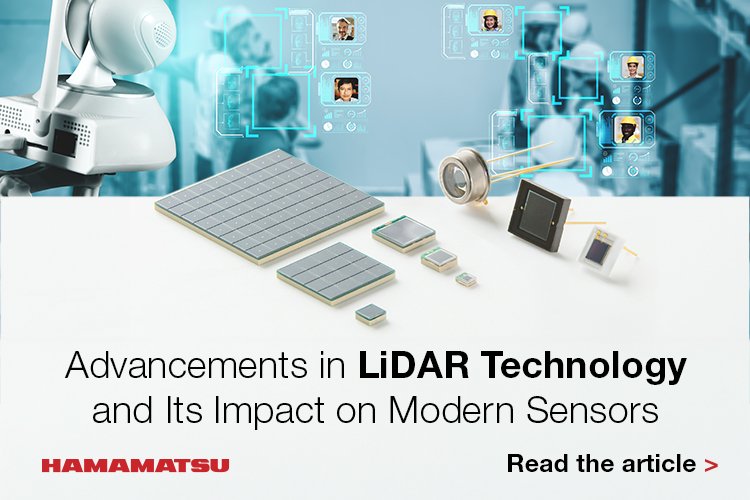
Harnessing Einstein’s Photoelectric Effect: Advancements in LiDAR Technology and Its Impact on Modern Sensors
Albert Einstein’s legacy goes beyond relativity and E = mc². His Nobel Prize was awarded for explaining the photoelectric effect, a discovery that underpins many modern technologies, including digital cameras, facial recognition, and LiDAR-based automation.
Understanding the Photoelectric Effect
Einstein showed that light consists of discrete packets called photons. When light of sufficient frequency hits a metal surface, it releases electrons. This proved the particle nature of light and laid the foundation for converting light into electrical signals, critical for imaging and sensing technologies.
Applications in Imaging and Automation
The photoelectric effect is widely used in digital cameras and facial recognition systems, enabling real-time image capture and interpretation. It also supports automation systems, such as touchless doors and robotic obstacle detection.
A key implementation is LiDAR (Light Detection and Ranging), particularly using the Time-of-Flight (ToF) method. LiDAR measures object distance by emitting light and timing how long it takes to reflect back from objects like pedestrians or vehicles.
LiDAR System Components
Light Sources
LiDAR systems commonly use Pulse Laser Diodes (PLDs) due to their high peak power and efficiency. Key selection factors include power, efficiency, and beam uniformity. Variants include integrated modules (µ-HPL) and specialized designs for industrial and safety applications.
Photosensors
Photosensors convert light into electrical signals and vary depending on range and sensitivity needs:
- PIN Photodiodes (PIN PD): Simple, high efficiency, ideal for short-range detection.
- Avalanche Photodiodes (APD): Provide gain for longer distances and low-light conditions.
- MPPC / SiPM (SPAD arrays): Detect single photons with very high sensitivity and low noise.
SPAD and MPPC Operation
SPADs operate in Geiger mode, using high reverse bias to achieve extreme gain. A quenching resistor limits current so the sensor can detect repeated photons. Aggregating multiple SPADs forms an MPPC, which outputs summed signals for improved detection in low-light or multi-photon scenarios.
Advanced Sensor Solutions
Modern LiDAR systems rely on improved sensors such as gain-stabilized APDs, which include temperature compensation to maintain consistent performance without external adjustments. New SiPM designs also operate at lower voltages and perform well in high ambient light.
Industry Impact
Advances in photoelectric-based technologies, especially APD and SiPM sensors, are driving progress in automotive, industrial, and safety applications. LiDAR systems are becoming more accurate, efficient, and adaptable, supporting automation and intelligent systems that integrate seamlessly into everyday life.