

Reducing energy consumption in electrode production
IDEEL project to manufacture laser-dried anodes and LFP cathodes first time in a roll-to-roll process.
The IDEEL research project aims to introduce a laser drying process as a more climate-friendly and economical method for the volume production of lithium-ion batteries. Within this context, it has now been possible to produce laser-dried anodes and LFP cathodes in a roll-to-roll process for the first time. The innovative manufacturing process significantly reduces energy consumption in electrode production and at the same time enables the drying speed to be doubled.
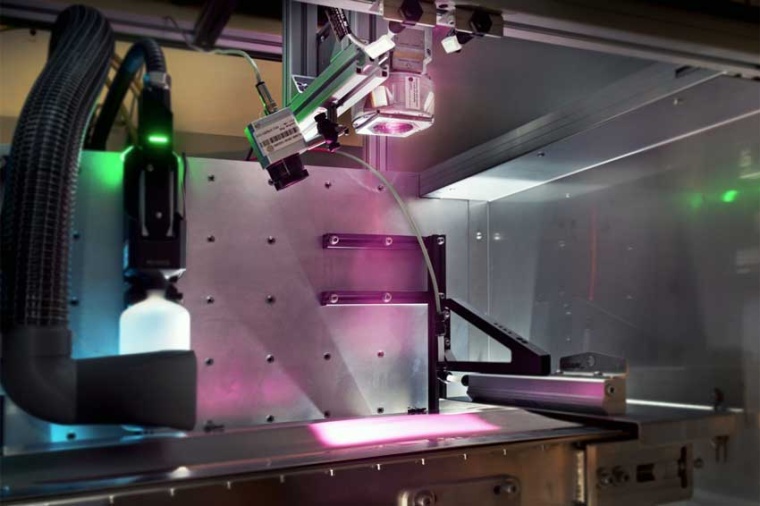
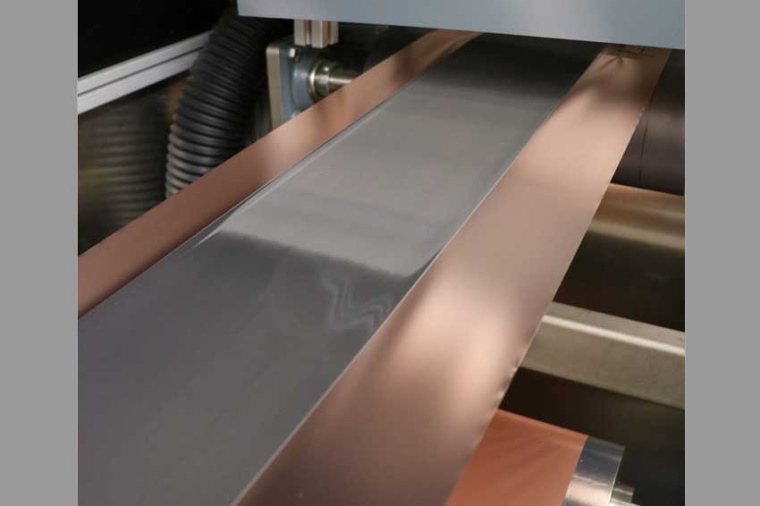
As part of the research project Implementation of Laser Drying Processes for Economical & Ecological Lithium-Ion Battery Production – IDEEL – led by Laserline , the production of laser-dried anodes and LFP cathodes in a roll-to-roll process has been achieved for the first time. Based on industry-relevant electrode pastes, the PEM (Production Engineering of E-Mobility Components of the RWTH Aachen University) was able to demonstrate processability of aqueous LFP cathodes and anodes at the prototype facility at the eLab (also of the RWTH).
In cooperation with the Münster Electrochemical Energy Technology (MEET) battery research center, the qualitative properties were evaluated, and optimized electrode pastes then developed. For proof-of-concept, a Laserline high-power diode laser with zoom optics was integrated into the existing film deposition system, resulting in generation of a homogeneous laser spot for drying the active material. The temperature distribution across the electrode was monitored using a Optris thermographic camera. The tests were carried out at a web speed of 1.3 m/min, and both pure laser drying and hybrid drying with both laser and a downstream convection oven were successfully demonstrated.
Initial results indicate that for pure laser drying, the new manufacturing process reduces energy consumption in electrode production by up to 85 percent. Through the addition of the laser, the hybrid process also yielded a doubling of the drying speed when compared to convection drying only. Taken together, battery production can thus be made more cost-effective and efficient.
Comparative benchmarking of the qualitative properties (residual moisture of the active material, adhesion of the coating to the carrier film) of convection-dried versus laser-dried electrodes support the indicated gain in productivity. The project results to date demonstrate that a hybrid process approach is achievable not only for new production systems, but also by retrofitting existing convection oven systems with complementary laser drying technology.
Over the course of the remaining project duration, it is planned to scale up the web speed to 10 m/min (Fraunhofer ILT) and ultimately to 30 m/min (Coatema Coating Machinery). To this end, Laserline is currently developing optics for generating a large-area laser spot. Initial research results also indicate that a reduction of the system size by a factor of 10 will be possible in the future.
Company
Fraunhofer Institute for Laser Technology ILTSteinbachstr. 15
52074 Aachen
Germany


most read

European machine vision expects slight recovery and growth in 2026
According to the VDMA Machine Vision department, sales are expected to increase by around 3%, following a decline of 2% in 2025.
Vision 2026 Breaks Exhibitor Record
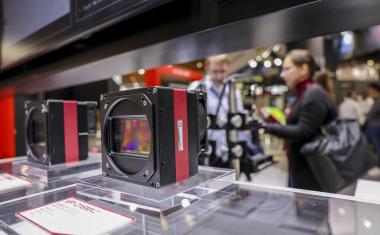
About 500 exhibiting companies—about two-thirds of which are from abroad and about 30 percent of which are first-time exhibitors—are showcasing their products at the trade show.
Forecast: Significant Growth in Industrial Robotics by 2030; Cobots Are Growing the Fastest
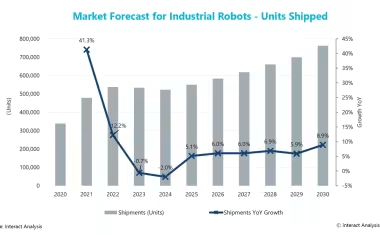
According to a recent analysis by Interact Analysis, global sales of industrial robots are expected to rise from about 550,000 units in 2025 to just over 760,000 units in 2030.

ZVEI Calls for Swift Protection of Critical Power Infrastructure
The association has issued a statement in response to the recent attempted attacks on substations in Brandenburg and North Rhine-Westphalia and warns of the consequences for Germany's energy security.
Schaeffler bundles Defense and New Space activities under new CEO
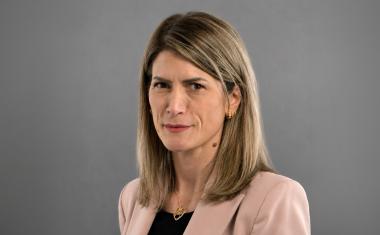
Celia Pelaz takes over the position of CEO Defence & New Space at Schaeffler on October 1, 2026 and becomes Chairwoman of the Management Board of Stech Defence GmbH.