

Quantum Brilliance to lead $22.5M project
Supported by German government, ‘DE-Brill’ features collaboration with Fraunhofer IAF and the University Ulm to lay foundation for ubiquitous quantum computing.
Quantum Brilliance, a German-Australian manufacturer of innovative quantum computing hardware, has launched a joint research project with the Fraunhofer Institute for Applied Solid State Physics IAF and the University of Ulm to develop new techniques for the fabrication and control of diamond-based quantum microprocessors.
The goal of the 19.9 million euro (22.5 million US dollar) ‘Deutsche Brilliance’ (DE-Brill) collaboration is to solve two key challenges surrounding diamond-based quantum computers by 2025: the development of atomically precise techniques for the fabrication of quantum microprocessors and to find new methods for selective initialization, read-out, and manipulation of qubits in quantum computers with multiple processor nodes. The research teams believe solving these challenges will serve as important milestones on the path to the mass commercialization of quantum computing technology. The project is 74.8 percent funded by the German Federal Ministry of Education and Research (BMBF).
As part of the collaboration, Fraunhofer IAF and Quantum Brilliance are jointly developing precision manufacturing techniques for the fabrication of scalable arrays of diamond qubits. In addition, the IAF will work on growth processes for diamond substrates of the highest purity and quality. The Quantum Brilliance team has been provided exclusive use of the IAF facility in Freiburg, Germany, to ensure productive and accelerated research outcomes. In parallel, a team at the Institute of Quantum Optics at the University of Ulm is developing scalable readout and control techniques for diamond-based qubits, allowing them to be precisely controlled.
The research project will play an important role in securing Germany as a key business center for quantum computing as well as give Quantum Brilliance a strong, sustainable position in the industry’s emerging global market, according to Dr Mark Mattingley-Scott, European head of Quantum Brilliance.
“With its research infrastructure and engineering knowledge base, Germany offers a unique framework for developing and producing quantum technology,” said Mattingley-Scott. “In addition, the German government also understands the importance of the field and consistently promotes important basic research. That’s why we recently opened our European headquarters in Stuttgart and are focusing on collaborations with the research institutions here to be at the forefront in commercializing high-performance quantum microprocessors in the future.”
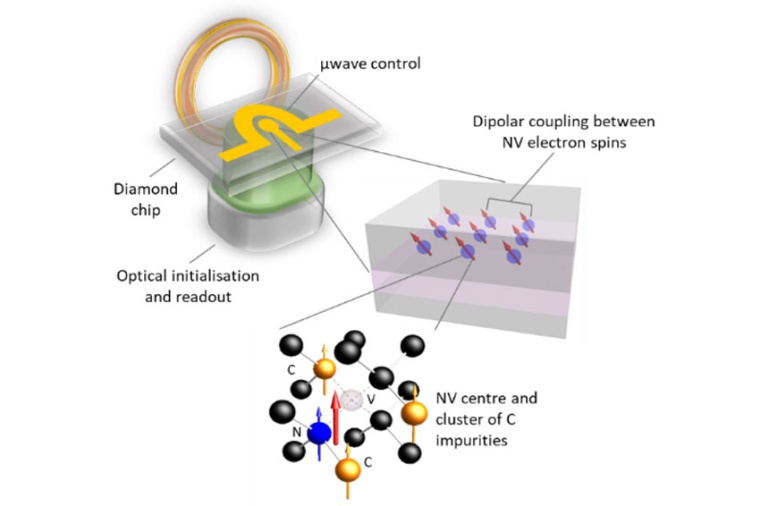
Quantum Brilliance is among the pioneers in using synthetically created diamonds in quantum computing. Targeted ‘impurities’ in diamonds – so-called NV centers in which a nitrogen atom takes the place of a carbon atom in the crystal lattice – are used in this process to generate qubits, the elementary computational units of a quantum computer.
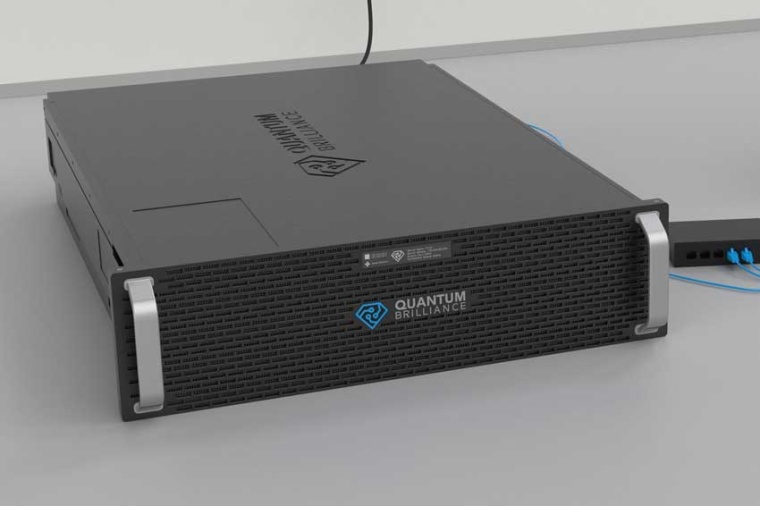
In contrast to large quantum computing mainframes which require energy-intensive cooling, quantum ‘accelerators’ based on synthetic diamonds can be produced in small form factors and operate at room temperature, enabling their use in a variety of real-world environments. A 19-inch server rack module of its diamond-based quantum accelerator is available. Continuing miniaturization with a corresponding increase in the number of qubits is planned over the next several years.
Also of interest: Quantum diamond biomarker detection – targeting simpler, faster and ultrasensitive medical diagnostics; (Element Six, QDTI), PhotonicsViews 19(1), February/March 2022
Company
Fraunhofer Institute for Applied Solid State Physics IAFTullastraße 72
79108 Freiburg
Germany



most read

Solid-State Transformers for AI Data Centers
As part of a strategic partnership, Siemens and Reinhausen are developing a solid-state transformer for AI data centers with an 800-volt DC system.

Siemens Consolidates Its Automation Business into a New Unit Called Automation
Rainer Brehm, who previously served as COO of the automation business and CTO of Digital Industries, was appointed president of the new unit.
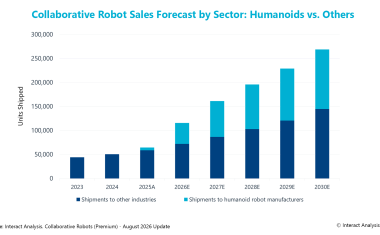
Humanoid robotics is driving demand for cobot arms and actuators
According to recent analyses, global production of humanoid robots exceeded the 20,000-unit mark in 2025 and is expected to more than triple in 2026.

IMTS 2026: America's Manufacturing Sector Focuses on Growth and Technology
The largest manufacturing trade show in the Western Hemisphere is bringing together 1,788 exhibitors this year, including about 400 companies participating for the first time.

Schaeffler bundles Defense and New Space activities under new CEO
Celia Pelaz takes over the position of CEO Defence & New Space at Schaeffler on October 1, 2026 and becomes Chairwoman of the Management Board of Stech Defence GmbH.