

Next-gen photonic scanner-detector chip unveiled
The new samples will be available from Scantinel for customers in Q4 2024.
Light detection and ranging sensor technology specialist Scantinel Photonics reinforces its position in the high integration of photonic integrated circuits (PICs) field with the introduction of its next generation photonic single chip based on standard CMOS technology.


The next-generation PIC feature a fully integrated, massively parallel detector system for coherent lidar. The recently fabricated photonic chip, which includes both a scanner and detector system on a single chip, was successfully tested at Scantinel. It demonstrated a significant per-pixel improvement in signal-to-noise ratio of about 20 dB compared to previous solid-state lidar scanners.
This scanner-detector chip is a fully integrated, automotive-ready device that serves for automotive lidar Samples. The Sample includes a photonic chip and a low-noise electronics board. Due to the SNR (signal-to-noise ratio) improvements, the system has achieved a tenfold reduction in lidar power consumption, paving the way for faster pixel rates. Compared to market systems using proprietary technology or two-mirror scanners, this generation features a solid-state scanning and fully leverages the advantages of FMCW technology over existing time-of-flight (TOF) lidar systems.
The PIC production is fully transferred to high-volume standard CMOS fabrication, indicating the advanced maturity of the technology being developed.
“We believe in the efficient integration of proven technology building blocks using CMOS fabrication in combination with hybrid-packaging processes to enable highly reliable single-chip photonic lidar sensors for the automotive market. Additionally, Scantinel’s integrated FMCW laser technology showcases a 10 kHz linewidth and 10 dBm in-waveguide power, which are critical parameters for an integrated optical amplification system,” explained Vladimir Davydenko, chief scientist and co-founder of Scantinel.
Company
Scantinel Photonics GmbHSöflinger Str. 100
89077 Ulm
Germany


most read

Solid-State Transformers for AI Data Centers
As part of a strategic partnership, Siemens and Reinhausen are developing a solid-state transformer for AI data centers with an 800-volt DC system.

The photonics industry is growing significantly again: New orders rise by 17 percent
The German photonics industry saw significant growth in the first half of 2026. Semiconductors, defense, aviation, and quantum technologies are the main drivers of this growth.

Siemens Consolidates Its Automation Business into a New Unit Called Automation
Rainer Brehm, who previously served as COO of the automation business and CTO of Digital Industries, was appointed president of the new unit.

IMTS 2026: AI, Automation, and Investment Are Driving the Next Phase of Growth in Manufacturing
IMTS 2026 drew more than 91,000 visitors. AI, robotics, and automation were the hallmarks of the trade show and reflect the transformation of U.S. manufacturing.
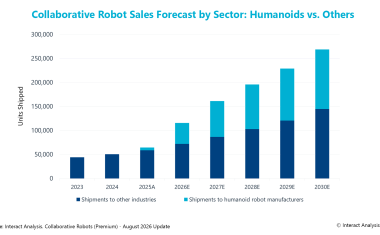
Humanoid robotics is driving demand for cobot arms and actuators
According to recent analyses, global production of humanoid robots exceeded the 20,000-unit mark in 2025 and is expected to more than triple in 2026.