Micromirror arrays for smart windows
Light modulation via optical microshutter and micromirror arrays could provide huge energy savings.
Buildings are responsible for 40 percent of primary energy consumption and 36 percent of total carbon dioxide emissions. Substituting the inefficient glazing areas of buildings with energy efficient smart glazing windows has great potential to decrease energy consumption for lighting and temperature control. Harmut Hillmer et al. of the University of Kassel in Germany demonstrate that potential in special micromirror arrays in smart windows for daylight steering.
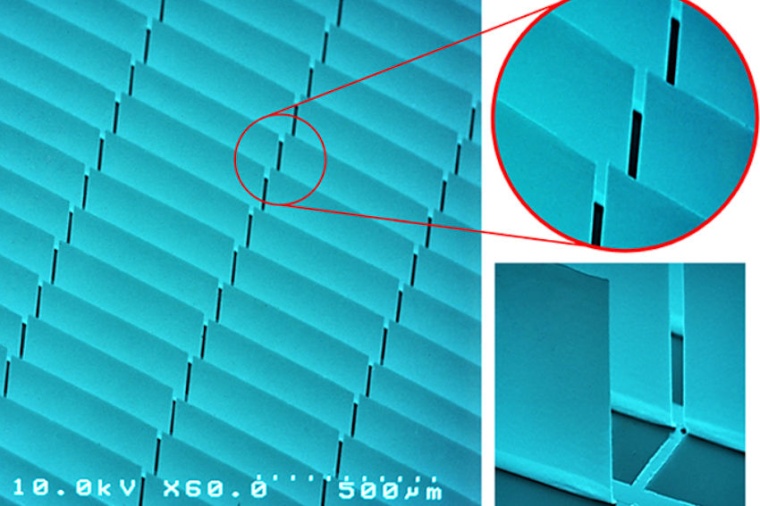
“Our smart glazing is based on millions of micromirrors, invisible to the bare eye, and reflects incoming sunlight according to user actions, sun positions, daytime, and seasons, providing a personalized light steering inside the building,” Hillmer said. The micromirror array is invulnerable to wind, window cleaning, or any weather conditions because it is located in the space between the windowpanes filled with noble gas such as argon or krypton. The glazing provides free solar heat in winter and overheating prevention in summer, and it enables healthy natural daylight, huge energy savings (up to 35 percent), massive carbon dioxide reduction (up to 30 percent), and a reduction of 10 percent steel and concrete in high-rise buildings.
Apart from the energy problem, artificial lighting also has consequences for health and well-being. Various studies have linked artificial lighting to lack of concentration, high susceptibility to illness, disturbed biorhythms, and sleeplessness. Smart glass can reduce reliance on artificial lighting by optimizing natural daylight in a room. Current state-of-the-art smart glazings are currently optimized either for winter or for summer-and not able to ensure energy-saving performance year-round. There has been a need for a smart and automatic technology that can react to local climate (daytime, season), uses available sunlight, regulates light and temperature, and saves substantial energy.
The researchers´ MEMS micromirror arrays are integrated inside insulation glazing and are operated by an electronic control system. The orientation of mirrors is controlled by the voltage between respective electrodes. Motion sensors in the room detect the number, position, and movement of users in the room. The results include much higher actuation speed in the sub-ms range, 40-times lower power consumption than electrochromic or liquid crystal concepts, reflection instead of absorption, and color neutrality. Rapid aging tests of the micromirror structure were performed to study reliability and revealed sustainability, robustness, and long lifetimes of the micromirror arrays. And with positive results like that, the benefits of this smart glass are crystal clear. (Source: SPIE)