Growth of the U.S. Robotics Industry and New National Robotics Strategies
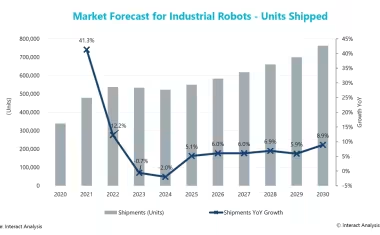
The U.S. market for industrial robots grew by 11 percent in 2025: According to preliminary figures from the International Federation of Robotics, approximately 38,000 units were newly installed
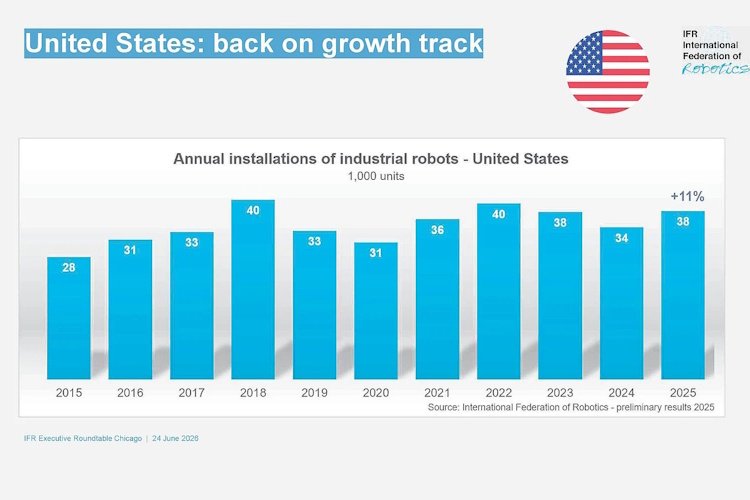
The main drivers are the food industry and other non-manufacturing sectors. The automotive industry remains the largest customer, with 13,500 installations, a figure only slightly below the previous year’s level.
The robot density in U.S. industry stands at 307 units per 10,000 employees. This places the U.S. eighth globally, behind countries such as South Korea, Germany, and Japan, but ahead of China. China, however, dominates the global market: in 2024, 295,000 industrial robots were installed there, accounting for a 54 percent share. This is based on a national robotics strategy that has been in place for about ten years and is being further expanded in the current five-year plan.
In North America, the industry association A3 is driving a national robotics strategy for the U.S. Plans include a federal office for robotics, a national coordination commission, tax incentives, training programs, and greater support for domestic robotics technology. The IFR expects a continuing trend toward modernization in North America, driven by the reshoring of production and a shortage of skilled workers.