

Manufacturing is more sustainable with green lasers
A collaboration between Trumpf, Fraunhofer ILT and DESY provides the most detailed of insights into laser welding processes to date thanks to a particle accelerator.
Lots of raw materials can be saved in the welding of high-performance electronics. This is the result of an investigation at the German Electron Synchrotron DESY of the Helmholtz Association in Hamburg. High-performance electronics are in every electric car and, as a key technology, ensure the best performance of the battery and motor. The Hamburg researchers, together with the high-tech company Trumpf and the Fraunhofer Institute for Laser Technology ILT, have now investigated the laser welding processes that are used in the manufacture of e-cars.
Trumpf, Fraunhofer ILT, DESY and the Helmholtz Center Hereon each contributed their highly specialized knowledge of x-rays, laser sources and welding processes. As a result, insights that remain invisible to the eye and even to microscopes have now been achieved for the first time. The result: When a laser with green wavelength is used, far fewer rejects are produced than with other laser welding processes. Car manufacturers save raw materials and thus contribute to more sustainable manufacturing.
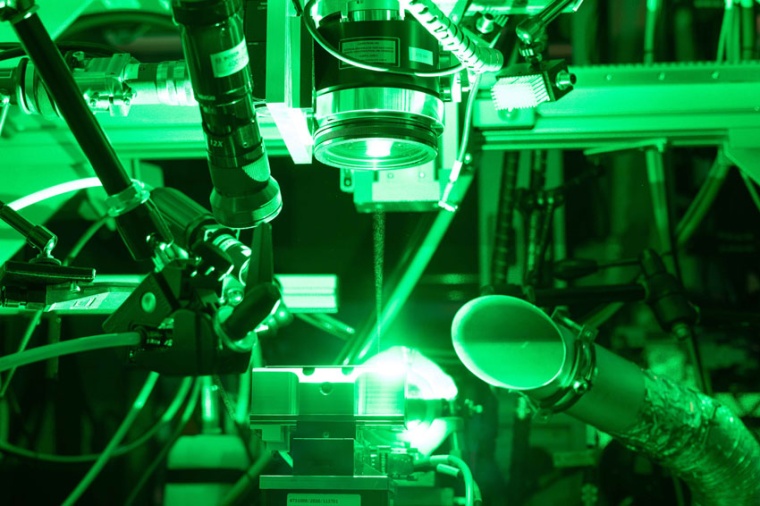
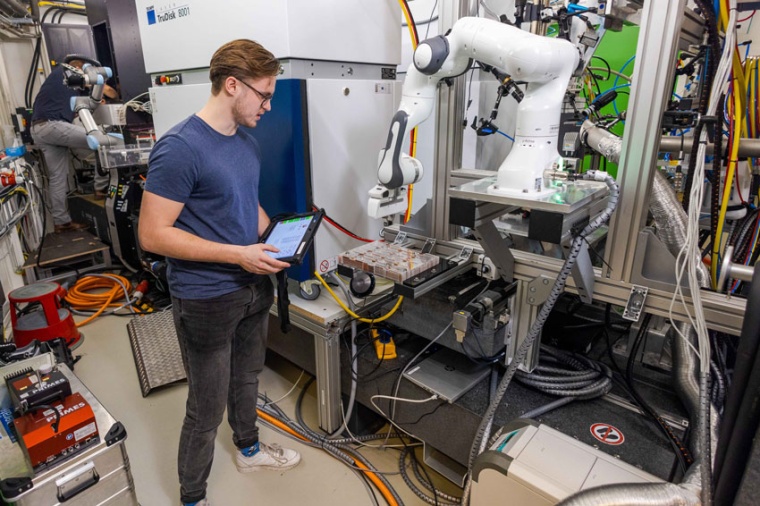
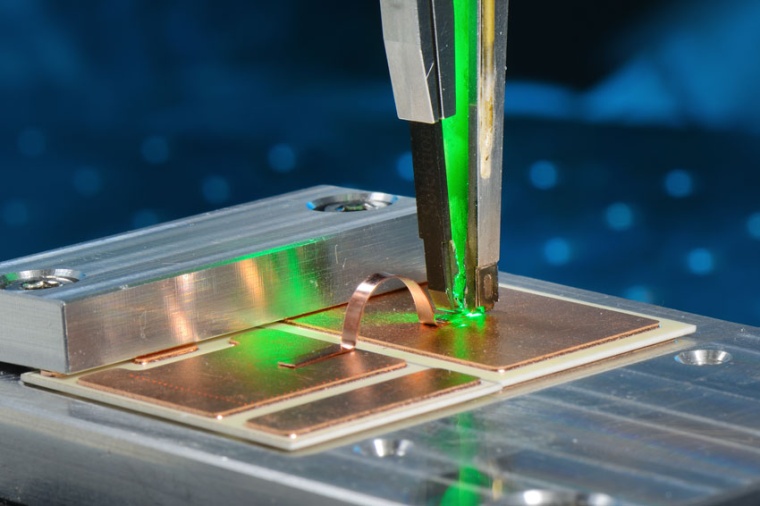
The project partners used the brilliant X-rays of the particle accelerator at the Hereon experimental setup for their investigation to take high-speed images at several thousand to ten thousand frames per second. “We wanted to use the investigations at the particle accelerator to find out exactly what makes the difference in copper welding. A stable welding process is important because manufacturers of electric vehicles have to weld several billion connections of the highest quality,” says Marc Hummel, a scientist at Fraunhofer ILT. In the future, Trumpf and the Fraunhofer ILT plan to expand research to other areas such as 3D printing, laser cutting and laser drilling with ultrashort pulse lasers, and to bring other industry partners on board.
Electromobility poses major challenges for laser technology. Copper is the most important material for the manufacturing of core e-mobility components. This non-ferrous metal absorbs only about five percent of laser radiation in the near-infrared range (NIR) and conducts heat very well. Both of these properties lead to considerable problems when welding. The processes are therefore under scrutiny. In addition to NIR lasers, Trumpf also has lasers with green wavelength in its product range. “Lasers with green wavelength are the solution to this problem. In fact, copper can be welded better with these lasers,” said Mauritz Möller, Automotive Industry Manager at Trumpf. Copper absorbs the green wavelength much better than the infrared. Because the material thus reaches its melting temperature more quickly, the welding process also starts faster and less laser power is required. “More stable processes when welding mean fewer rejects and thus greater sustainability, which is a major issue in e-mobility,” said Mauritz Möller.
To study welding processes in detail, experts from the Fraunhofer ILT, in collaboration with the chair of laser technology at RWTH Aachen University, use the PETRA III X-ray light source on the experimental setup at the Helmholtz Center Hereon. “Conventional methods actually only see the electromagnetic emissions from the plasma. With DESY’s radiation, we can not only look inside the melt, but we can even make the melt dynamics visible,” explained Marc Hummel.
To do this, a team from Fraunhofer ILT and Trumpf studied laser welding processes at DESY using two different laser systems: an NIR laser and a laser with green wavelength. “For us, this is a great opportunity to study welding processes on industrial parts. For example, how do spatters and pores form, and how does the heat from the welding process affect sensitive components such as electronic parts,” said Möller.
Company
Fraunhofer Institute for Laser Technology ILTSteinbachstr. 15
52074 Aachen
Germany


most read
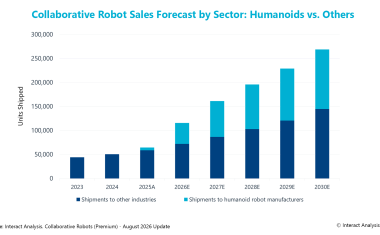
Humanoid robotics is driving demand for cobot arms and actuators
According to recent analyses, global production of humanoid robots exceeded the 20,000-unit mark in 2025 and is expected to more than triple in 2026.
Vision 2026 Breaks Exhibitor Record
About 500 exhibiting companies—about two-thirds of which are from abroad and about 30 percent of which are first-time exhibitors—are showcasing their products at the trade show.
Solid-State Transformers for AI Data Centers
As part of a strategic partnership, Siemens and Reinhausen are developing a solid-state transformer for AI data centers with an 800-volt DC system.

European machine vision expects slight recovery and growth in 2026
According to the VDMA Machine Vision department, sales are expected to increase by around 3%, following a decline of 2% in 2025.

Schaeffler bundles Defense and New Space activities under new CEO
Celia Pelaz takes over the position of CEO Defence & New Space at Schaeffler on October 1, 2026 and becomes Chairwoman of the Management Board of Stech Defence GmbH.