

First node for the quantum internet of the future
Just in time for the start of Unesco’s International Year of Quantum Science and Technology 2025, North Rhine-Westphalia is setting up its first node.
An international team led by QuTech in Delft, the Netherlands, is driving forward the development of so-called metropolitan-scale quantum networks in order to provide users from industry and science with access to powerful computers, to be able to connect different quantum computer platforms with one another or to make entangled qubits usable for the secure encryption of sensitive data. A team from the Fraunhofer Institute for Laser Technology ILT brought the system developed at TNO in Delft, the Netherlands, to Aachen in mid-January to test and further develop it and establish the first regional connections in the direction of Jülich and Bonn.
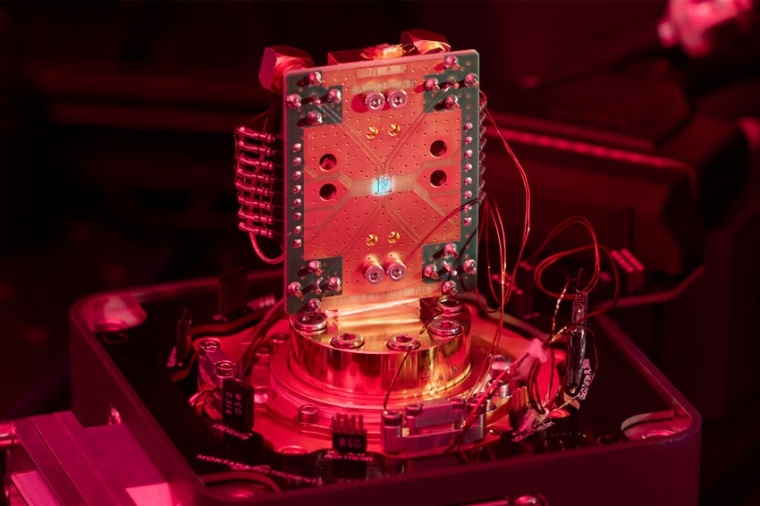
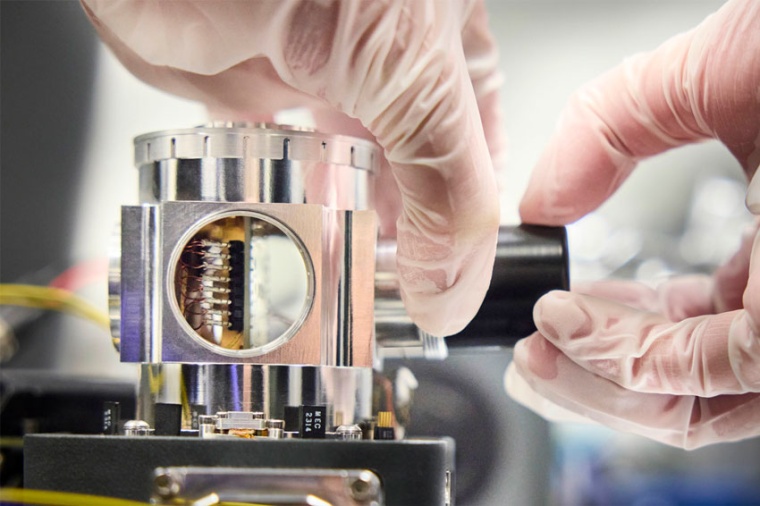
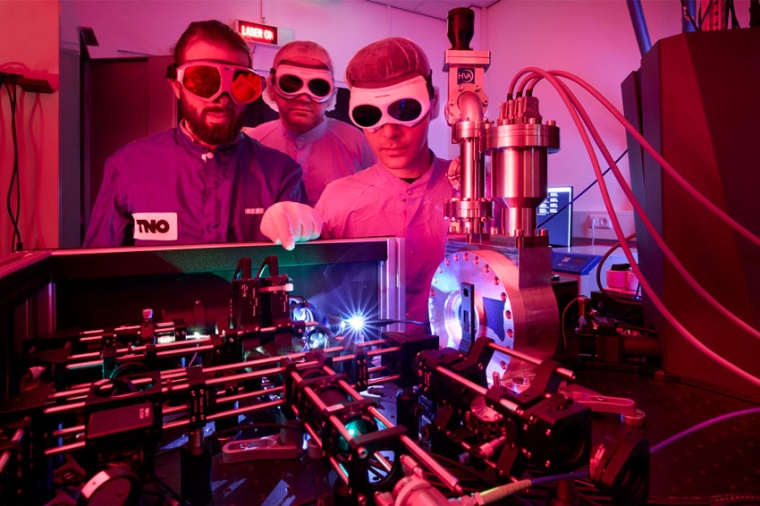
Networks that can be implemented locally or regionally are considered to be the nuclei of the quantum internet of the future. For long-distance connections, there is a lack of repeaters that amplify the signals transmitted by individual photons without breaking the quantum entanglement. Simple cloning of photons as in conventional transmission networks is ruled out due to the laws of quantum physics. Nevertheless, the research team led by Ronald Hanson from QuTech – which is backed by TU Delft and the research organization TNO – was recently able to report a breakthrough. It connected two quantum computers in Delft and The Hague with 25 km of underground optical fiber and was able to reproducibly generate quantum entanglement.
One of the key challenges is to guide the photons emitted in all directions and beyond the usual telecom wavelengths efficiently and with low noise into the optical fiber. A specifically shaped optical system integrated directly into the diamond chip and a virtually noise-free quantum frequency converter developed by Fraunhofer ILT are used here.
The stability of the connection over the 25 km long glass fiber must maintain accuracies in the order of one wavelength of the photons. All of this could only be solved with the cooperation of various partners. In addition to QuTech and the Fraunhofer ILT, the Dutch timing hardware specialist OPNT, Element Six as a supplier of synthetic diamonds and qubit chip substrates and Toptica Photonics as a specialist for high-stability lasers are involved in the project.
In addition to the connection between The Hague and Delft, the cooperation has now implemented a further quantum internet node, optimized on the basis of the experience gained, with funds from the North Rhine-Westphalian funding project N-QUIK. Gradually, research and industrial sites in the region, throughout North Rhine-Westphalia and, as the technology matures, throughout Germany are to be connected. To achieve this, the repeater problem caused by the no-cloning theorem needs to be solved.
Further reading: United to champion quantum internet: QuTech and Fraunhofer Institute for Laser Technology ILT cooperate, wileyindustrynews.com, 6 January 2022
Company
Fraunhofer Institute for Laser Technology ILTSteinbachstr. 15
52074 Aachen
Germany



most read

IMTS 2026: America's Manufacturing Sector Focuses on Growth and Technology
The largest manufacturing trade show in the Western Hemisphere is bringing together 1,788 exhibitors this year, including about 400 companies participating for the first time.

Schaeffler bundles Defense and New Space activities under new CEO
Celia Pelaz takes over the position of CEO Defence & New Space at Schaeffler on October 1, 2026 and becomes Chairwoman of the Management Board of Stech Defence GmbH.

Solid-State Transformers for AI Data Centers
As part of a strategic partnership, Siemens and Reinhausen are developing a solid-state transformer for AI data centers with an 800-volt DC system.

European machine vision expects slight recovery and growth in 2026
According to the VDMA Machine Vision department, sales are expected to increase by around 3%, following a decline of 2% in 2025.

Siemens Consolidates Its Automation Business into a New Unit Called Automation
Rainer Brehm, who previously served as COO of the automation business and CTO of Digital Industries, was appointed president of the new unit.