

A quantum highway for Germany
Existing fiber quantum link to be extended in 2024 to connect Berlin and Frankfurt, €12M funding from EU and BMBF.
The Free State of Thuringia is about to become an important hub for the German quantum network. Existing test links for researching quantum-secured fiber links between Erfurt and Jena are now to be extended by new sections in the direction of Nordhausen and, in perspective, Berlin and Frankfurt am Main.
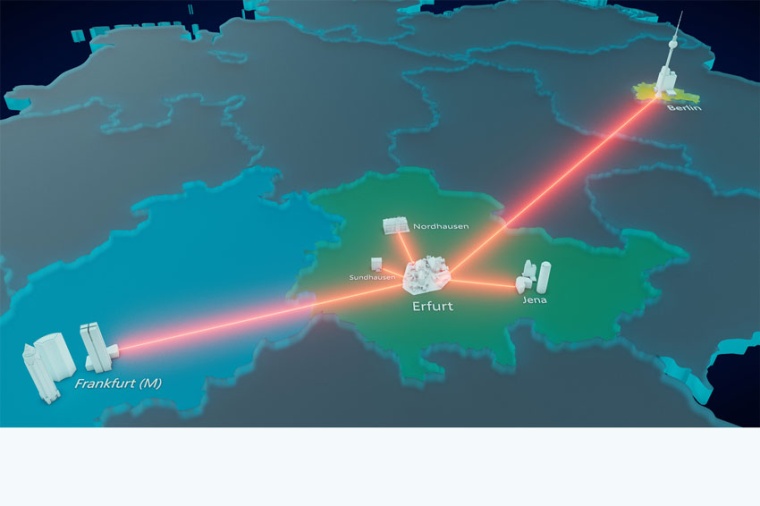
With funding from the state, an optical fiber test link has already been established between the Fraunhofer Institute for Applied Optics and Precision Engineering IOF in Jena and the Fraunhofer Center in Erfurt. Here, quantum keys have already been successfully exchanged between Thuringia’s metropolitan cities over a distance of 75 kilometers as part of the QuNET initiative funded by the German Federal Ministry of Education and Research (BMBF). For the test link, it was possible to use an existing infrastructure of conventional telecommunications fiber optics.
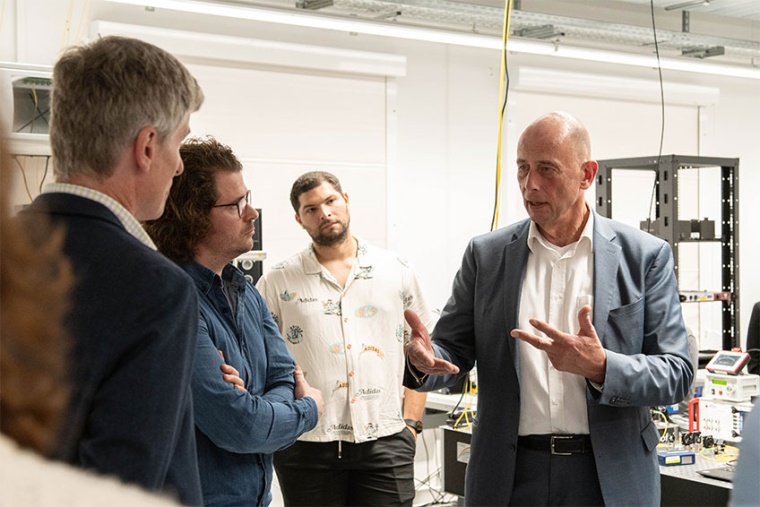
The Thuringian communities of Nordhausen and Sundhausen will be connected to the existing link between Jena and Erfurt by 2024. Furthermore, within Jena, the University Hospital will also be connected to the test link. This will extend the fiber-based test route to a total length of more than 150 kilometers. Further sections are planned as far as Berlin and Frankfurt am Main by the end of 2024. The go-ahead was given by Thuringia’s Science Minister Wolfgang Tiefensee in August 2023 during a visit of the Fraunhofer Center in Erfurt.
In the Q-net-Q project, led by Nordhausen University of Applied Sciences and with the participation of Fraunhofer IOF, the application potential of high-security quantum communication for telemedical software will initially be tested as an example. Rural regions in particular often suffer from a serious shortage of (specialist) physicians. Medical care could be more convenient and efficient in the future. Against this backdrop, the Thuringian community of Sundhausen will also be connected to the new fiber-optic test link as an example of a rural region.
The Q-net-Q project is being implemented as part of the European program EuroQCI. The EU and the BMBF are funding the project with a total of 11.8 million euros. In addition to Fraunhofer IOF and the Nordhausen University of Applied Sciences, which is acting as consortium leader, the Q-net-Q research association includes five other academic partners: the Technical University of Munich, the Technical University of Berlin, the Friedrich Alexander University of Erlangen-Nuremberg and the Fraunhofer HHI. Furthermore, two industrial partners, Utimaco and DE-CIX Management, are also involved in the project.
Further reading: Quantum keys fiber-linked over 75 kilometers – First successful exchange of quantum keys between Erfurt and Jena via optical fiber enables new QKD experiments, wileyindustrynews.com, 27 October 2022
Company
Fraunhofer Institute for Applied Optics and Precision Engineering IOFAlbert-Einstein-Str. 7
07745 Jena
Germany

most read
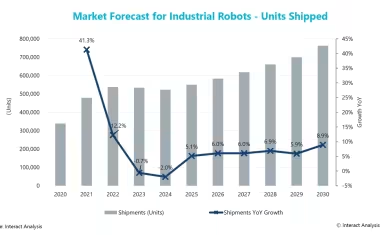
Forecast: Significant Growth in Industrial Robotics by 2030; Cobots Are Growing the Fastest
According to a recent analysis by Interact Analysis, global sales of industrial robots are expected to rise from about 550,000 units in 2025 to just over 760,000 units in 2030.
Siemens Consolidates Its Automation Business into a New Unit Called Automation
Rainer Brehm, who previously served as COO of the automation business and CTO of Digital Industries, was appointed president of the new unit.

European machine vision expects slight recovery and growth in 2026
According to the VDMA Machine Vision department, sales are expected to increase by around 3%, following a decline of 2% in 2025.

IMTS 2026: America's Manufacturing Sector Focuses on Growth and Technology
The largest manufacturing trade show in the Western Hemisphere is bringing together 1,788 exhibitors this year, including about 400 companies participating for the first time.
Schaeffler bundles Defense and New Space activities under new CEO
Celia Pelaz takes over the position of CEO Defence & New Space at Schaeffler on October 1, 2026 and becomes Chairwoman of the Management Board of Stech Defence GmbH.