

Singular Photonics steps into the spotlight at Photonics West
Startup introduces range of sensors with layers of advanced computation to extract valuable information from images.
Singular Photonics emerged from stealth mode, launching next-generation image sensors based on single-photon avalanche diodes (SPADs). A spin-out from the University of Edinburgh, Singular is one of the first companies to bring advanced computation to SPAD-based image sensing, enabling in-pixel and cross-pixel storage and computations at the lowest light levels to reveal previously invisible details of the material world and its photon events. The young company will showcase its products for the first time at next week’s SPIE Photonics West in San Francisco.
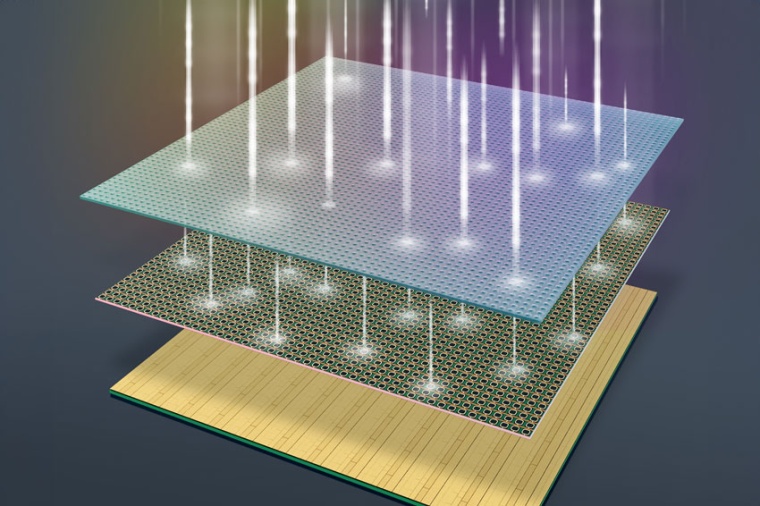
SPADs use the "avalanche" effect in semiconductors to convert light directly into an electrical current, without the need for cooling or amplification. While most commercial SPAD-based image sensors have been limited to time-resolved counting of photons, Singular’s core innovation lies in complex layers of computation beneath 3D-stacked SPAD sensors, comparable to the way FPGAs and GPUs revolutionized parallel computing by conducting high-speed, localized processing.
Prof Henderson leads the University of Edinburgh’s CMOS sensors and systems group. In 2005, he designed one of the first SPAD image sensors in nanometer CMOS technologies, leading to the first time-of-flight sensors in 2013, which today perform an autofocus-assist feature in more than a billion smartphones worldwide.
“There can be no doubt that SPAD sensors are the future of digital imaging, but their use to date in commercial devices hasn’t extended much beyond time-resolved counting of photons,” said Prof Henderson. “Computational cleverness can be the difference. We are building next-generation imaging sensors, where the computation is done digitally at the pixel level – exactly where the photons arrive.”
Simultaneously capturing depth and temporal dimensions to generate 4D images that provide deep, data-rich insights, Singular’s noiseless sensors enable more information to be extracted from light, supporting applications ranging from consumer and automotive electronics to the scientific and medical fields. The company’s approach transforms SPAD sensors into 3D stacked computational engines capable of performing a wide range of sophisticated tasks, such as real-time photon counting, timing, and advanced processing techniques, including in-pixel histograms, statistical analysis and autocorrelation.
Singular is launching with two sensors, both of which are available today: Andarta, developed in collaboration with tech giant Meta, optimized for use in a number of medical imaging modalities, and Sirona, capable of time-correlated single photon counting (TCSPC) for Raman spectroscopy, fluorescence lifetime imaging microscopy (FLIM), time-of-flight, and quantum applications.
Singular has already inked multiple deals for its sensors with some of the world’s leading instrumentation companies, and expects to announce more collaborations in 2025. “We are in a unique position where we already have commercially available products and are generating revenue in our first year of incorporation,” said Shahida Imani, CEO of Singular Photonics. “With new, even more advanced sensors coming to the market in 2025, we are well positioned to lead the SPAD-driven imaging revolution.”
Company
Singular PhotonicsHiggs Centre for Innovation
Edinburgh, EH9 3HJ
UK


most read

European machine vision expects slight recovery and growth in 2026
According to the VDMA Machine Vision department, sales are expected to increase by around 3%, following a decline of 2% in 2025.
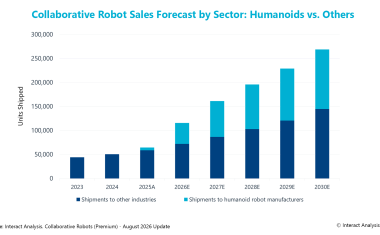
Humanoid robotics is driving demand for cobot arms and actuators
According to recent analyses, global production of humanoid robots exceeded the 20,000-unit mark in 2025 and is expected to more than triple in 2026.
Vision 2026 Breaks Exhibitor Record
About 500 exhibiting companies—about two-thirds of which are from abroad and about 30 percent of which are first-time exhibitors—are showcasing their products at the trade show.

Siemens Consolidates Its Automation Business into a New Unit Called Automation
Rainer Brehm, who previously served as COO of the automation business and CTO of Digital Industries, was appointed president of the new unit.
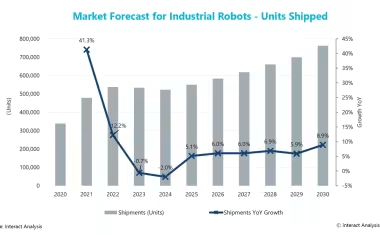
Forecast: Significant Growth in Industrial Robotics by 2030; Cobots Are Growing the Fastest
According to a recent analysis by Interact Analysis, global sales of industrial robots are expected to rise from about 550,000 units in 2025 to just over 760,000 units in 2030.