

Development of a spectrograph ‘on-a-chip’
EU funding of 3.4 million euros for the Pics4sens project
The joint project Pics4sens by the Leibniz Institutes AIP and IHP in cooperation with the InnoFspec transfer laboratory at the University of Potsdam won the competition in last year’s Staf call for proposals and will be funded over a period of four years with a total of 3.4 million euros, 2.2 million euros of which will go to the AIP.
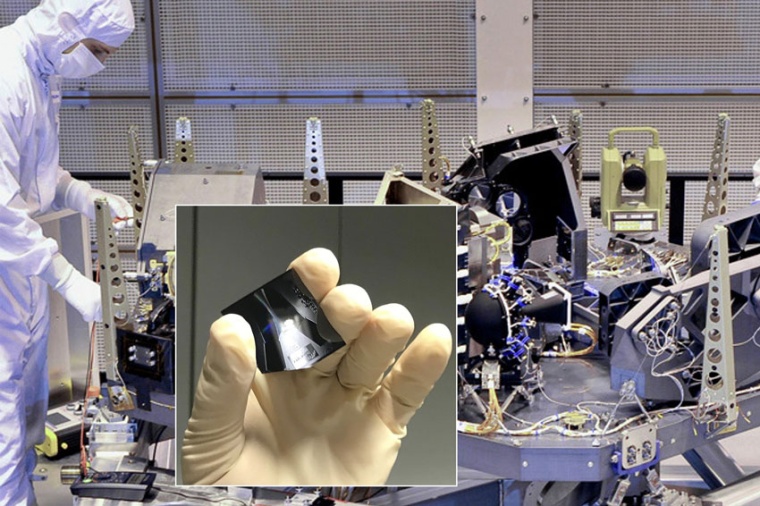
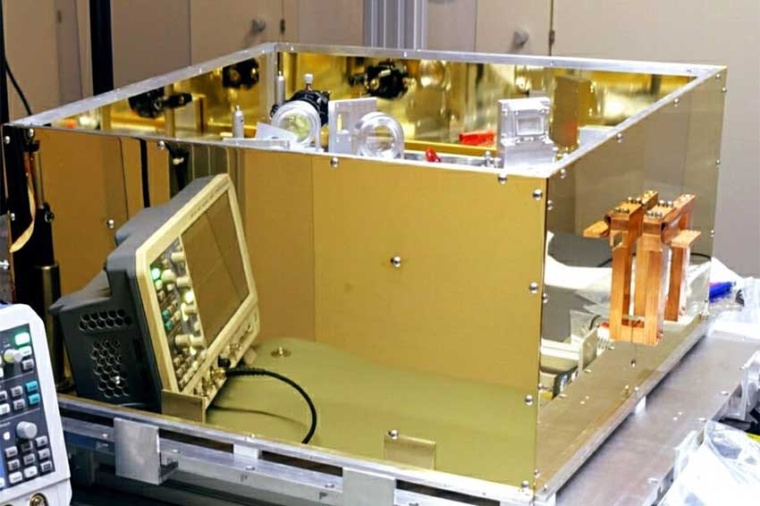
The StaF-Verbund funding program to promote the strengthening of technological and application-oriented research in research networks of scientific institutions in the state of Brandenburg is financed by the European Regional Development Fund (ERDF). Pics4sens will help to increase the technological maturity and shorten the path to commercialisation of photonic integrated circuits in sensor technology.
These somewhat unwieldy terms can be summarized in a short sentence: the development of a spectrograph 'on-a-chip'. This picture gives an idea of what is involved: the realization of what are traditionally large and expensive high-performance optics in a tiny photonic chip. PICs have already established themselves in computer centers and Internet data communication. Another area of application is still in its infancy: spectroscopy and sensor technology.
The scientists in the AIP's Astrophotonics section, led by Dr Kalaga Madhav, have achieved a leading international position in this field and have developed and utilized various generations of PICs for applications in spectroscopy and interferometry. With a chip of the type shown in the picture, a spectrograph designed for the near-infrared range was built for the first time in the world with the support of AIP research technology: Paws, the Potsdam Arrayed Waveguide Spectrograph. Here, a highly sensitive image sensor is cooled to a temperature of –190 °C in order to electronically record the chip’s high-resolution spectrum.
The rather bulky design of the cooling housing for the infrared image sensor compared to the chip shows that miniaturisation has not yet been fully achieved. This is precisely where the Pics4sens project comes in: The Leibniz Institute for Innovative Microelectronics (IHP) has all the prerequisites and expertise to integrate the image sensor into the PIC, a marriage of photonics and electronics, so to speak.
Researchers hope that this will not only lead to a breakthrough for astrophysical instruments, particularly in space, but also to outstanding innovation potential and future market opportunities in areas such as agricultural technology, mobility, healthcare, food technology and chemistry – future topics that have been prioritized by the ‘innoBB2025 plus’ innovation strategy and the master plan for the optics and photonics cluster in Berlin and Brandenburg.
Project manager Martin Roth emphasized: “With the Leibniz Institute for Innovative Microelectronics (IHP) in Frankfurt (Oder) and the Leibniz Institute for Astrophysics Potsdam (AIP), the state of Brandenburg has two top performers in top international research, according to the latest evaluations by the Leibniz Association. In cooperation with the InnoFspec transfer laboratory at the University of Potsdam, the Pics4sens project has excellent prerequisites for further expanding and utilising our technological lead.”
Company
Cluster Optik und Photonik Berlin Brandenburgc/o Berlin Partner für Wirtschaft und Technologie GmbH
10623 Berlin
Germany

most read
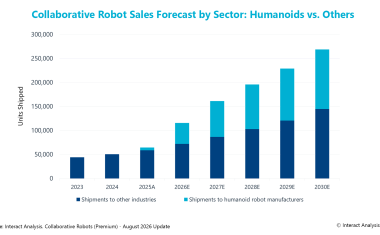
Humanoid robotics is driving demand for cobot arms and actuators
According to recent analyses, global production of humanoid robots exceeded the 20,000-unit mark in 2025 and is expected to more than triple in 2026.
Schaeffler bundles Defense and New Space activities under new CEO
Celia Pelaz takes over the position of CEO Defence & New Space at Schaeffler on October 1, 2026 and becomes Chairwoman of the Management Board of Stech Defence GmbH.
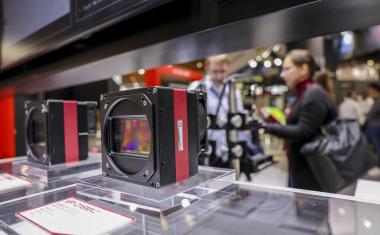
Vision 2026 Breaks Exhibitor Record
About 500 exhibiting companies—about two-thirds of which are from abroad and about 30 percent of which are first-time exhibitors—are showcasing their products at the trade show.

ZVEI Calls for Swift Protection of Critical Power Infrastructure
The association has issued a statement in response to the recent attempted attacks on substations in Brandenburg and North Rhine-Westphalia and warns of the consequences for Germany's energy security.
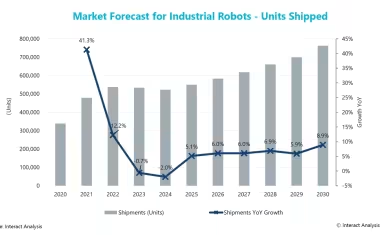
Forecast: Significant Growth in Industrial Robotics by 2030; Cobots Are Growing the Fastest
According to a recent analysis by Interact Analysis, global sales of industrial robots are expected to rise from about 550,000 units in 2025 to just over 760,000 units in 2030.