Asia Is Driving the Automation Boom
The number of industrial robots installed worldwide reached the five-million mark in 2025. The main drivers of this growth are China, the U.S., and India.
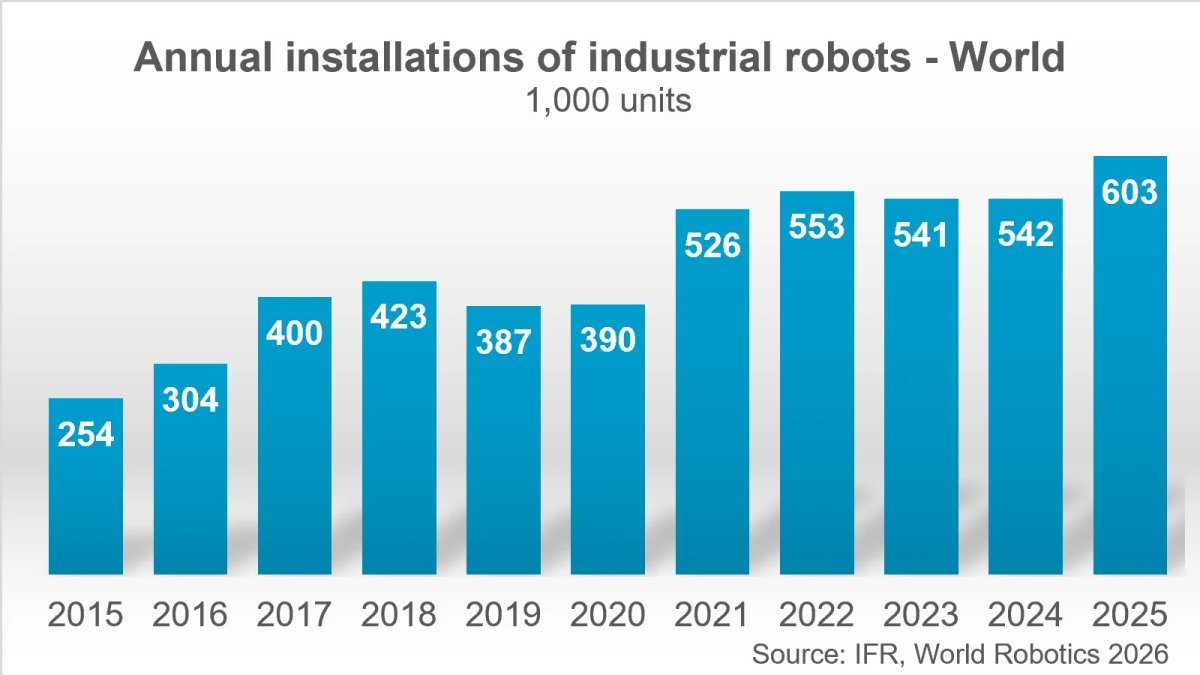
The global robotics industry has reached a new milestone: By the end of 2025, five million industrial robots were in use in factories worldwide for the first time. According to the International Federation of Robotics (IFR), the global robot installed base rose by 9 percent compared to the previous year. At the same time, new installations increased by 11 percent, surpassing the 600,000-unit mark.
The market in Asia is growing particularly rapidly. China further expanded its leading position, accounting for 59 percent of all industrial robots installed worldwide. With approximately 354,000 newly installed systems, the country set a new record. For the first time, Chinese manufacturers significantly outperformed their foreign competitors in their home market.
The U.S. also continued its growth trajectory and overtook Japan as the world’s second-largest robot market. Installations rose to just under 38,500 units. India established itself as one of the most dynamic growth markets, with a 15 percent increase and approximately 10,500 newly installed robots. Since 2020, installations there have grown by an average of 27 percent per year.
Europe, by contrast, is experiencing more moderate growth. While Germany remains the continent’s largest robotics market and ranks fifth globally, it saw a decline in installations of 8 percent in 2025, falling to fewer than 25,000 units. Italy, France, and Spain also reported declining figures.
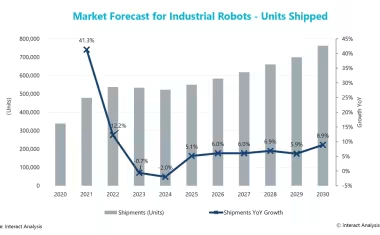
Nevertheless, the IFR anticipates continued expansion of the robotics market. By 2029, annual installations are expected to rise to more than 800,000 units. The most important drivers of growth are considered to be the shortage of skilled workers, the reshoring of production capacity, more resilient supply chains, and advances in artificial intelligence, machine vision, and sensor technology. In particular, AI-powered image processing and simpler integration options are expanding the range of applications for robots and making automation economically attractive even for new user groups.