

Additive manufacturing for mass production
New 3D printer from Trumpf uses second laser to double productivity
High-technology company Trumpf recently unveiled the new series of its TruPrint 3000 3D printing system at a virtual customer event. The medium-format machine uses powder-bed-based laser melting to produce parts with a diameter of up to 300 millimeters and a height of up to 400 millimeters. It can handle all weldable materials including steels, nickel-based alloys, titanium and aluminum. “We’ve improved key aspects of the TruPrint 3000 to tailor it even more closely to the quality requirements, certifications and production processes of various industries,” says Klaus Parey, managing director of Trumpf Additive Manufacturing.
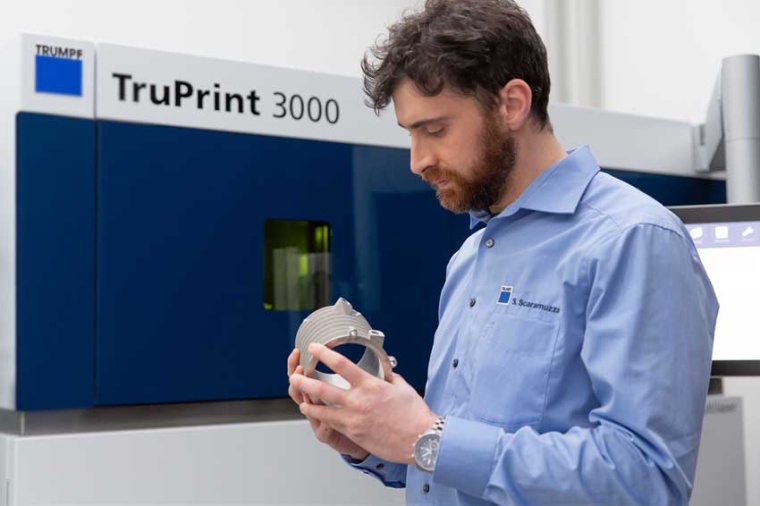
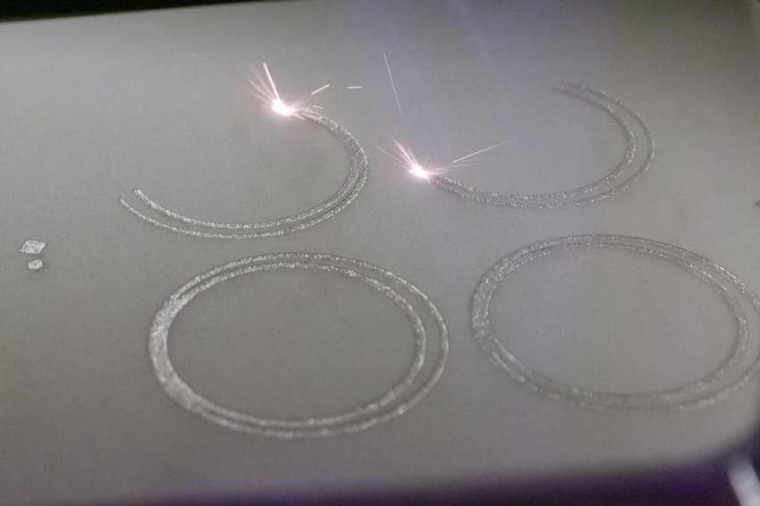
The new machine can be equipped with a second laser that almost doubles its productivity. “The multilaser option significantly reduces part costs – that’s how we help our customers make the move into mass production,” says Parey. Two 500-watt lasers scan the machine’s entire build chamber in parallel. This makes production much faster and more efficient regardless of the number and geometries of the parts. With the Automatic Multilaser Alignment option, the system can automatically monitor the multilaser scan fields during the build stage and calibrate them to each other. With each laser scanning a contour, the process does not lead to any kind of weld seams. This is what allows multilaser parts to meet such outstanding quality standards.
The Trumpf experts have transformed the movement of inert gas through the TruPrint 3000. The way in which it flows through the machine from back to front is now even steadier and more uniform. As well as boosting the quality of printed parts, this also allows the operator to remove excess powder from the part while it is still inside the machine. Previous models required the operator to take the part out and remove the powder at a separate station. The new machine is designed to process the powder in a shielded environment, using an inert gas to prevent the powder from becoming contaminated during the build. This is a major advantage for sensitive industries such as medical device manufacturing.
The new TruPrint 3000 also comes with a melt pool monitoring function. This safeguards the quality of the part during 3D printing by automatically monitoring melt pool emissions and other metrics during the process. Special sensors in the laser optics continuously monitor the melt pool. A special piece of software compares these readings to the figures for a reference workpiece stored in its database and presents a graphical display of any deviations, such as a melt pool that is too cold or too hot. This gives machine operators the information they need to detect any errors and take whatever action may be necessary.
Different industries and components have different requirements, which is why Trumpf offers such flexible production solutions. “The new TruPrint 3000 lets us tailor the process chain to perfectly match each customer’s manufacturing process,” says Parey. As well as the solution outlined above for powder removal within the machine, the TruPrint 3000 also offers an exchangeable cylinder principle with external unpacking and depowdering stations. This has several advantages, allowing the machine to better meet the customer’s specific needs, respond to growing production volumes and keep downtime to a minimum by working in parallel with production. (Source: Trumpf)
Link: Additive manufacturing, TRUMPF GmbH + Co. KG (Holding), Ditzingen, Germany


most read

Siemens Consolidates Its Automation Business into a New Unit Called Automation
Rainer Brehm, who previously served as COO of the automation business and CTO of Digital Industries, was appointed president of the new unit.

European machine vision expects slight recovery and growth in 2026
According to the VDMA Machine Vision department, sales are expected to increase by around 3%, following a decline of 2% in 2025.
Laser 2000 and Büchner Lichtsysteme cooperate
Through this cooperation, Laser 2000 is expanding its portfolio in the areas of machine vision, metrology and smart sensor technologies.

Indus Engineering segment increases incoming orders
In the 2025 financial year, the export-oriented Engineering segment of Indus Holding generated sales of EUR 583 million, slightly below the previous year (EUR 596.7 million).

Schaeffler bundles Defense and New Space activities under new CEO
Celia Pelaz takes over the position of CEO Defence & New Space at Schaeffler on October 1, 2026 and becomes Chairwoman of the Management Board of Stech Defence GmbH.