

Quantum light source goes fully on-chip
The new development is scalable and suitable for use in photonic quantum computers.
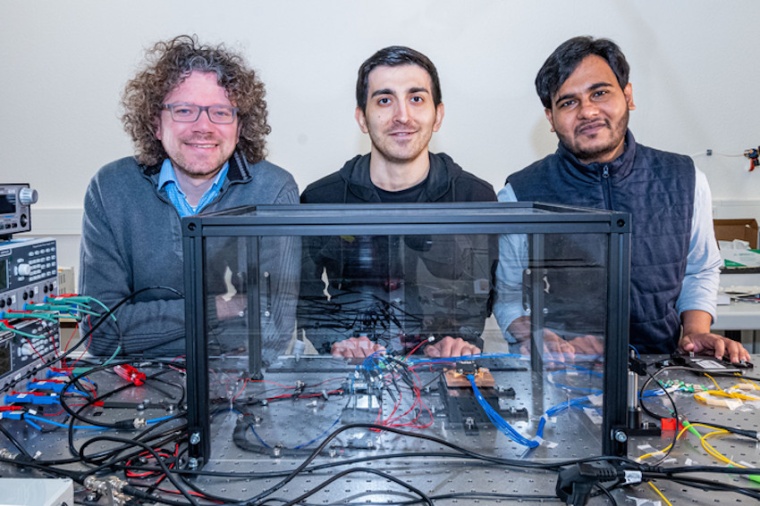
An international team of researchers from Leibniz University Hannover, the University of Twente and the start-up company QuiX Quantum has presented an entangled quantum light source fully integrated for the first time on a chip. “Our breakthrough allowed us to shrink the source size by a factor of more than 1000, allowing reproducibility, stability over a longer time, scaling, and potentially mass-production. All these characteristics are required for real-world applications such as quantum processors,” says Michael Kues, head of the Institute of Photonics at Leibniz University Hannover.
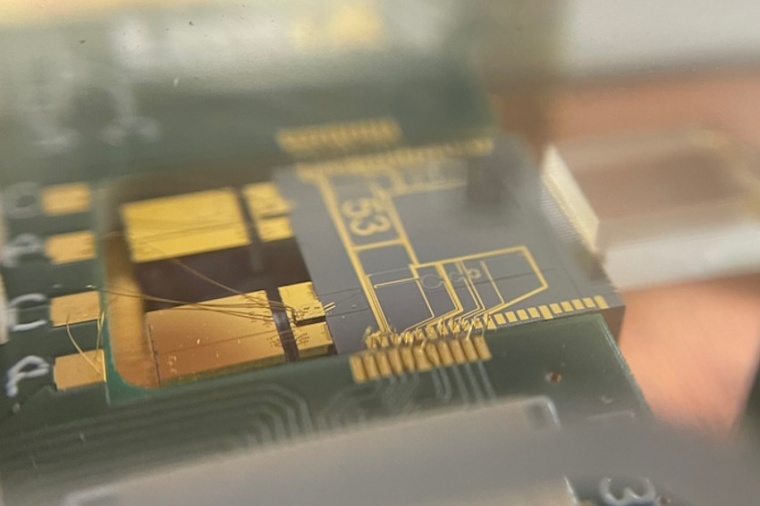
Quantum light sources generate photons that can be used as quantum bits. On-chip photonics has become a leading platform for processing optical quantum states as it is compact, robust, and allows to accommodate and arrange many elements on a single chip. Here, light is directed on the chip through extremely compact structures, which are used to build photonic quantum computing systems. These are already accessible today through the cloud. Scalably implemented, they could solve tasks that are inaccessible to conventional computers due to their limited computing capacities. This superiority is referred to as quantum advantage.
“Until now, quantum light sources required external, off-chip and bulky laser systems, which limited their use in the field. However, we overcome these challenges through a novel chip design and by exploiting different integrated platforms,” says Hatam Mahmudlu, a Ph.D. student in Kues' team. Their new development, an electrically-excited, laser-integrated photonic quantum light source, fits entirely on a chip and can emit frequency-entangled qubit states.
“Qubits are very susceptible to noise. The chip must be driven by the laser field, completely free from noise, requiring an on-chip filter. Previously, it was a major challenge to integrate laser, filter, and a cavity on the same chip as there was no unique material that was efficient to build these different components,” says Raktim Haldar, a Humboldt fellow in Kues’ group. The key was the hybrid technology that sticks the laser made of indium phosphide, a filter, and a cavity made of silicon nitride and brings them together into a single chip. On the chip, in a spontaneous nonlinear process, two photons are created from a laser field. Each photon spans a range of colors simultaneously and the colors of both photons are correlated, i.e., the photons are entangled and can store quantum information. “We achieve remarkable efficiencies and state qualities required for application in quantum computers or the quantum internet,” says Kues.
“Now we can integrate the laser with other components on a chip so that the whole quantum source is smaller than a one-euro coin. Our tiny device could be considered a step towards quantum advantage on a chip with photons. Unlike Google, which currently uses super-cold qubits in cryogenic systems, the quantum advantage could be achieved with such photonic systems on a chip even at room temperature,” says Haldar. The scientists also expect their discovery to help lower the production costs of applications. “We can imagine that our quantum light source will soon be a fundamental component of programmable photonic quantum processors,” says Kues. (Source: LUH)
Link: Cluster of Excellence PhoenixD, Leibniz University Hannover, Hannover, Germany


most read

ZVEI Calls for Swift Protection of Critical Power Infrastructure
The association has issued a statement in response to the recent attempted attacks on substations in Brandenburg and North Rhine-Westphalia and warns of the consequences for Germany's energy security.
Vision 2026 Breaks Exhibitor Record
About 500 exhibiting companies—about two-thirds of which are from abroad and about 30 percent of which are first-time exhibitors—are showcasing their products at the trade show.

Solid-State Transformers for AI Data Centers
As part of a strategic partnership, Siemens and Reinhausen are developing a solid-state transformer for AI data centers with an 800-volt DC system.

European machine vision expects slight recovery and growth in 2026
According to the VDMA Machine Vision department, sales are expected to increase by around 3%, following a decline of 2% in 2025.

Siemens Consolidates Its Automation Business into a New Unit Called Automation
Rainer Brehm, who previously served as COO of the automation business and CTO of Digital Industries, was appointed president of the new unit.