

Light converting films accelerate plant growth
Plastic sheets coated with an europium-based compound converts UV light to red light.
An interdisciplinary team from Hokkaido University’s Engineering and Agriculture departments and the Institute for Chemical Reaction Design and Discovery (WPI-ICReDD) has developed a europium-based thin-film coating that they demonstrated accelerates both vegetal plant and tree growth. This technology can improve plant production speed and has the potential to help address global food supply issues.
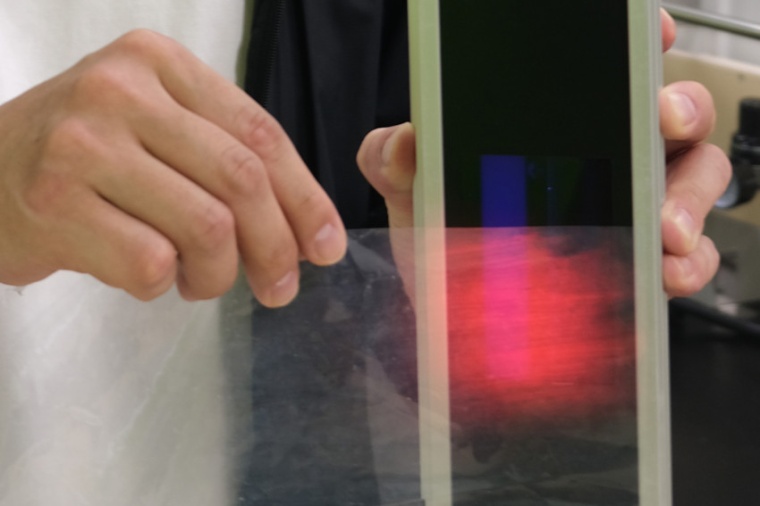
Plants convert visible light to energy via photosynthesis. In addition to visible light, sunlight also contains ultraviolet light. Researchers in this study aimed to provide plants with additional visible light to use in photosynthesis by employing a wavelength converting material (WCM) that can convert the UV light into red light. They developed a WCM based on a europium complex and made a thin-film coating that can be applied to commercially available plastic sheets. They not only showed that the film converts UV light to red light, but also that the film does not block any of the beneficial visible light from the sun.
The film was then tested by comparing plant growth using sheets with and without the WCM coating. Trials were performed for both Swiss chard, a vegetal plant, and Japanese larch trees. In summer, when days are long and sun irradiation is strong, no significant difference was observed for Swiss chard when using the WCM films. In winter, however, when days are shorter and sunlight is weaker, Swiss chard plants grown using the WCM films showed 1.2 times greater plant height and 1.4 times greater biomass after 63 days. The researchers attributed this accelerated growth to the increased supply of red light provided by the WCM films.
Trials involving Japanese larch trees also showed accelerated growth. Seedlings showed a higher relative growth rate in the initial 4 months of growth, resulting in a stem diameter 1.2-fold larger and total biomass 1.4-fold larger than trees grown without the WCM coating. Critically, this enabled the seedlings to reach the standard size for planting in the forestry of Hokkaido within one year. Use of WCM films could shorten the growth period of seedlings from two years to one year, resulting in more cost-efficient plant production. This technology also has the potential to help with food security issues in colder climates and is beneficial because it does not require any electricity to operate. Researchers see the customizability of the technology as especially promising.
“By using a coating of wavelength changing material, we were able to successfully create a transparent film and demonstrate its ability to accelerate plant growth,” said Sunao Shoji. “By rationally designing the light-emitting ion, we can freely control the color of emitted light to be other colors like green or yellow, so we expect to be able to create wavelength converting films that are optimized for different plant types. This opens a large avenue of future development for next generation agricultural and forestry engineering.” (Source: Hokkaido U.)
Link: Faculty of Engineering, Hokkaido University, Sapporo, Japan


most read

Solid-State Transformers for AI Data Centers
As part of a strategic partnership, Siemens and Reinhausen are developing a solid-state transformer for AI data centers with an 800-volt DC system.

ZVEI Calls for Swift Protection of Critical Power Infrastructure
The association has issued a statement in response to the recent attempted attacks on substations in Brandenburg and North Rhine-Westphalia and warns of the consequences for Germany's energy security.

European machine vision expects slight recovery and growth in 2026
According to the VDMA Machine Vision department, sales are expected to increase by around 3%, following a decline of 2% in 2025.
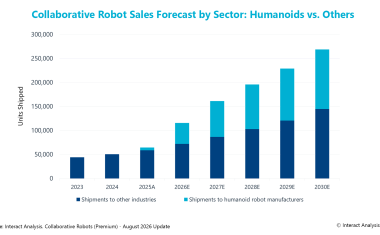
Humanoid robotics is driving demand for cobot arms and actuators
According to recent analyses, global production of humanoid robots exceeded the 20,000-unit mark in 2025 and is expected to more than triple in 2026.

Siemens Consolidates Its Automation Business into a New Unit Called Automation
Rainer Brehm, who previously served as COO of the automation business and CTO of Digital Industries, was appointed president of the new unit.