Extremely low driving voltage in OLEDs
New device is based on upconversion transition associated with triplet–triplet annihilation that doubles the energy of excited states.
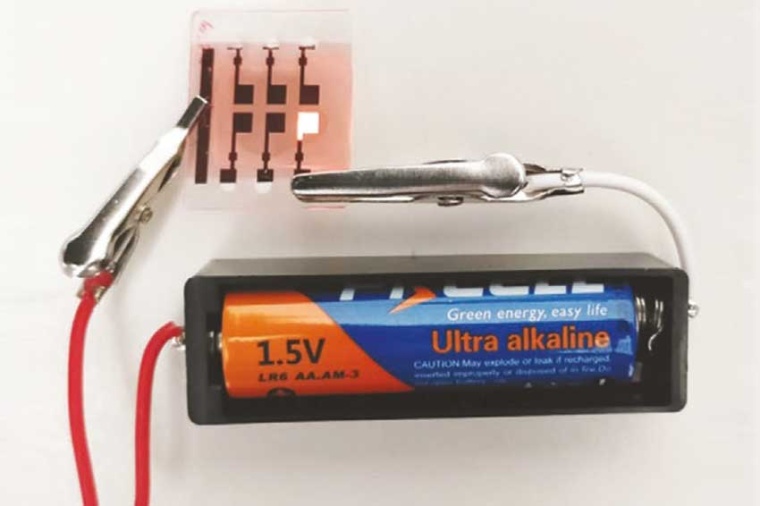
Researchers at Institute for Molecular Science and at University of Toyama in Japan report that an efficient organic light emitting diode (OLED), operable by a 1.5-V battery, produces bright emission equivalent to luminance of a typical display. The OLED is based on upconversion transition associated with triplet–triplet annihilation that doubles the energy of excited states.
Various properties of OLEDs have been optimized, including current to photon conversion efficiency. An external quantum efficiency exceeding 20 %, with internal quantum efficiency of 100 %, has been achieved owing to the development of thermally activated delayed fluorescent and phosphorescent materials that manage the spin of excited states. However, the operating voltage of common types of OLEDs is very high; that of an OLED emitting approximately 600-nm light at a luminance of 100 cd/m2, which is a general display condition, is as high as 4.5 V.
The group of Seiichiro Izawa and Masahiro Hiramoto at Institute for Molecular Science in Japan, and Masahiro Morimoto and Shigeki Naka at University of Toyama in Japan report that an efficient OLED, operable by a 1.5-V battery, that produces bright emission equivalent to luminance of a typical display. The OLED has a smaller turn-on voltage at 0.97 V than the optical energy of emitted photons at 2.04 eV (608 nm), because the OLED is based on upconversion transition associated with triplet–triplet annihilation that doubles the energy of excited states.
The researchers reveal that the characteristics of charge transfer state at the interface are key to efficient upconversion, and the percentage of excited states deactivated by parasitic loss processes during the upconversion transition is significantly reduced from over 90 % to approximately 10 % by introducing a highly crystalline acceptor material and an emissive dopant.
Consequently, the upconversion-OLED reaches 100 cd/m2 at a voltage and emission wavelength of 1.33 V and 608 nm (2.04 eV), respectively. This is the lowest operating voltage reported for an OLED that achieves a luminance of 100 cd/m2. It was further demonstrated that the UC-OLED can be operated by a 1.5-V battery to realize luminance of 177 cd/m2. (Source: NINS)