

App creates time-lapse videos with a smartphone
The freely available app has three capture modes that cover a range of scenarios.
An app developed by Cornell researchers uses augmented reality to help users repeatedly capture images from the same location with a phone or tablet to make time-lapse videos – without leaving a camera on site. Time-lapse photography, which involves combining photos taken over long periods of time, provides a powerful way to visualize phenomena such as changing seasons or the movement of the sun. Traditionally, photographers would leave a camera on a tripod for the duration of the event, but researchers working with Abe Davis in the Cornell Ann S. Bowers College of Computing and Information Science have developed a more convenient method. Their iOS app, ReCapture, is now freely available in the Apple app store.

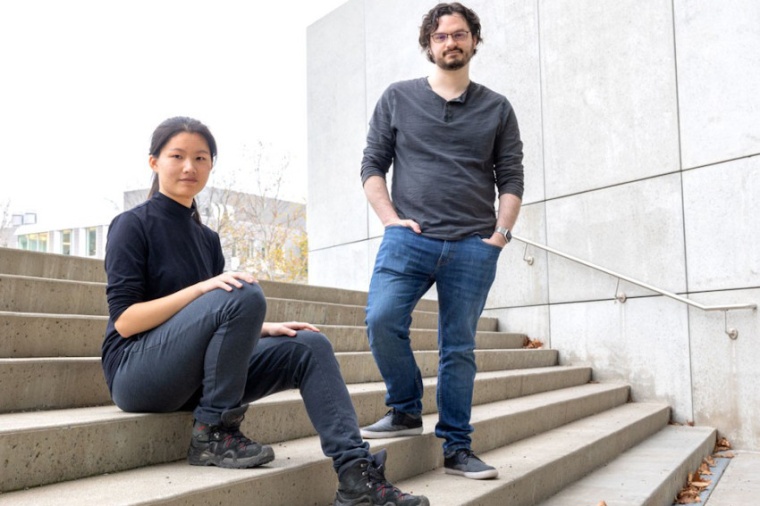
The app has three capture modes that cover a range of scenarios. One works best for landscapes, one helps capture close-up scenes and a third collects a range of images that can be used to reconstruct the scene in 3D offline. Each capture mode uses different information about the scene. The simplest mode uses an overlay of previous shots to help the user line up new photos. For close-up scenes, which tend to be more difficult to capture, the application tries to figure out where the camera is in 3D space and uses arrows to tell the user how to move and tilt their phone toward the correct location.
Abe Davis had been envisioning a project that would help field researchers repeatedly find and re-photograph precise locations from their field sites to track any changes. Together with Ruyu Yan he came up with the idea of “geocaching with pictures,” which ultimately evolved into ReCapture. “Geocaching may be something that people are doing for fun, but if you’re a scientist and you're doing field work, then there’s a similar kind of problem at play,” Davis said.
Yan said the hardest part was developing the app interface to guide users through the process, because “what works intuitively for me may not work intuitively for others.” She sought feedback from 20 beta testers and also worked with the XR Collaboratory at Cornell Tech, which advises researchers on augmented reality, virtual reality and mixed reality applications. Additionally, she had to figure out how to manage the mountains of data associated with the photos. “The app used to crash a lot,” she said. This was a problem because if the app was too slow or constantly crashing, people wouldn’t collect enough footage, leading to jerky, poor quality videos.
In future versions of the app, Davis thinks they may be able to smooth out gaps and abrupt transitions in the footage using recent machine learning techniques, which would yield higher quality videos. Besides making gifs and videos, the app may also have valuable scientific applications, as Davis had envisioned. The team has shared the app with field researchers in other departments at Cornell, and colleagues in the School of Integrative Plant Science in the College of Agriculture and Life Sciences have already begun using it to collect data. (Source: Cornell U.)
Link: Project ReCapture, Dept. of Computer Science, Cornell University, Ithaka, USA

most read
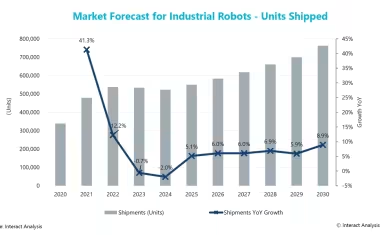
Forecast: Significant Growth in Industrial Robotics by 2030; Cobots Are Growing the Fastest
According to a recent analysis by Interact Analysis, global sales of industrial robots are expected to rise from about 550,000 units in 2025 to just over 760,000 units in 2030.
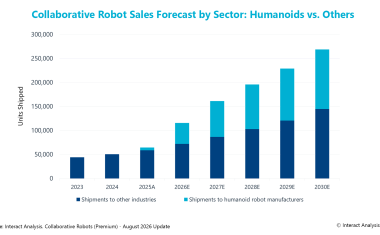
Humanoid robotics is driving demand for cobot arms and actuators
According to recent analyses, global production of humanoid robots exceeded the 20,000-unit mark in 2025 and is expected to more than triple in 2026.
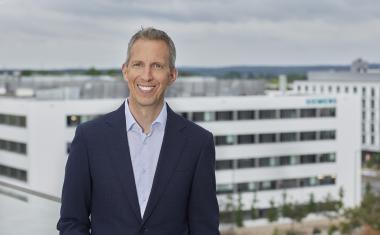
Siemens Consolidates Its Automation Business into a New Unit Called Automation
Rainer Brehm, who previously served as COO of the automation business and CTO of Digital Industries, was appointed president of the new unit.

Solid-State Transformers for AI Data Centers
As part of a strategic partnership, Siemens and Reinhausen are developing a solid-state transformer for AI data centers with an 800-volt DC system.
Schaeffler bundles Defense and New Space activities under new CEO
Celia Pelaz takes over the position of CEO Defence & New Space at Schaeffler on October 1, 2026 and becomes Chairwoman of the Management Board of Stech Defence GmbH.