

Ultrakompakte Lichtquelle für Quantenverschlüsselung
Fraunhofer IOF präsentiert VCSEL-basierte Photonenquelle für quantenverschlüsselte Kommunikation auf der Photonics West.
The concept of using strongly attenuated, randomly polarized light pulses for secure quantum communication has been around since the mid-1980s. Most commercial light sources for quantum communication are still based on this idea today. The biggest challenge here is to generate indistinguishable and randomly polarized photons at a high rate in a source that is as compact and energy-efficient as possible.
Fraunhofer IOF in Jena has now developed a photon source based on a linear array of eight semiconductor lasers (VCSELs). It has a ultracompact design, high spectral and temporal precision and good polarization quality. The system has been specially developed for secure connections from satellites to the ground station.
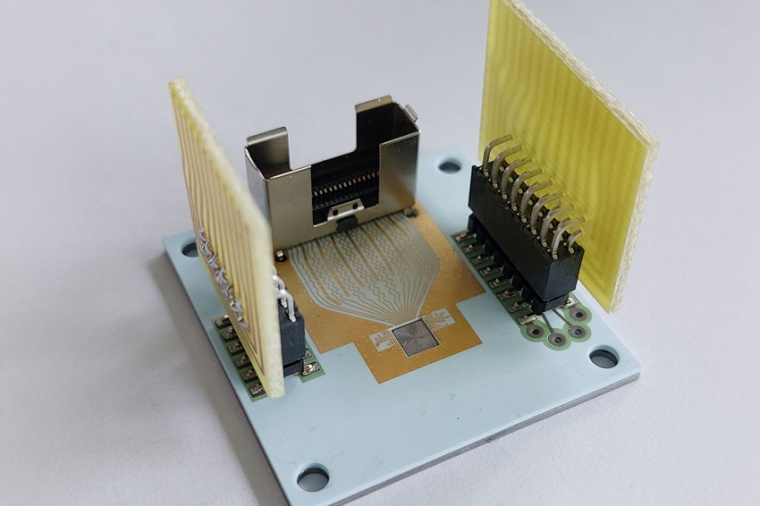
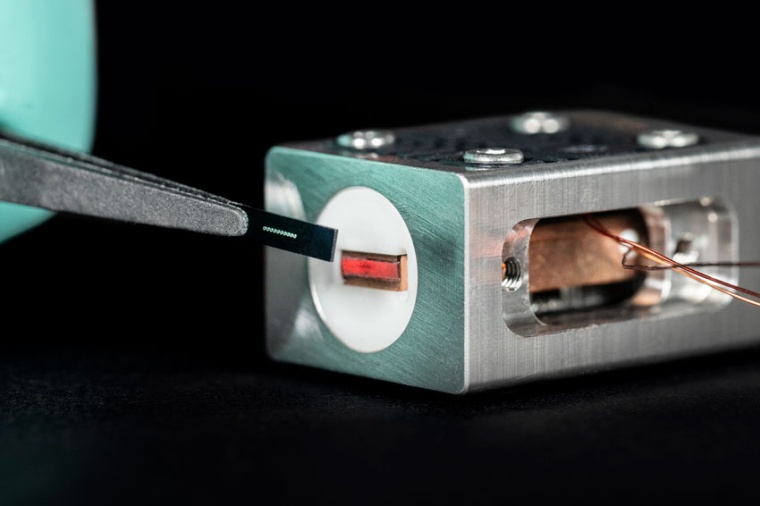
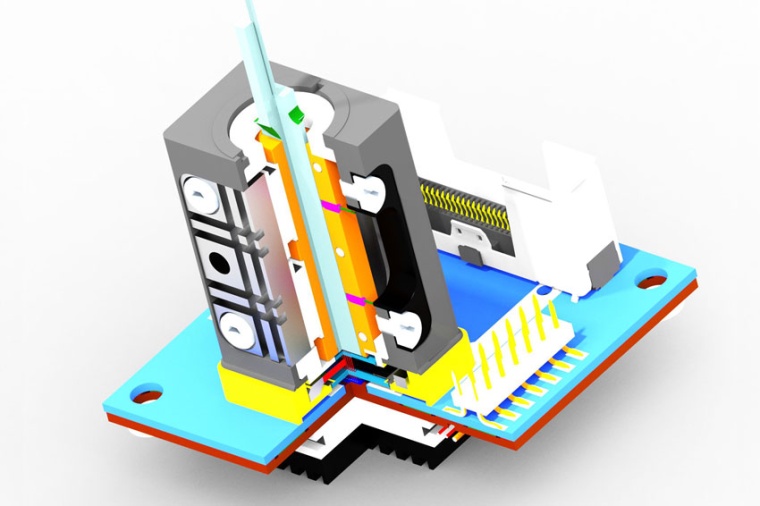
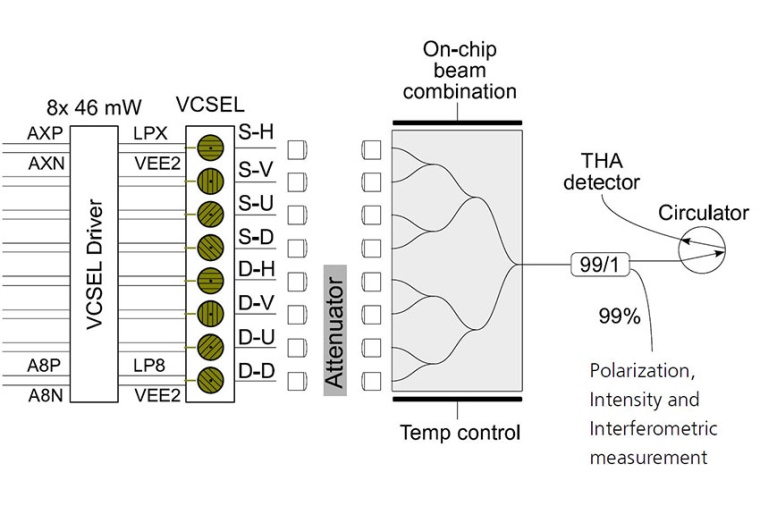
The new photon source uses a gallium arsenide (GaAs) substrate for eight VCSELs with lithographically structured polarizers developed at the University of Stuttgart. With these integrated components, the source can deliver four polarization states (H/V/D/A) for signals according to the BB84 protocol from an ultracompact box.
The temperature deviations of the individual VCSELs are significantly smaller than 0.5 K. As a result, the wavelength differences of the polarized photon packets < 40 pm (around 850 nm) can be maintained. Preliminary data show that the on-chip polarizers achieve an extinction ratio of at least 12 dB in the diagonal direction and at least 20 dB in the horizontal or vertical direction.
Four of the eight VCSEL channels provide decoy states by using an attenuator (~4 dB). This increases the overall security of the quantum communication link, as both signal and decoy pulses are generated in the system in a spectrally and temporally indistinguishable manner.
The integrated digital-to-analog conversion allows pulse rates of up to 5 GHz. This signal is expected to originate from an additional quantum random number generator. The optical system of the source is housed in a Kovar box with a low expansion coefficient.
The VCSEL source for BB84-based quantum key distribution with decoy states fits into a volume of 40 × 40 × 43 mm³ thanks to the integrated components. The signals of the eight separate channels differ spectrally by less than 50 pm and indicate differences of time delays of <1ps. This makes the source a promising candidate for a space mission on a microsatellite (Cubesat). All technologies have been selected to be ready for future qualification in space.
The Fraunhofer IOF team will present a prototype of the photon source for secure quantum communication at SPIE Photonics West in San Francisco (USA) from January 28 to 30 at the Fraunhofer booth in the German Pavilion (4205 North Hall).
Dr Erik Beckert, head of the Opto-mechatronic Components and Systems department at Fraunhofer IOF, will present the technology on January 26 at 1:50 pm (Room 158, Moscone South) in his lecture “Ultracompact, VCSEL-based photon source for prepare-and-measure QKD”.
Anbieter
Fraunhofer-Institut für Angewandte Optik und Feinmechanik IOFAlbert-Einstein-Str. 7
07745 Jena
Deutschland


Meist gelesen
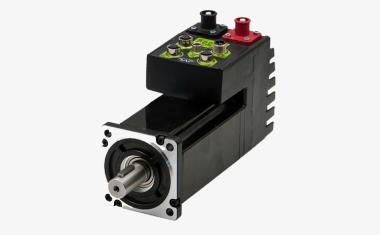
JVL erweitert Portfolio integrierter Motoren für Industrieautomation
Das Unternehmen stellt mehrere Neuerungen im Bereich integrierter Antriebstechnik vor

Sick steigert Umsatz 2025
Das Unternehmen hat im Geschäftsjahr 2025 seinen Umsatz auf 1,85 Milliarden Euro erhöht, ein Plus von 6,5 Prozent gegenüber dem Vorjahr.

Fusion sucht die Industrie
Fraunhofer ILT veranstaltet Industrietag Fusion 2.0 am 15. und 16. Oktober 2026 in Aachen
Schaeffler bündelt Defence- und New-Space-Aktivitäten unter neuer CEO
Celia Pelaz übernimmt zum 1. Oktober 2026 die Position der CEO Defence & New Space bei Schaeffler und wird Vorsitzende der Geschäftsführung der Stech Defence GmbH.
Vision 2026 übertrifft Ausstellerrekord
Rund 500 ausstellende Unternehmen, davon etwa zwei Drittel aus dem Ausland und rund 30 Prozent Erstaussteller, präsentieren auf der Messe.