

Food production using integrated photonic microchips
Sustainable food production and distribution are top of the menu in a new roadmap from leading photonics experts and researchers.
Public-private initiative PhotonDelta and OnePlanet Research Center have today launched the ‘Integrated Photonics for Agrifood’ roadmap during the Post Harvest Unlimited Conference (PHUC) at Wageningen University, the Netherlands. It was presented by Lex Oosterveld, principal member of the technical staff at OnePlanet Research Center.
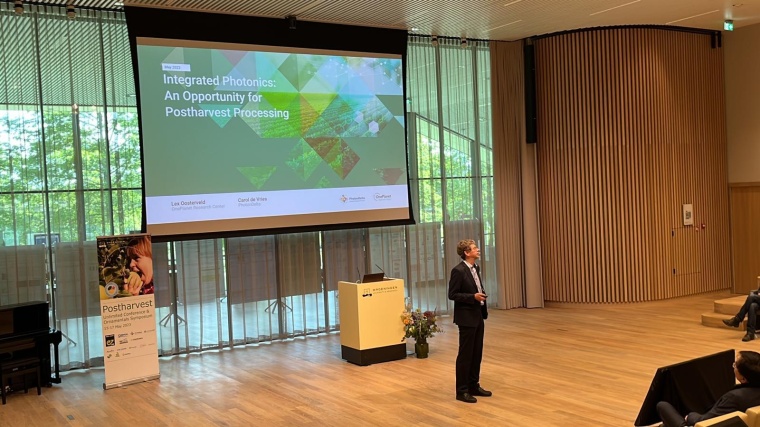
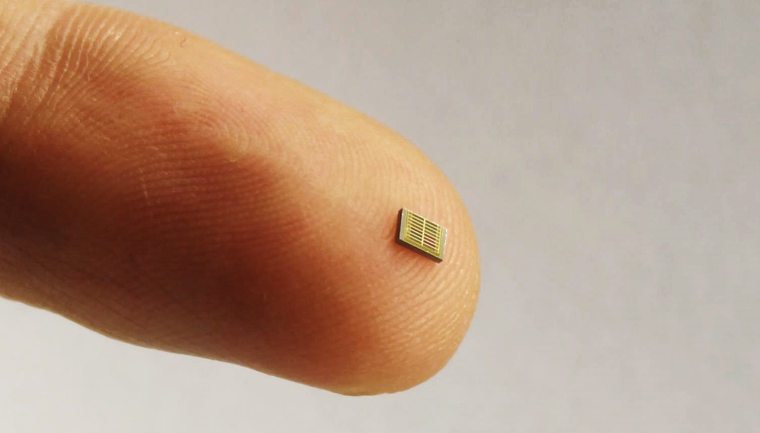

The roadmap describes the role integrated photonics will play in the transformation of sustainable farming practices and food distribution – maximizing yield and minimizing food waste throughout the food supply chain. Multiple organizations have contributed to the roadmap’s creation, including MantiSpectra, Eindhoven University of Technology, and Delft University of Technology.
Precision agriculture is at the forefront of this transformation. It uses sensors to enable highly precise and optimized growing and distribution techniques. That is where photonic integrated circuits (PICs) come in.The integrated photonic microchips are fabricated like semiconductors, but use photons instead of electrons. Miniaturization and low power consumption make them well-suited to handheld devices. They are ideal for optical sensing applications, particularly real-time remote sensing of crop and food composition, both in the field and throughout the supply chain.
Integrated photonic sensors enable farmers to give crops the optimum amount of water, light, and nutrients – and food producers are able to accurately assess crop yield and quality. Sensors also allow early detection of crop conditions and diseases, avoiding waste. A limited number of platforms have multiple applications, opening up exciting opportunities within the agrifood industry. Not only that, these improvements also lead to significant cost-savings.
Company
Cooperatie Photon Delta U.A.High Tech Campus 31
5656AE Eindhoven
Netherlands


most read

Indus Engineering segment increases incoming orders
In the 2025 financial year, the export-oriented Engineering segment of Indus Holding generated sales of EUR 583 million, slightly below the previous year (EUR 596.7 million).
Schaeffler bundles Defense and New Space activities under new CEO
Celia Pelaz takes over the position of CEO Defence & New Space at Schaeffler on October 1, 2026 and becomes Chairwoman of the Management Board of Stech Defence GmbH.
Laser 2000 and Büchner Lichtsysteme cooperate
Through this cooperation, Laser 2000 is expanding its portfolio in the areas of machine vision, metrology and smart sensor technologies.

Siemens Consolidates Its Automation Business into a New Unit Called Automation
Rainer Brehm, who previously served as COO of the automation business and CTO of Digital Industries, was appointed president of the new unit.

ABB Machine Automation (B&R) Appoints Christian Strahberger as New Division President
He succeeds Florian Schneeberger, who died in a tragic accident in April.