

Telescope system for Zettawatt Equivalent laser
Optical Surfaces has been selected by the Gérard Mourou Center for Ultrafast Optical Science (CUOS) at the University of Michigan (USA) to provide beam expander optics for its ground-breaking Zettawatt-Equivalent Ultrashort-pulse laser System (ZEUS).
Sponsored by the US National Science Foundation, the ZEUS laser facility is being constructed to allow a petawatt laser pulse from one of its beamlines to collide with a beam of GeV-energy electrons generated by its other beamline. In this collision, the electrons will encounter a zettawatt (1021watt) equivalent laser power as measured in their rest frame.
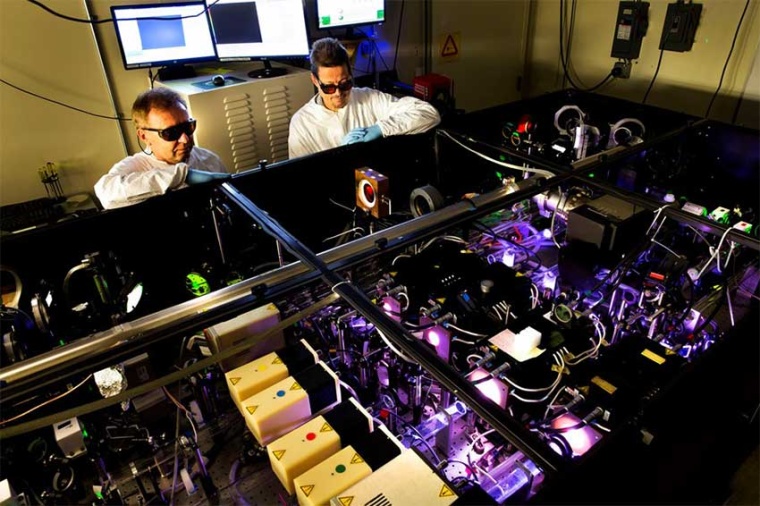
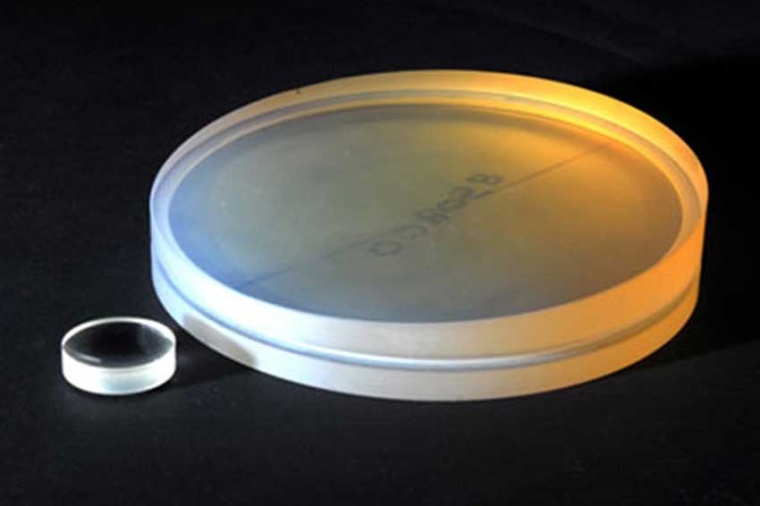
John Nees, a research scientist at CUOS said “The construction of the ZEUS facility began in 2020 and is slated to be operational in 2024. Among its numerous challenges, the chirped-pulse amplified (CPA) laser system requires an ‘aberration-free’ telescope to deliver the fully amplified pulses at a safe fluence to the three petawatt compressor where their power is increased 50,000-fold for experimental use. The telescope comprises a 170 mm diameter convex aspheric mirror and a 255 mm positive spherical mirror used in an off-axis design. As a leading manufacturer of ultrahigh-precision petawatt laser optics we selected Optical Surfaces to fabricate the precision mirror substrates that will be coated and used to expand the pulsed beam diameter from 140 to 305 mm.” He added “I really did appreciate Optical Surfaces energetic responses to my inquiries as I was planning the telescope. Their knowledgeable input gave me a good comfort level in moving the project forward”.
Dr Aris Kouris, director of sales at Optical Surfaces, commented “With the ZEUS laser system, the CUOS team is excited about the possibility of probing quantum electrodynamics, the reigning explanation of how the universe operates at the subatomic level. In addition, ZEUS could help develop new methods and technologies for use in medicine, defense, material science and astrophysics.”
Globally, only a few optical manufacturers can produce off-axis optics as part of the delivery system of sufficient surface quality to enable ultrahigh-power lasers to focus their massive energy onto targets only a few microns in size. Under these extreme conditions the laser-matter interactions can produce energetic beams of electrons and protons as well as bright, coherent sources of x-rays which enable researchers to address fundamental questions in areas including plasma physics, x-ray radiography, proton therapy and fast ignition experiments.
The company's ISO 9001-2015 approved manufacturing workshops and test facilities are deep underground in a series of tunnels excavated in solid chalk. This provides an environment where temperature is naturally thermally stable, and vibration is extremely low. With such stable conditions testing of high precision mirrors, particularly with long path lengths, becomes quantifiable and reliable. In addition to these natural advantages, Optical Surfaces has invested in an extensive range of test equipment and have developed methods to ensure accurate and reliable testing.
Company
Optical Surfaces Ltd.Godstone Road
Kenley
UK




most read

ZVEI Calls for Swift Protection of Critical Power Infrastructure
The association has issued a statement in response to the recent attempted attacks on substations in Brandenburg and North Rhine-Westphalia and warns of the consequences for Germany's energy security.

Vision 2026 Breaks Exhibitor Record
About 500 exhibiting companies—about two-thirds of which are from abroad and about 30 percent of which are first-time exhibitors—are showcasing their products at the trade show.

Siemens Consolidates Its Automation Business into a New Unit Called Automation
Rainer Brehm, who previously served as COO of the automation business and CTO of Digital Industries, was appointed president of the new unit.

IMTS 2026: America's Manufacturing Sector Focuses on Growth and Technology
The largest manufacturing trade show in the Western Hemisphere is bringing together 1,788 exhibitors this year, including about 400 companies participating for the first time.

Forecast: Significant Growth in Industrial Robotics by 2030; Cobots Are Growing the Fastest
According to a recent analysis by Interact Analysis, global sales of industrial robots are expected to rise from about 550,000 units in 2025 to just over 760,000 units in 2030.