

A quantum highway for Germany
Existing fiber quantum link to be extended in 2024 to connect Berlin and Frankfurt, €12M funding from EU and BMBF.
The Free State of Thuringia is about to become an important hub for the German quantum network. Existing test links for researching quantum-secured fiber links between Erfurt and Jena are now to be extended by new sections in the direction of Nordhausen and, in perspective, Berlin and Frankfurt am Main.
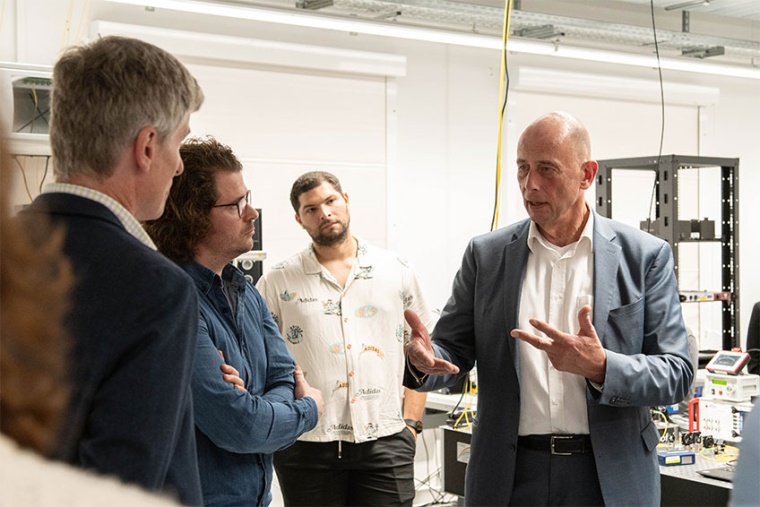
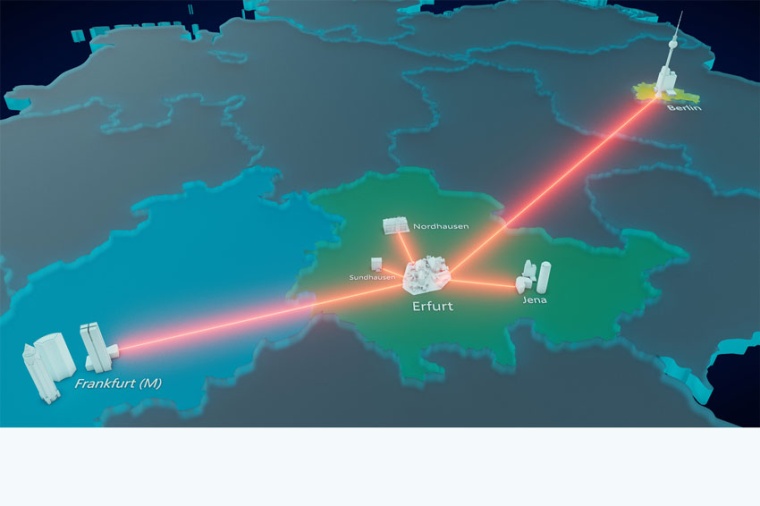
With funding from the state, an optical fiber test link has already been established between the Fraunhofer Institute for Applied Optics and Precision Engineering IOF in Jena and the Fraunhofer Center in Erfurt. Here, quantum keys have already been successfully exchanged between Thuringia’s metropolitan cities over a distance of 75 kilometers as part of the QuNET initiative funded by the German Federal Ministry of Education and Research (BMBF). For the test link, it was possible to use an existing infrastructure of conventional telecommunications fiber optics.
The Thuringian communities of Nordhausen and Sundhausen will be connected to the existing link between Jena and Erfurt by 2024. Furthermore, within Jena, the University Hospital will also be connected to the test link. This will extend the fiber-based test route to a total length of more than 150 kilometers. Further sections are planned as far as Berlin and Frankfurt am Main by the end of 2024. The go-ahead was given by Thuringia’s Science Minister Wolfgang Tiefensee in August 2023 during a visit of the Fraunhofer Center in Erfurt.
In the Q-net-Q project, led by Nordhausen University of Applied Sciences and with the participation of Fraunhofer IOF, the application potential of high-security quantum communication for telemedical software will initially be tested as an example. Rural regions in particular often suffer from a serious shortage of (specialist) physicians. Medical care could be more convenient and efficient in the future. Against this backdrop, the Thuringian community of Sundhausen will also be connected to the new fiber-optic test link as an example of a rural region.
The Q-net-Q project is being implemented as part of the European program EuroQCI. The EU and the BMBF are funding the project with a total of 11.8 million euros. In addition to Fraunhofer IOF and the Nordhausen University of Applied Sciences, which is acting as consortium leader, the Q-net-Q research association includes five other academic partners: the Technical University of Munich, the Technical University of Berlin, the Friedrich Alexander University of Erlangen-Nuremberg and the Fraunhofer HHI. Furthermore, two industrial partners, Utimaco and DE-CIX Management, are also involved in the project.
Further reading: Quantum keys fiber-linked over 75 kilometers – First successful exchange of quantum keys between Erfurt and Jena via optical fiber enables new QKD experiments, wileyindustrynews.com, 27 October 2022
Company
Fraunhofer Institute for Applied Optics and Precision Engineering IOFAlbert-Einstein-Str. 7
07745 Jena
Germany



most read
Heitec takes over Artschwager + Kohl
Through the acquisition, the company aims to expand its range of warehouse logistics solutions and open up new market segments.
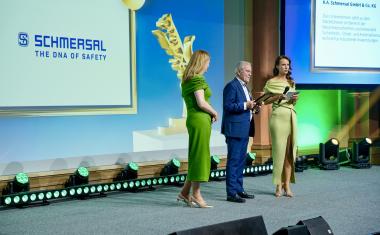
Best Managed Companies Award 2026 for Schmersal
With this repeated honor, the company has been awarded the gold status of the seal of approval, which is awarded by Deloitte Private, UBS Group, the Frankfurter Allgemeine Zeitung and the Federation of German Industries.
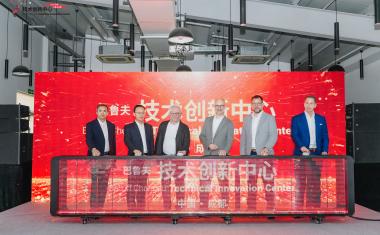
Balluff opens new technology center in Chengdu
With around 400 square meters of laboratory and office space, the center focuses on the development of sensor technologies, in particular inductive sensors and position measuring systems.

Sick increases sales in 2025
In the 2025 financial year, the company increased its turnover to 1.85 billion euros, an increase of 6.5% compared to the previous year.
Helukabel becomes Helu
Managing Director Marc Luksch emphasizes that the future of connection technology lies in the integration of ready-to-connect systems.