

Powerful new external cavity laser module
Anyone with demanding laser requirements for their product has an opportunity to attend Chilas’ new product launch and be among the first to discover the possibilities it can offer. The launch will be held online with the support of European Photonics Industry Consortium (EPIC).
Chilas produces semiconductor external cavity tunable lasers with ultranarrow linewidth. The existing products can be continuously tuned over the C-band covering a wavelength range larger than 100 nm and has a very narrow linewidth of a few kilohertz. These lasers are made using hybrid integration technology, integrating InP and SiN, two the most leading platforms for fabricating PICs. This technology with its extremely low loss SiN allows Chilas to make cavities with very high Q-factor and thus ultranarrow linewidth.
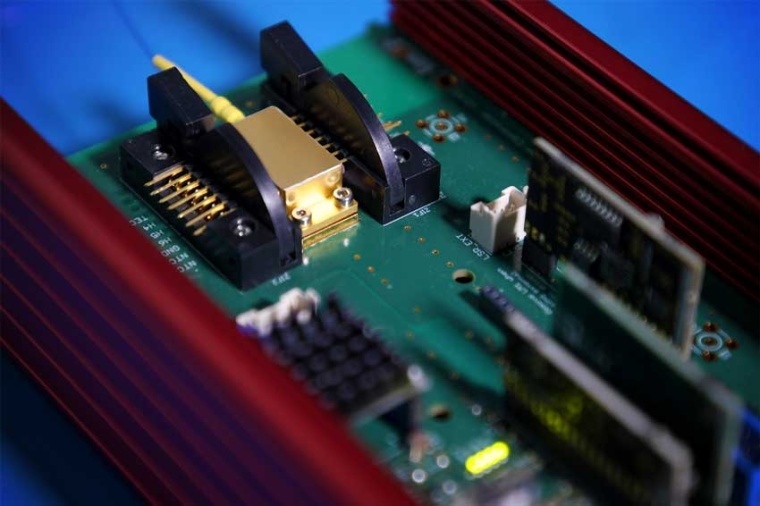
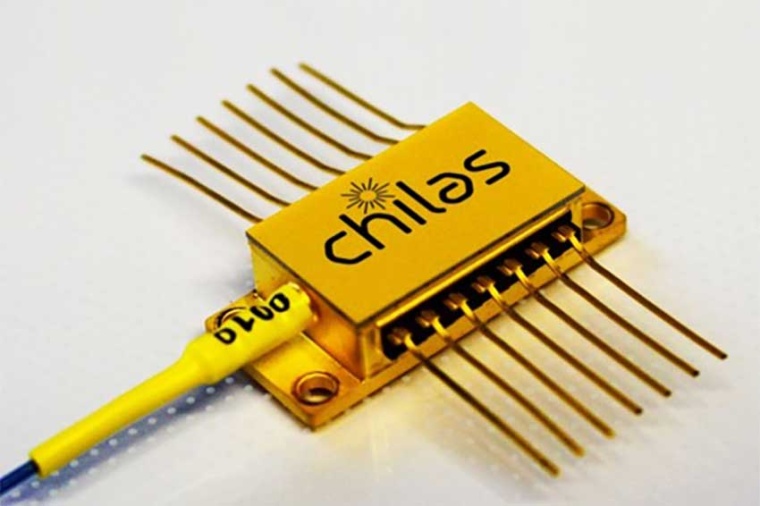
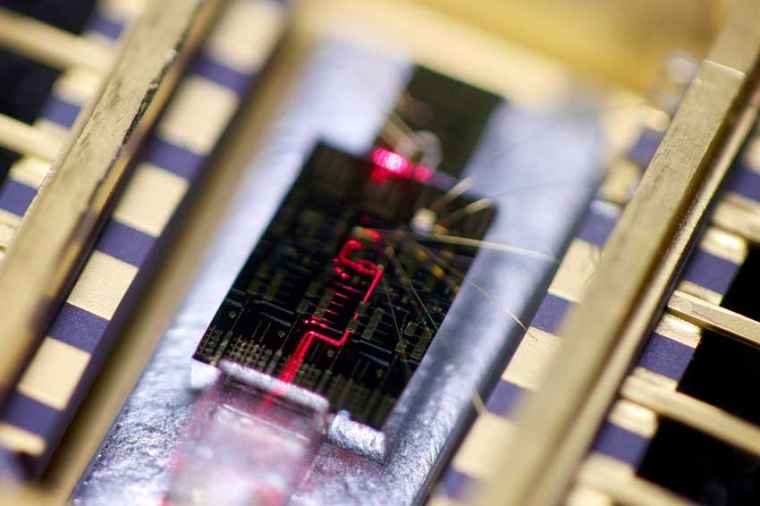
“The unique combination of ultranarrow linewidth and continuous tunability over a wide frequency range in a compact footprint makes our lasers ideal for a wide range of applications such as coherent optical communications, fiber sensing, and microwave photonics,” states Sami Musa, CEO at Chilas BV.
Extremely low loss SiN, high Q-factor, ultranarrow linewidth
The new external cavity laser (ECL) has a unique set of laser characteristics that make this robust and compact laser module a workhorse for a large variety of applications.
The ultranarrow linewidth (<5 kHz), low phase noise, compact footprint and robust character of the Chilas laser will allow you to increase the sensitivity of your metrology application such as optical fiber sensors, in harsh environments.
The possibility of high output power, low RIN (≤ -150 dB/Hz) and low phase noise of the laser will warp your transceiver into the future, meeting novel standards for small channel spacing and enables advanced modulation methods (PAM, PSK, QAM, …)
The resolution of an optical coherence tomography (OCT) application can be boosted to microscopic levels by exploiting the full >100 nm bandwidth of this laser.
Large variety of applications across industries
Chilas develops and supplies high-end semiconductor external cavity tunable lasers with ultranarrow linewidth. The lasers can be continuously tuned over the C-band covering a wavelength range larger than 100 nm and have a linewidth of <5 KHz. Their lasers have a unique combination of characteristics including ultranarrow linewidth, broad and continuous wavelength tuning range, high output power and low noise. The laser is temperature stabilized and comes in a 14-pins butterfly package.
Technology details, top tier materials used and the main advantages of the new ECL will be revealed on the online product launch set for 7 September 2021, from 4:00 to 5:00 pm CEST (Europe). Register at this link to join: epic-assoc.com/chilas-new-product-launch/
Company
European Photonics Industry Consortium EPIC17 Rue Hamelin
75016 Paris
France



most read

Schaeffler bundles Defense and New Space activities under new CEO
Celia Pelaz takes over the position of CEO Defence & New Space at Schaeffler on October 1, 2026 and becomes Chairwoman of the Management Board of Stech Defence GmbH.

IMTS 2026: America's Manufacturing Sector Focuses on Growth and Technology
The largest manufacturing trade show in the Western Hemisphere is bringing together 1,788 exhibitors this year, including about 400 companies participating for the first time.

Solid-State Transformers for AI Data Centers
As part of a strategic partnership, Siemens and Reinhausen are developing a solid-state transformer for AI data centers with an 800-volt DC system.

Siemens Consolidates Its Automation Business into a New Unit Called Automation
Rainer Brehm, who previously served as COO of the automation business and CTO of Digital Industries, was appointed president of the new unit.

ZVEI Calls for Swift Protection of Critical Power Infrastructure
The association has issued a statement in response to the recent attempted attacks on substations in Brandenburg and North Rhine-Westphalia and warns of the consequences for Germany's energy security.