

First light of the FHI far-infrared laser
The free electron laser team of the Fritz Haber Institute of the Max Planck Society observed first lasing of the new FIR FEL.
Over the last few years the FHI FEL team has been working on a machine upgrade including the installation of a second FEL branch designed to generate far-infrared (FIR) radiation at wavelength up to 165 micron. The FIR FEL includes a new hybrid-magnet undulator which was built in-house at the FHI. In addition, a 500 MHz kicker cavity has been installed downstream of the electron linear accelerator (LINAC). When powered, the kicker cavity will enable simultaneous 2-color operation of both MIR and FIR FEL.
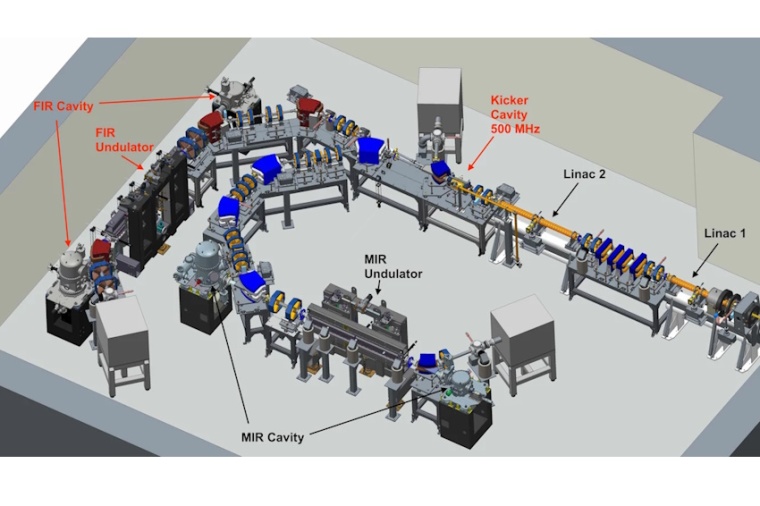
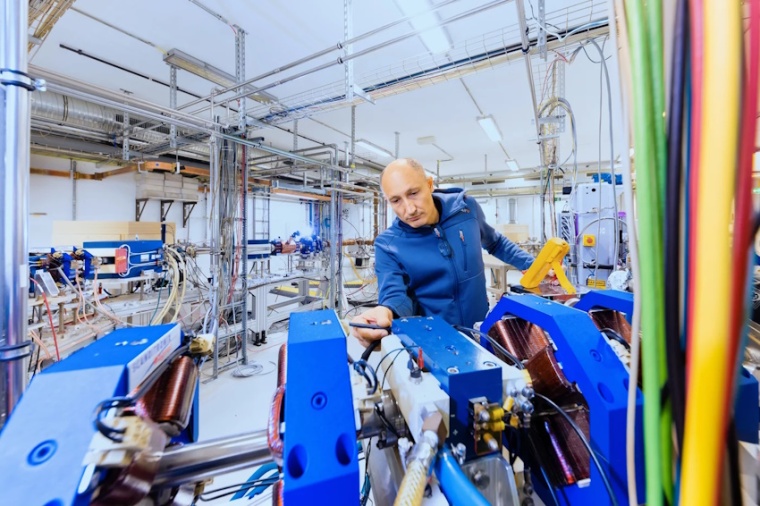
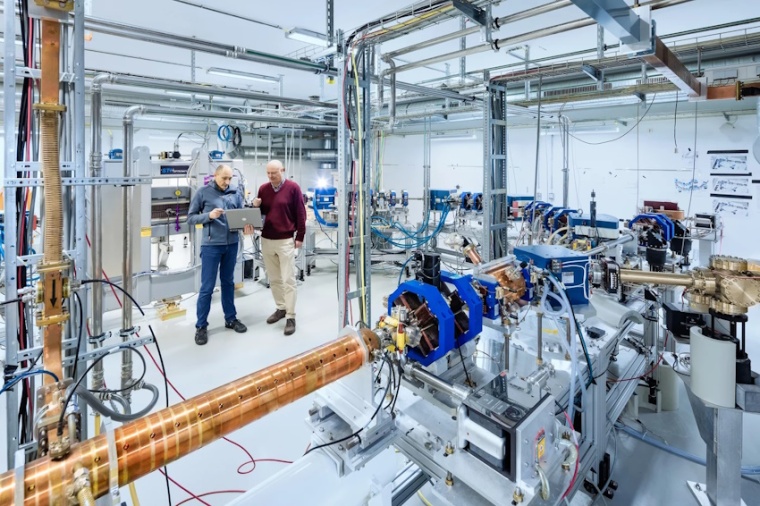
At an electron energy of 36 MeV lasing was observed at wavelengths ranging from 9 to 34 microns. This large continuous tuning range is made possible by mechanical variation of the undulator gap. Pulse energies in excess of 100 mJ were observed on the first day indicating powerful performance in agreement with design goals. Next, the FHI FEL Team is going to explore the full design wavelength range from 4.5 to 165 microns by operating the LINAC at various electron energies.
The next major goal will be to demonstrate 2-color operation by running the MIR and FIR FEL simultaneously. To this end, the new kicker cavity was designed to deflect every second electron bunch coming from the accelerator to the MIR branch, and every other second bunch to the FIR branch. In this 2-color mode both FEL’s run in parallel each generating infrared pulses at independently tunable wavelengths. The 2-color mode will open up new possibilities to FHI FEL user groups including, for instance, MIR/FIR pump-probe experiments.
Since 2013 the FHI Free-Electron Laser (FHI FEL) provides intense, pulsed mid-infrared (MIR) radiation continuously tunable from 2.8 to 50 microns wavelength. The generation of molecular vibrational spectra is one of the main uses of the FHI FEL. The infrared spectral region is often referred to as the ‛molecular fingerprint’ region, as it is the region in which the fundamental vibrational modes of molecules, clusters or solid materials are located.
Company
Fritz-Haber-Institut der Max-Planck-GesellschaftFaradayweg 4-6
14195 Berlin
Germany



most read

Schaeffler bundles Defense and New Space activities under new CEO
Celia Pelaz takes over the position of CEO Defence & New Space at Schaeffler on October 1, 2026 and becomes Chairwoman of the Management Board of Stech Defence GmbH.
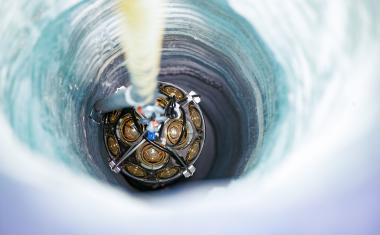
Icecube Neutrino Observatory: Hamamatsu Photonics Boosts Sensitivity with New Photodetectors
The detector array is installed in one cubic kilometer of clear Antarctic ice and detects Cherenkov light produced by neutrino interactions.

ZVEI Calls for Swift Protection of Critical Power Infrastructure
The association has issued a statement in response to the recent attempted attacks on substations in Brandenburg and North Rhine-Westphalia and warns of the consequences for Germany's energy security.
Vision 2026 Breaks Exhibitor Record
About 500 exhibiting companies—about two-thirds of which are from abroad and about 30 percent of which are first-time exhibitors—are showcasing their products at the trade show.

Siemens Consolidates Its Automation Business into a New Unit Called Automation
Rainer Brehm, who previously served as COO of the automation business and CTO of Digital Industries, was appointed president of the new unit.