

First commercial UV-plus-visible hyperspectral camera
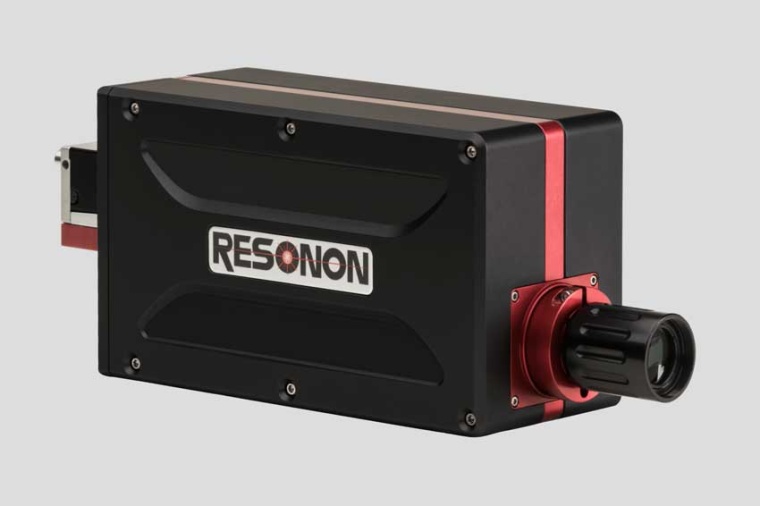
Resonon has released the Pika NUV2, the only ultraviolet plus visible hyperspectral camera available commercially. It will be an essential tool for advanced research, industrial vision systems, remote sensing, and many other hyperspectral imaging applications.
The Pika NUV2 is a line scan imaging spectrometer that scans a spectral range of 330 – 800 nm. It can be used in Resonon’s benchtop, outdoor, airborne, and machine vision systems.
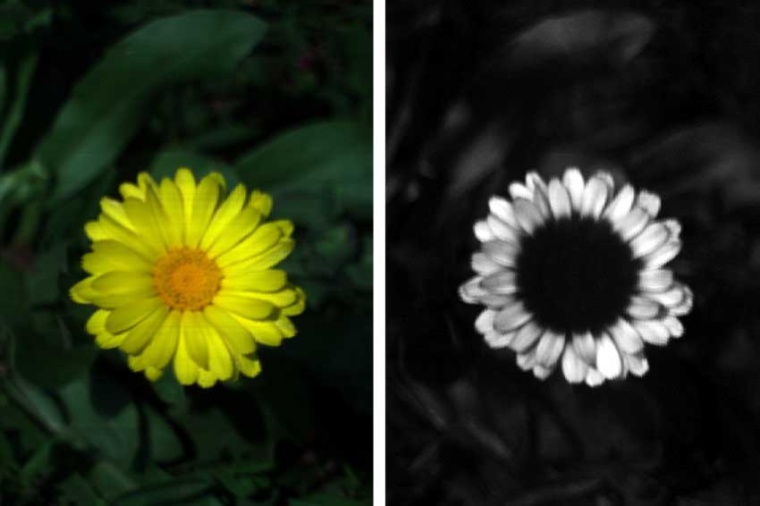
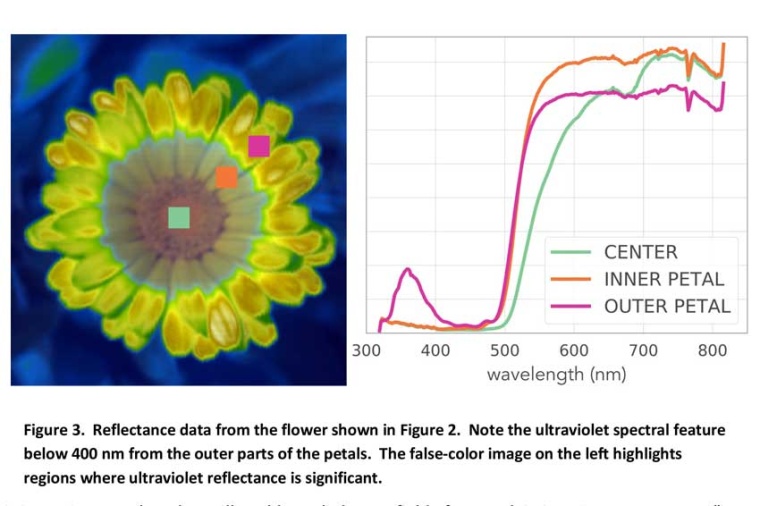
Flowers and plants often have noteworthy ultraviolet features, and solar illumination extends down to about 300 nm at the Earth’s surface. Furthermore, pharmaceuticals and other industrial products can possess unique ultraviolet signatures which the NUV2 can quantify for sorting or quality control purposes.
“This is a unique product that will enable a whole new field of research in imaging spectroscopy,” says Rand Swanson, CEO of Resonon. “We are really excited to see the research and applications that this imager enables our customers to pursue.”
Most glass materials that comprise optical lenses do not transmit light below about 350 nm. “This made designing the Pika NUV2 a very difficult optical problem,” says Mike Kehoe, chief optical engineer for Resonon. “Nonlinear dispersion indices make distortion control very challenging. We had to develop advanced design and fabrication methods to allow us to successfully overcome these issues. We improved a lot upon our older ultraviolet models. The end result is an optical train that provides excellent imaging and spectroscopic quality.”
Over a spectral range of 330 – 800 nm the Pika NUV2 provides 255 contiguous spectral channels at each pixel, and each spectral channel is 1.84 nm wide. The spectral resolution (FWHM) is 3.2 nm. Each camera frame is an image line that has 1500 spatial pixels.
Company
Resonon, Inc.123 Commercial Drive
Bozeman, MT 59715
US


most read

European machine vision expects slight recovery and growth in 2026
According to the VDMA Machine Vision department, sales are expected to increase by around 3%, following a decline of 2% in 2025.
The photonics industry is growing significantly again: New orders rise by 17 percent
The German photonics industry saw significant growth in the first half of 2026. Semiconductors, defense, aviation, and quantum technologies are the main drivers of this growth.

Vision Components Celebrates 30 Years of Machine Vision with an Anniversary Event at Vision 2026
Vision Components is celebrating 30 years in business. At Vision 2026, the manufacturer is hosting an anniversary celebration featuring an exhibition, live music, and new products.

IMTS 2026: AI, Automation, and Investment Are Driving the Next Phase of Growth in Manufacturing
IMTS 2026 drew more than 91,000 visitors. AI, robotics, and automation were the hallmarks of the trade show and reflect the transformation of U.S. manufacturing.

German Society for Robotics Elects First Regular Board of Directors Under Wolfram Burgard
The German Society for Robotics has elected its first regular board of directors. Starting in October, Wolfram Burgard will assume the presidency of the young professional society.