

Approaching Shannon’s Limit: KDPOF becomes KD
The opening of the new prototyping laboratory and assembly and test plant in Tres Cantos, Madrid, was accompanied by a rebranding.
KDPOF, an established supplier for high-speed connectivity over fiber optics in harsh environments, presented its business extension and new corporate identity, evolving from ‘KDPOF – Knowledge Development for Plastic Optical Fiber’ to ‘KD – Approaching Shannon’s Limit’.

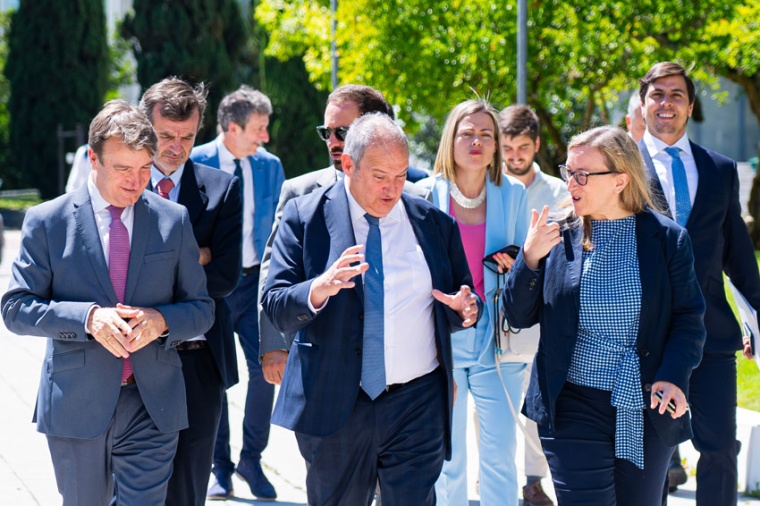

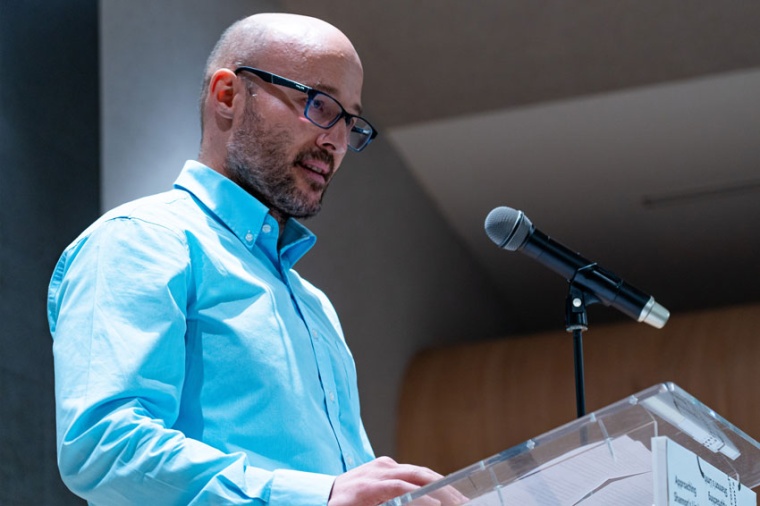
Last Thursday, July 4th, KDPOF successfully announced its rebranding and was honored to have the presence of personalities such as the Minister for Industry and Tourism of the Government of Spain, Jordi Hereu, the Mayor of Tres Cantos, Jesús Moreno García, investors, and friends of the company.
The Shannon limit or Shannon capacity of a communication channel refers to the maximum rate of error-free data that can theoretically be transferred over the channel if the link is subject to random data transmission errors, for a particular noise level. Stated by Claude Shannon in 1948, his theorem has wide-ranging applications in both communications and data storage.
When Carlos Pardo and Rubén Pérez-Aranda founded KDPOF in 2010, they entered new terrain as pioneers in the optical networking sector. Since then, the engineers have always kept exploring the limits of the impossible – striving for innovations nearing the Shannon limit. With their own production facility, KD empowers new paradigms of hybrid integration of microelectronics, photonics, and optics.
With the 26.8 million euro IPCEI investment from the European Commission, KD is setting up a packaging plant for optoelectronic devices in Spain. “We’re excited to pioneer the manufacturing of automotive optoelectronics in Spain in high volume, thus reducing the dependency on Asia and US,” explained Pardo.
Close to its headquarters in Tres Cantos, KD is advancing a high-quality packaging factory for state-of-the-art optoelectronic devices. In addition, the company is opening their first prototype laboratory for testing their own products.
The new laboratory was inaugurated a few weeks ago and is equipped with highly qualified machinery for the necessary testing of KD products. During the day of the presentation of the new corporate identity, Jordi Hereu and Jesús Moreno García took a guided tour to learn about the quality processes that have been carried out in this new workspace for the past few weeks.
The encapsulation and testing factory for large volumes will go into operation in 2025.
Further reading: KDPOF receives investment of the European Commission for chip development – Company gets access to access to the 8.1 billion euro investment for their projected packaging plant for optoelectronic devices in Spain, wileyindustrynews.com, 10 July 2023
Reference: R. Pérez-Aranda (KDPOF) & J. Pankert (Trumpf Photonic Components): Optical neurons to interconnect sensors and artificial brains in autonomous vehicles – Fiber optics connectivity based on long-wavelength VCSELs and fully-integrated and adaptive electronics, PhotonicsViews 21(1), February/March 2024, first published online: 01 December 2023; DOI: 10.1002/phvs.202300047 (online open)
Company
KD – Knowledge Development for POF, S.L.Ronda de Poniente 14, 2ª Planta
28760 Tres Cantos
Spain


most read

European machine vision expects slight recovery and growth in 2026
According to the VDMA Machine Vision department, sales are expected to increase by around 3%, following a decline of 2% in 2025.

Solid-State Transformers for AI Data Centers
As part of a strategic partnership, Siemens and Reinhausen are developing a solid-state transformer for AI data centers with an 800-volt DC system.

Indus Engineering segment increases incoming orders
In the 2025 financial year, the export-oriented Engineering segment of Indus Holding generated sales of EUR 583 million, slightly below the previous year (EUR 596.7 million).
Schaeffler bundles Defense and New Space activities under new CEO
Celia Pelaz takes over the position of CEO Defence & New Space at Schaeffler on October 1, 2026 and becomes Chairwoman of the Management Board of Stech Defence GmbH.

ABB Machine Automation (B&R) Appoints Christian Strahberger as New Division President
He succeeds Florian Schneeberger, who died in a tragic accident in April.